Functional and morphological determinants of left ventricular fibrosis in patients with mitral annular disjunction in cardiac magnetic resonance imaging
Martin F Reiner, Daniel Escribano-García, Federica Guidetti, Verena C Wilzeck, Rabea Schlenker, Andrea Biondo, Firat Duru, Frank Ruschitzka, Gianluigi Savarese, Hatem Alkadhi, Robert Manka

TL;DR
The study finds that age and heart movement patterns are key factors in predicting heart tissue scarring in patients with a specific heart condition called mitral annular disjunction.
Contribution
This study identifies novel independent determinants of left ventricular fibrosis in patients with mitral annular disjunction using cardiac magnetic resonance imaging.
Findings
Age and accelerated longitudinal motion of the basal inferolateral LV segment are independent determinants of replacement fibrosis.
Bileaflet mitral valve prolapse and MAD size are significantly associated with accelerated motion of the LV segment.
Patients with fibrosis were older and more likely to have mitral valve prolapse and larger MAD distances.
Abstract
The study investigates determinants of left ventricular (LV) fibrosis in patients with inferolateral mitral annular disjunction (MAD). This single centre retrospective cohort study included 111 patients [median age 52 years (25th–75th percentile 36–69), 47% female] with inferolateral MAD that underwent cardiac magnetic resonance imaging. Mid-myocardial replacement fibrosis of the basal inferolateral LV wall was present in 27 (24%) patients. Patients with fibrosis were older [63.0 years (25th–75th percentile 53.0–70.0) vs. 47.5 years (25th–75th percentile 34.0–67.5), P = 0.011], more likely to have mitral valve prolapse (MVP) [24/27 (89%) vs. 58/84 (69%), P = 0.041], had larger isolated posterior prolapse size [5.0 mm (25th–75th percentile 5.0–5.0) vs. 3.0 mm (25th–75th percentile 2.0–4.0), P = 0.041], were more likely to have bileaflet MVP [17/27 (63%) vs. 30/84 (36%), P = 0.013], had…
Genes, proteins, chemicals, diseases, species, mutations and cell lines named across the full text — each resolved to its canonical identifier and authoritative record.
Click any figure to enlarge with its caption.
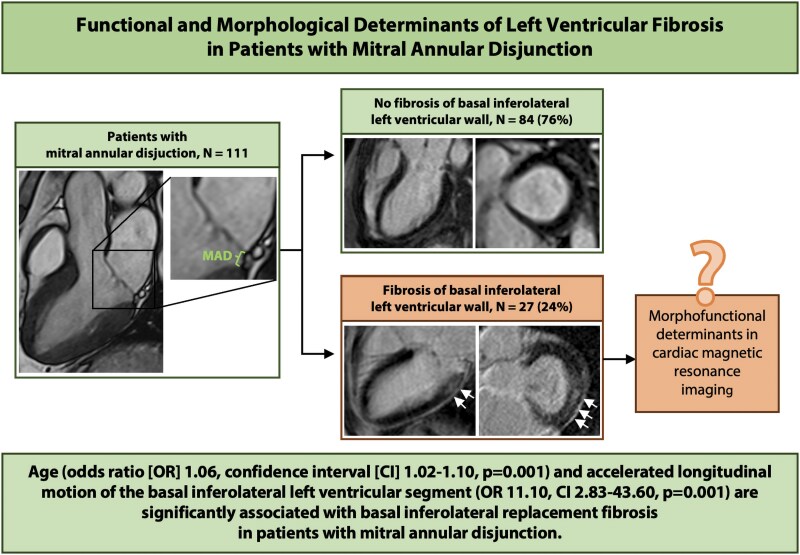 Figure 1
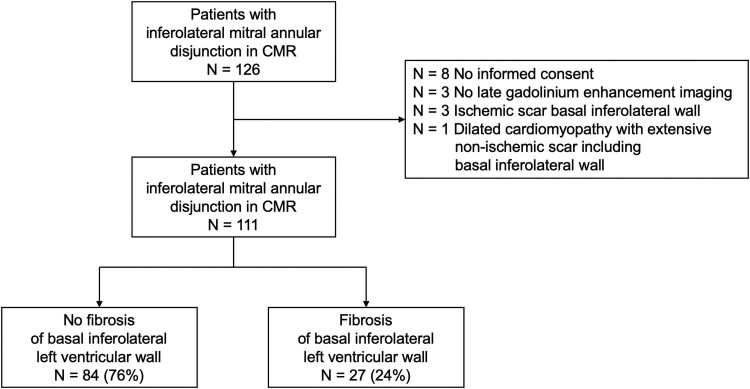 Figure 2
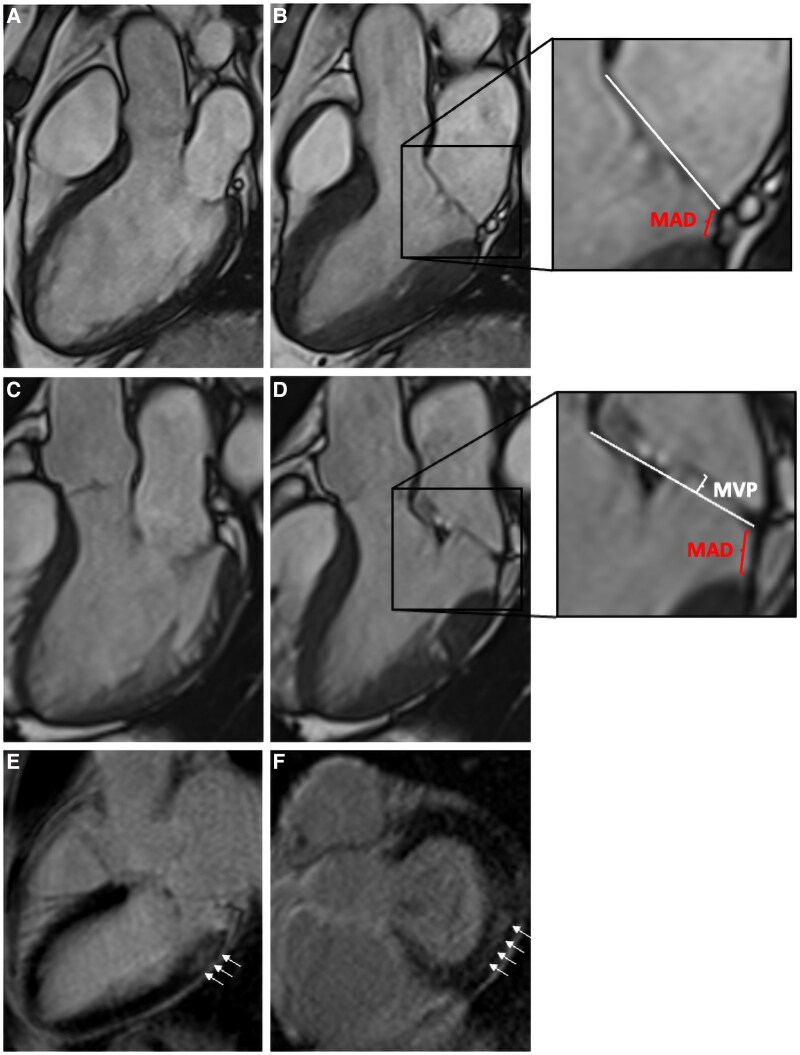 Figure 3
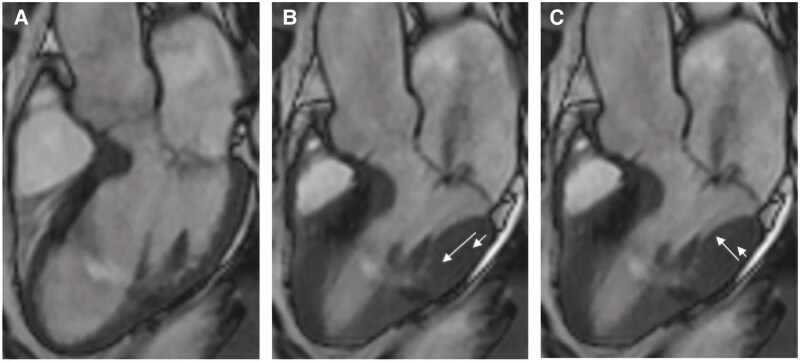 Figure 4
 Figure 5
Peer Reviews
No public reviews on file for this paper yet. If you reviewed it on a platform where reviews are public (OpenReview, ICLR, NeurIPS, ICML), you can paste yours below so the community can read it here.
Videos
No videos yet. Explain this paper in a talk, walkthrough, or lecture? Add one.
Taxonomy
TopicsCardiac Imaging and Diagnostics · Cardiovascular Disease and Adiposity · Cardiovascular Function and Risk Factors