Microbial composition and function are nested and shaped by food web topologies
Samira Fatemi, Nicola G Kriefall, Danyel Yogi, Danya Weber, Nicole A Hynson, Matthew C I Medeiros, Peter Sadowski, Anthony S Amend

TL;DR
This study shows that bacteria in food webs are nested and follow the structure of the food web, with their composition and function influenced by host trophic position.
Contribution
The study introduces the concept of microbial composition and function being nested within food web topologies.
Findings
Bacterial taxonomy and function are compositionally nested and mirror the pyramid-shaped food web structure.
Most bacterial taxa and genes associated with hosts are found in host-independent environmental samples.
Bacterial taxa correlate with host location and trophic position, but functional genes do not show spatial structure.
Abstract
Food webs govern interactions among organisms and drive energy fluxes within ecosystems. With an increasing appreciation for the role of symbiotic microbes in host metabolism and development, it is imperative to understand the extent to which microbes conform to, and potentially influence, canonical food web efficiencies and structures. Here, we investigate whether bacteria and their taxa and functional genes are compositionally nested within a simple model food web hierarchy, and the extent to which this is predicted by the trophic position of the host. Using shotgun and amplicon sequencing of discrete food web compartments within replicate tank bromeliads, we find that both taxonomy and function are compositionally nested and largely mirror the pyramid-shaped distribution of food webs. Further, nearly the entirety of bacterial taxa and functional genes associated with hosts are…
Genes, proteins, chemicals, diseases, species, mutations and cell lines named across the full text — each resolved to its canonical identifier and authoritative record.
Click any figure to enlarge with its caption.
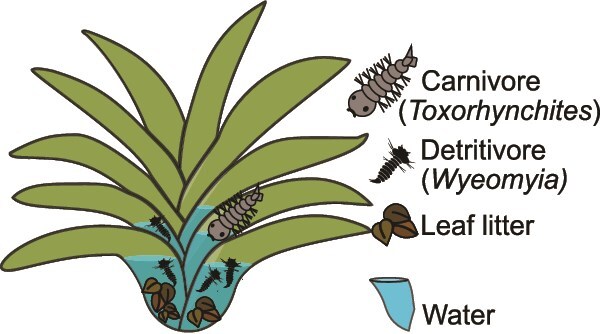 Figure 1
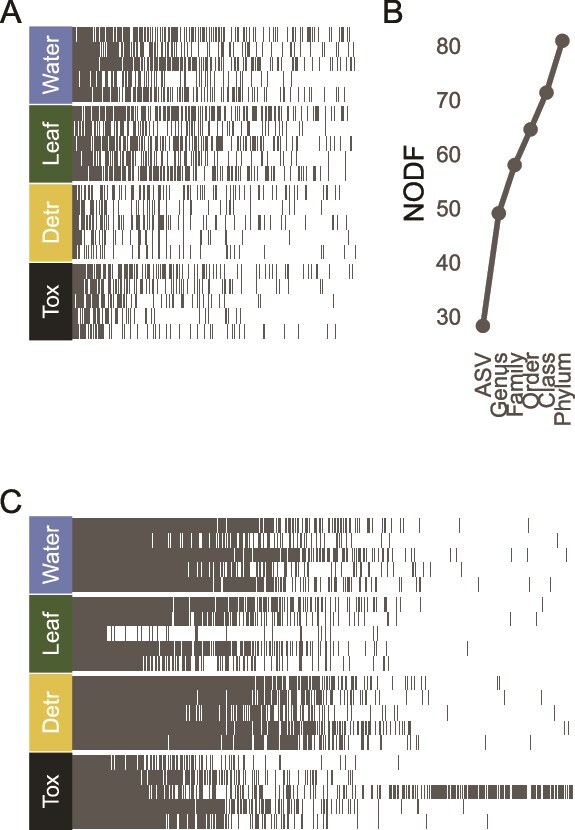 Figure 2
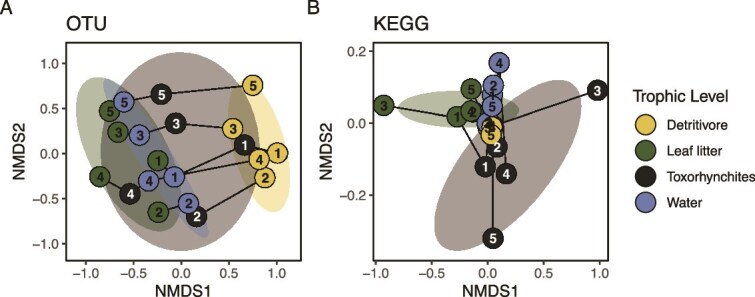 Figure 3
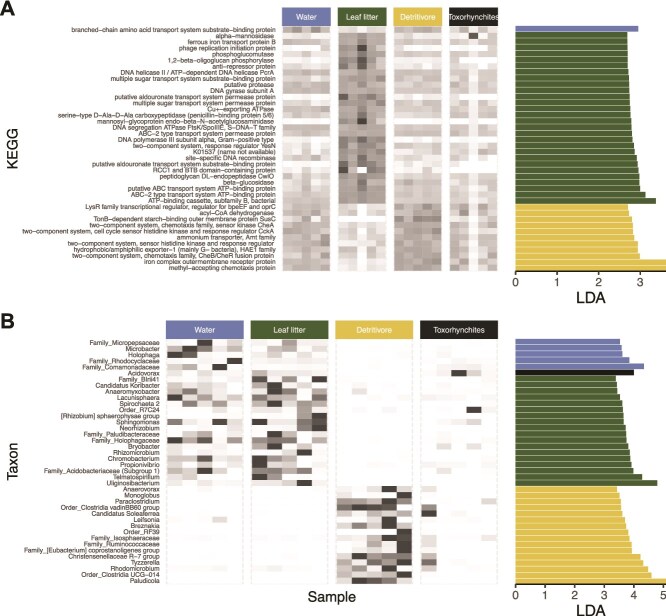 Figure 4
Peer Reviews
No public reviews on file for this paper yet. If you reviewed it on a platform where reviews are public (OpenReview, ICLR, NeurIPS, ICML), you can paste yours below so the community can read it here.
Videos
No videos yet. Explain this paper in a talk, walkthrough, or lecture? Add one.
Taxonomy
TopicsFermentation and Sensory Analysis · Probiotics and Fermented Foods · Microbial Community Ecology and Physiology