Comparing vaccination coverage and dog population demographics among four pilot dog rabies vaccination strategies in Uganda
Dickson Akankwatsa, Terence Odoch, Anna Mary Kahunde, Sonja Hartnack, Arthur Bagonza, Juliet Kiguli, Samuel George Okech, Adrian Herrera, Clovice Kankya, Lamorde Mohammed, Doreen Agado, Monique Léchenne, Frederic Lohr, Andrew Kambugu, Salome Dürr

TL;DR
This study compared four dog vaccination strategies in Uganda and found that integrating dog vaccination with human health services achieved the highest coverage.
Contribution
The study evaluates and compares the effectiveness of four dog vaccination strategies in a rabies-endemic area, highlighting the One Health approach as most effective.
Findings
The D-H (One Health) strategy achieved the highest mean vaccination coverage of 74.5% among owned dogs.
The proportion of ownerless dogs varied significantly across strategies, with the D-L strategy showing the highest mean of 29.7%.
The D-H strategy consistently reached over 60% coverage in all three parishes, demonstrating its effectiveness.
Abstract
The zero by 30 initiative aims to eliminate dog-mediated human rabies by 2030, for which dog vaccination is a crucial pillar. This study piloted four different dog vaccination campaign strategies in Kyegegwa, a rural district in Uganda, where rabies is endemic, and compared the vaccination coverages achieved by the strategies. Four vaccination strategies were rolled out, each in three parishes from different sub-counties: (i) static point vaccination (SP), (ii) school-based (SB, i.e., information campaigns were mainly conducted at schools and vaccination was done at the school during weekends), (iii) integrated dog with livestock vaccination (D-L), and (iv) integrated dog vaccination with human health services (D-H, One Health approach). Vaccination coverage was estimated using transect and household survey data, analyzed with a Bayesian model that estimated, besides the vaccination…
Genes, proteins, chemicals, diseases, species, mutations and cell lines named across the full text — each resolved to its canonical identifier and authoritative record.
Click any figure to enlarge with its caption.
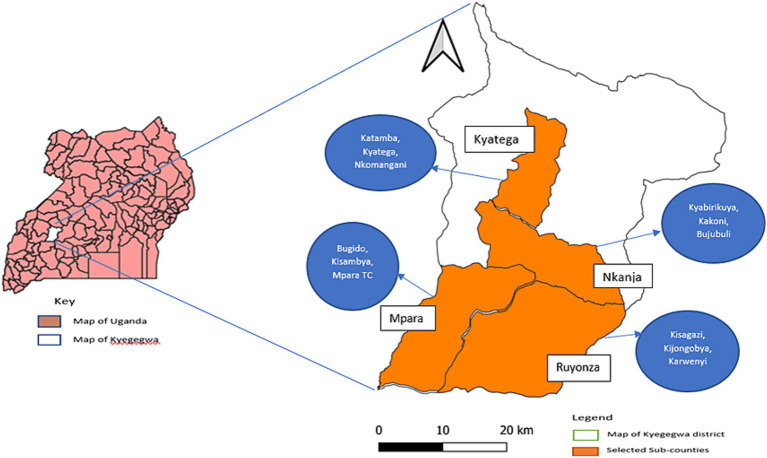 Figure 1
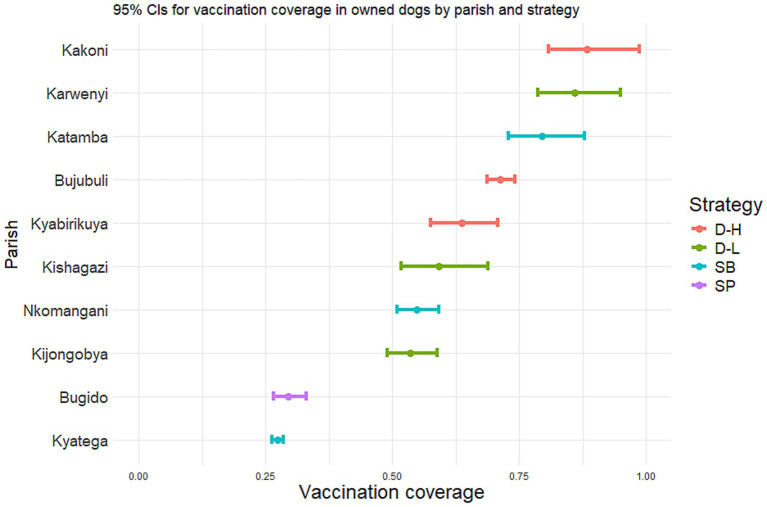 Figure 2
Peer Reviews
No public reviews on file for this paper yet. If you reviewed it on a platform where reviews are public (OpenReview, ICLR, NeurIPS, ICML), you can paste yours below so the community can read it here.
Videos
No videos yet. Explain this paper in a talk, walkthrough, or lecture? Add one.
Taxonomy
TopicsRabies epidemiology and control · Virology and Viral Diseases · Microbial infections and disease research