Implementation of McMurchie–Davidson Algorithm for Gaussian AO Integrals Suited for SIMD Processors
Andrey Asadchev, Edward F. Valeev

TL;DR
This paper presents a new way to compute Gaussian integrals using modern processors, achieving high performance and open-source availability.
Contribution
A novel SIMD-optimized implementation of the McMurchie–Davidson algorithm for Gaussian AO integrals using standard C++.
Findings
The implementation achieves up to 50% of the theoretical hardware peak FP64 performance on SIMD platforms.
Speedups of up to 30x are observed compared to state-of-the-art one-shellset-at-a-time implementations.
The code is portable and uses upcoming C++ features like std::simd without explicit code generation.
Abstract
We report an implementation of the McMurchie–Davidson evaluation scheme for 1- and 2-particle Gaussian AO integrals designed for processors with Single Instruction Multiple Data (SIMD) instruction sets. Like in our recent MD implementation for graphical processing units (GPUs) [ AsadchevA., ; ValeevE. F., . J. Chem. Phys. 2024, 160, 244109.]38934632 10.1063/5.0217001, variable-sized batches of shellsets of integrals are evaluated at a time. By optimizing for the floating point instruction throughput rather than minimizing the number of operations, this approach achieves up to 50% of the theoretical hardware peak FP64 performance for many common SIMD-equipped platforms (AVX2, AVX512, NEON), which translates to speedups of up to 30 over the state-of-the-art one-shellset-at-a-time implementation of Obara–Saika-type schemes in Libint for a variety of primitive and contracted integrals.…
Genes, proteins, chemicals, diseases, species, mutations and cell lines named across the full text — each resolved to its canonical identifier and authoritative record.
Click any figure to enlarge with its caption.
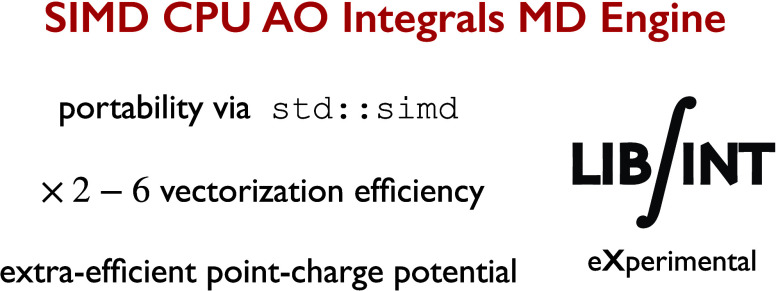 Figure 1
 Figure 2
 Figure 3
 Figure 4
 Figure 5
 Figure 6
 Figure 7
 Figure 8
 Figure 9
 Figure 10
 Figure 11
 Figure 12
 Figure 13
 Figure 14
 Figure 15
 Figure 16
 Figure 17
 Figure 18
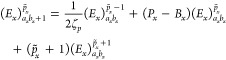 Figure 19
 Figure 20
 Figure 21
 Figure 22
 Figure 23
 Figure 24
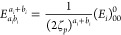 Figure 25
 Figure 26
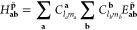 Figure 27
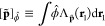 Figure 28
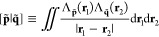 Figure 29
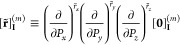 Figure 30
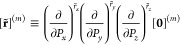 Figure 31
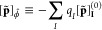 Figure 32
 Figure 33
 Figure 34
 Figure 35
 Figure 36
 Figure 37
 Figure 38
 Figure 39
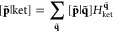 Figure 40
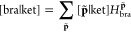 Figure 41
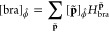 Figure 42
 Figure 43
 Figure 44
 Figure 45
 Figure 46
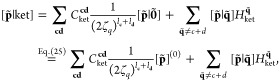 Figure 47
 Figure 48
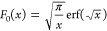 Figure 49
 Figure 50
Peer Reviews
No public reviews on file for this paper yet. If you reviewed it on a platform where reviews are public (OpenReview, ICLR, NeurIPS, ICML), you can paste yours below so the community can read it here.
Videos
No videos yet. Explain this paper in a talk, walkthrough, or lecture? Add one.
Taxonomy
TopicsBlind Source Separation Techniques · Target Tracking and Data Fusion in Sensor Networks · Optical Polarization and Ellipsometry