Lenvatinib after progression on pemigatinib and futibatinib in FGFR2 fusion-positive biliary tract cancer with an acquired kinase point mutation
Fabian Kleinhenz, Nicole Pfarr, Lisa Steinhelfer, Alisa M Lörsch, Henriette Bendz, Mathias Friedrich, Lea Liesenfeld, Melissa Barroux, Carlo Maurer, Patrick Wenzel, Angelika Kestler, Mai-Lan Koppermann, Carolin Mogler, Stephan Spahn, Anna L Illert, Roland M Schmid

TL;DR
A patient with biliary tract cancer resistant to FGFR2 inhibitors showed a positive response to lenvatinib, suggesting it as a potential treatment option.
Contribution
This case study suggests lenvatinib as a viable treatment for FGFR2 fusion-positive biliary tract cancer with acquired resistance.
Findings
The patient responded well to lenvatinib after resistance to pemigatinib and futibatinib.
Lenvatinib was well tolerated with only mild side effects.
The treatment provided a 15-month response period.
Abstract
Biliary tract cancers (BTC) represent a heterogeneous group of malignancies with a poor prognosis and rising incidence. Oncogenic FGFR2 fusions are one of several actionable molecular alterations. In this context, selective FGFR tyrosine kinase inhibitors have demonstrated promising and durable response rates and are now approved and included in clinical guidelines. However, secondary kinase mutations frequently arise over time, leading to resistance against these drugs. We present the case of a 41-year-old male patient with metastatic BTC who underwent molecular analysis after disease progression to various established chemotherapy combinations. Testing identified an oncogenic FGFR2 fusion (FGFR2::BICC1). The patient was treated with pemigatinib for 14 months. Upon disease progression, the resistance-associated FGFR2 p. E565A variant was detected in a follow-up biopsy. Treatment was…
Genes, proteins, chemicals, diseases, species, mutations and cell lines named across the full text — each resolved to its canonical identifier and authoritative record.
Click any figure to enlarge with its caption.
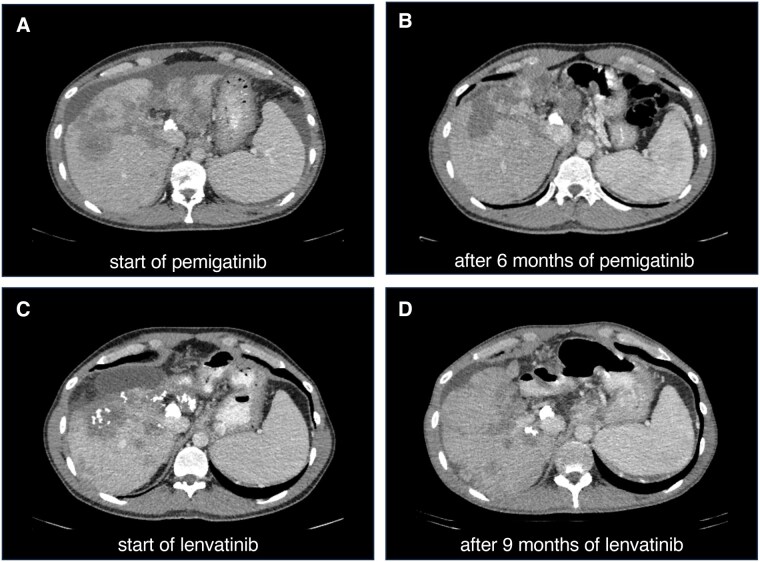 Figure 1
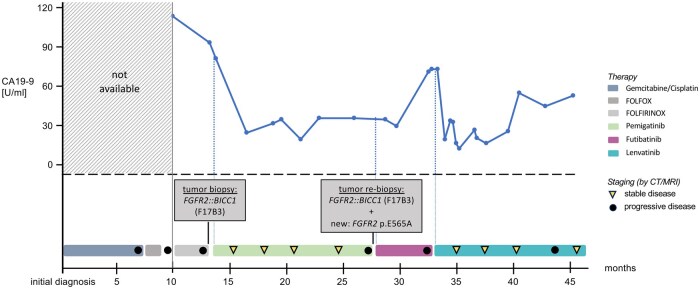 Figure 2
Peer Reviews
No public reviews on file for this paper yet. If you reviewed it on a platform where reviews are public (OpenReview, ICLR, NeurIPS, ICML), you can paste yours below so the community can read it here.
Videos
No videos yet. Explain this paper in a talk, walkthrough, or lecture? Add one.
Taxonomy
TopicsFibroblast Growth Factor Research · IgG4-Related and Inflammatory Diseases · Neuroendocrine Tumor Research Advances