3D-printed in vitro models of Stanford type B aortic dissection: A scoping review
Matthias Niklas Hagedorn, Marcello Mächerle, Roger Karl, C. Soeren Bergt, Dittmar Böckler, Sandy Engelhardt, Katrin Meisenbacher

TL;DR
3D-printed models of aortic dissections help study anatomy and treatments but need standardization to be more useful.
Contribution
This scoping review identifies gaps and opportunities in 3D-printed aortic dissection models for clinical and research applications.
Findings
Five studies used PolyJet technology with flexible photopolymers for 3D-printed aortic phantoms.
Current models lack standardization and face limitations in material durability and anatomical completeness.
Improved biomimetic materials and protocols could enhance model accuracy and practicality.
Abstract
Patient-specific three-dimensional-printed phantoms have emerged as valuable tools for simulating Stanford type B aortic dissections in vitro, enabling detailed studies of dissection morphology, hemodynamics, and interventional techniques under controlled, anatomically realistic conditions. Despite their potential, current methodologies remain heterogeneous and lack standardization. This scoping review, compliant with the PRISMA guidelines, systematically evaluated literature describing additive-manufactured flexible aortic phantoms specifically for pulsatile flow experiments or endovascular procedures. From an initial pool of 120 publications, five studies met the inclusion criteria, all using clinical imaging data and PolyJet-technology with flexible photopolymers. Four studies used full-scale models to simulate hemodynamics or thoracic endovascular aortic repair, and one investigated…
Genes, proteins, chemicals, diseases, species, mutations and cell lines named across the full text — each resolved to its canonical identifier and authoritative record.
Click any figure to enlarge with its caption.
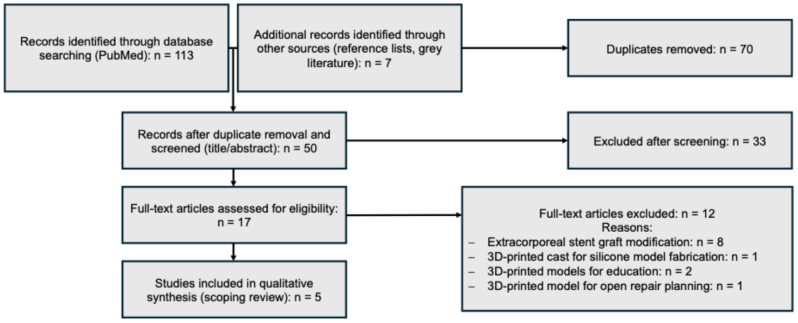 Figure 1
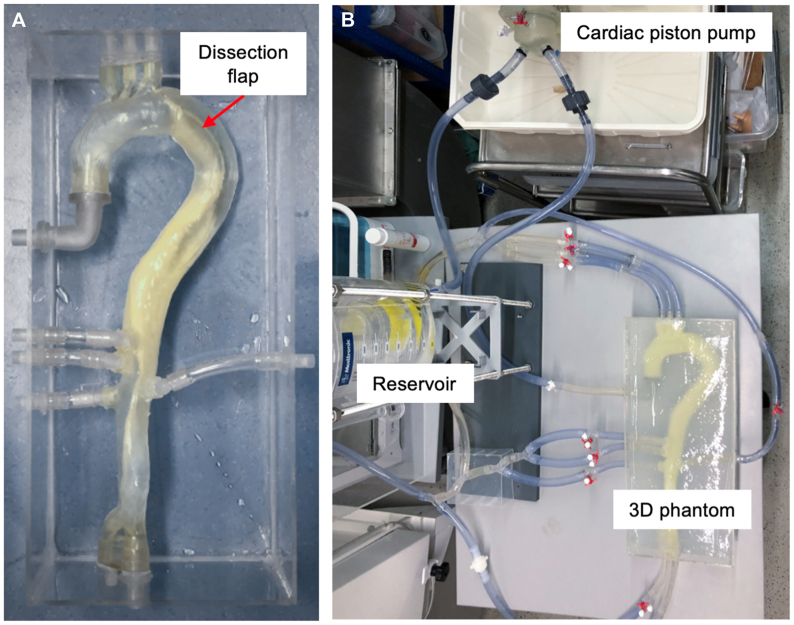 Figure 2
Peer Reviews
No public reviews on file for this paper yet. If you reviewed it on a platform where reviews are public (OpenReview, ICLR, NeurIPS, ICML), you can paste yours below so the community can read it here.
Videos
No videos yet. Explain this paper in a talk, walkthrough, or lecture? Add one.
Taxonomy
TopicsAortic Disease and Treatment Approaches · Aortic aneurysm repair treatments · Cardiac Valve Diseases and Treatments