Invasive treatment strategy for older patients with non-ST-elevation acute coronary syndrome: a systematic review and meta-analysis of randomized controlled trials
Vaibhav Vats, Rai Dilawar Shahjehan, Bavurothu Sharanya Kumar, Keerthi Sanapala, Kartik Mittal, Carlos Andres Barba Herazo, Seema Nabil Nimer, Aishwarya Raparthi, Jasneet K. Arora, Nikhil Kumar Balagoni, Alaa Hamza Hermis, Rawaa M. Mohammad, Huzaifa Ahmad Cheema, Bilawal Nadeem

TL;DR
This study compares invasive and conservative treatments for older patients with a specific heart condition and finds that invasive treatment reduces heart attacks but increases bleeding risks.
Contribution
The study provides new evidence on treatment outcomes for older patients with non-ST-elevation acute coronary syndrome using randomized controlled trials.
Findings
Invasive management significantly decreased the risk of MI and revascularization.
Invasive treatment increased the incidence of severe bleeding compared to conservative management.
There was no significant difference in all-cause mortality or cardiovascular mortality between the two strategies.
Abstract
The optimal strategy for managing older patients with non-ST-elevation acute coronary syndrome (NSTE-ACS) is uncertain. We aimed to compare the outcomes of invasive vs. conservative strategies for managing NSTE-ACS in older patients ≥65 years. We systematically searched MEDLINE, Embase, CENTRAL, and ClinicalTrials.gov, up to March 2025. We included randomized controlled trials (RCTs) comparing a routine invasive treatment strategy with conservative management alone in patients ≥65 years old with NTE-ACS. We pooled risk ratios (RRs) and hazard ratios (HRs) under a random-effects model. We included 8 RCTs (3,887 patients). There was no significant difference between invasive and conservative management in the risk of a composite outcome of all-cause mortality or MI (RR 0.91, 95% CI: 0.79, 1.06; HR 0.88, 95% CI: 0.74, 1.05), and all-cause mortality (RR 1.05, 95% CI: 0.93, 1.17; HR 1.03,…
Genes, proteins, chemicals, diseases, species, mutations and cell lines named across the full text — each resolved to its canonical identifier and authoritative record.
Click any figure to enlarge with its caption.
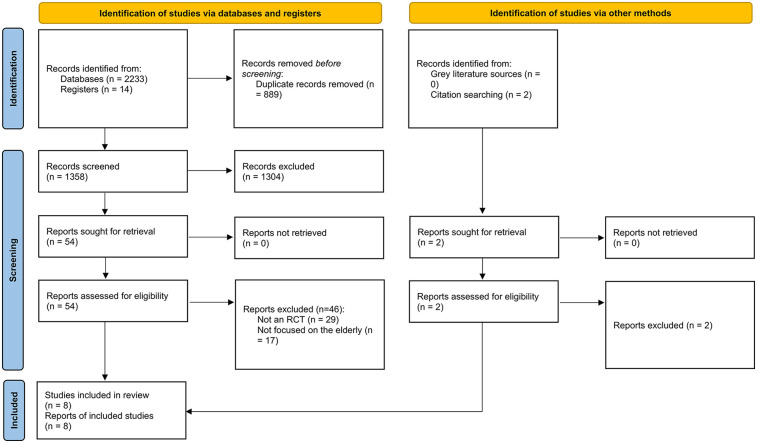 Figure 1
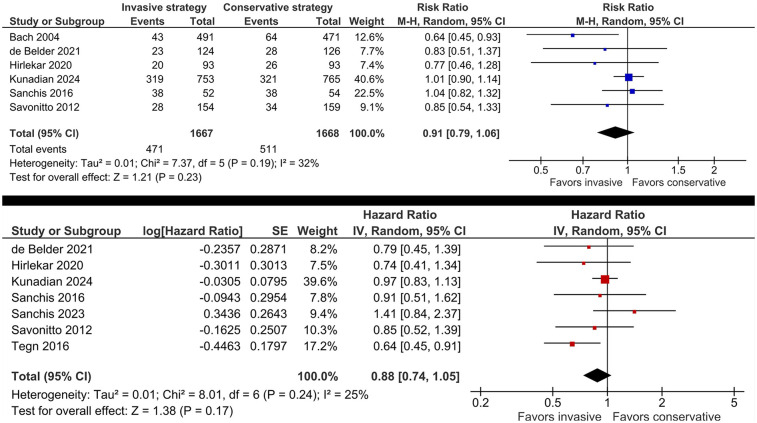 Figure 2
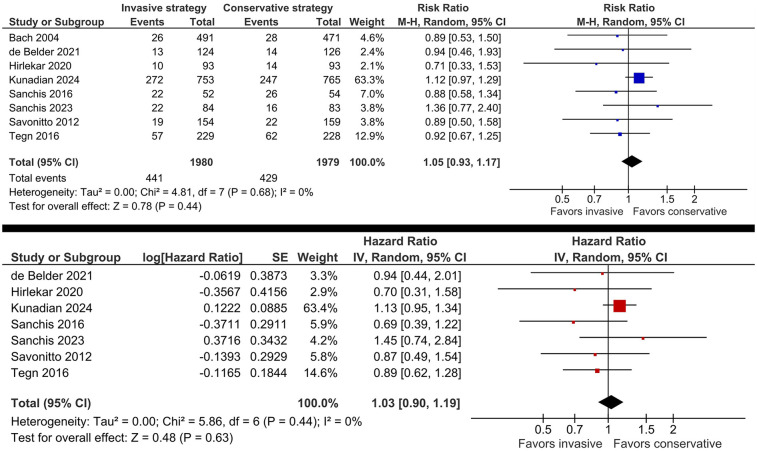 Figure 3
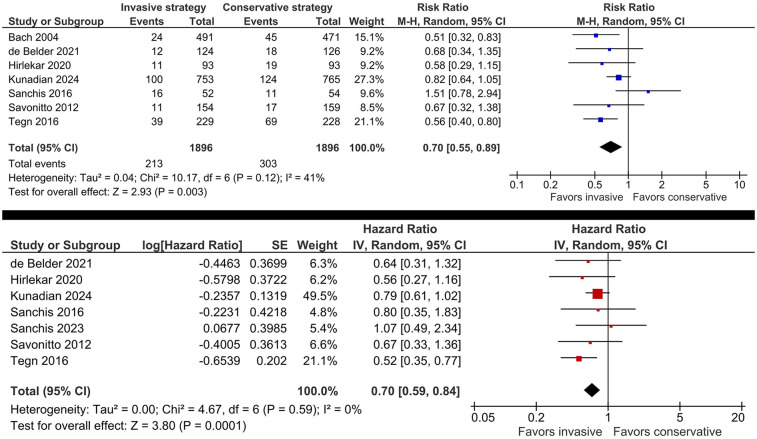 Figure 4
Peer Reviews
No public reviews on file for this paper yet. If you reviewed it on a platform where reviews are public (OpenReview, ICLR, NeurIPS, ICML), you can paste yours below so the community can read it here.
Videos
No videos yet. Explain this paper in a talk, walkthrough, or lecture? Add one.
Taxonomy
TopicsAcute Myocardial Infarction Research · Coronary Interventions and Diagnostics · Cardiac, Anesthesia and Surgical Outcomes