Comparative effectiveness of empagliflozin versus dapagliflozin in adults with metabolic dysfunction-associated steatotic liver disease
Jheng-Yan Wu, Yu-Kuan Tu, Chia-Chih Kuo, Mei-Yuan Liu, Wan-Hsuan Hsu, Ya-Wen Tsai, Ting-Hui Liu, Po-Yu Huang, Min-Hsiang Chuang, Kuo-Chuan Hung, Tsung Yu, Kuang-Ming Liao, Chih-Cheng Lai

TL;DR
This study compares empagliflozin and dapagliflozin in treating liver disease linked to metabolic issues, finding empagliflozin more effective in reducing hospitalizations and mortality.
Contribution
The study provides new evidence on the comparative effectiveness of two SGLT2 inhibitors in MASLD patients, highlighting empagliflozin's broader clinical benefits.
Findings
Empagliflozin reduced the risk of a composite outcome including hospitalization, mortality, and kidney events compared to dapagliflozin.
Empagliflozin showed lower risks for all-cause mortality, cardiovascular events, and kidney events but not for liver decompensation.
The benefits of empagliflozin were consistent across most subgroups, including patients with heart failure and chronic kidney disease.
Abstract
Sodium-glucose co-transporter-2 inhibitors (SGLT2is) show promise in treating metabolic dysfunction-associated steatotic liver disease (MASLD). However, the relative efficacy of different SGLT2is remains unclear. We aimed to compare the clinical effectiveness of empagliflozin versus dapagliflozin in adults with MASLD. Using the TriNetX database, we conducted a retrospective cohort study of adults with MASLD who were newly prescribed either empagliflozin or dapagliflozin between January 2013 and September 2024. After propensity score matching, we compared 13,274 patients in each group. The primary outcome was a composite of all-cause hospitalization, all-cause mortality, major adverse cardiovascular events (MACEs), major adverse kidney events (MAKEs), and decompensated hepatic events. Secondary outcomes included each individual component of the primary outcome. Empagliflozin was…
Genes, proteins, chemicals, diseases, species, mutations and cell lines named across the full text — each resolved to its canonical identifier and authoritative record.
Click any figure to enlarge with its caption.
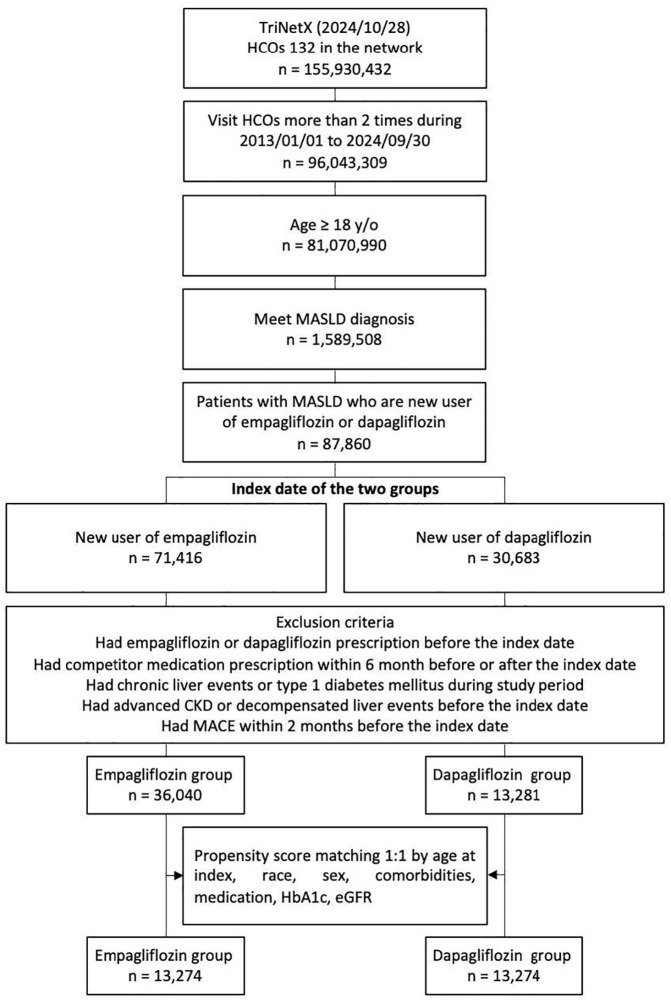 Figure 1
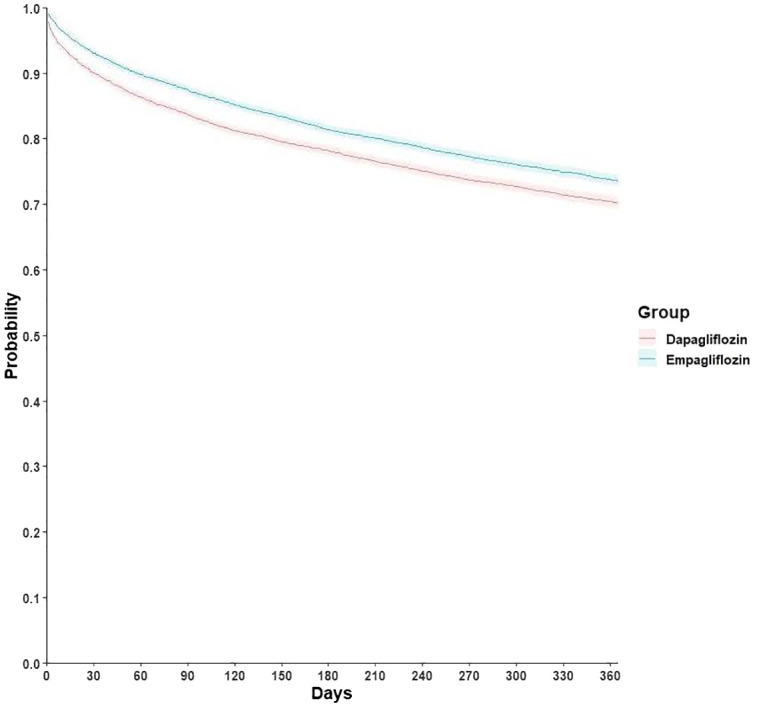 Figure 2
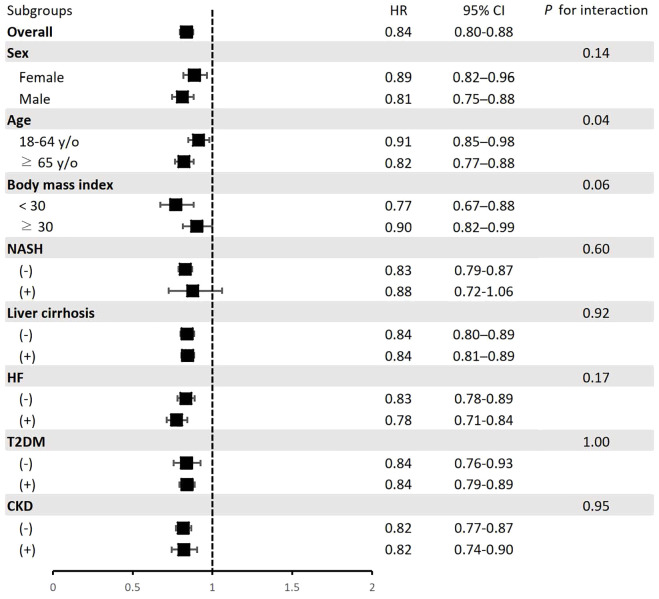 Figure 3
Peer Reviews
No public reviews on file for this paper yet. If you reviewed it on a platform where reviews are public (OpenReview, ICLR, NeurIPS, ICML), you can paste yours below so the community can read it here.
Videos
No videos yet. Explain this paper in a talk, walkthrough, or lecture? Add one.
Taxonomy
TopicsLiver Disease Diagnosis and Treatment · Diabetes Treatment and Management · Pancreatic function and diabetes