A filtering approach for statistical inference in a stochastic SIR model with an application to Covid-19 data
Katia Colaneri, Camilla Damian, Rüdiger Frey

TL;DR
This paper introduces a statistical method to estimate the spread of infectious diseases like Covid-19 using a model that accounts for hidden infections and random changes in transmission.
Contribution
The novelty is using nested particle filtering in a Bayesian framework for inference in a partially observed stochastic SIR model.
Findings
The method successfully estimates unobserved states and parameters in the SIR model.
The approach was applied to Austrian Covid-19 data, showing its practical utility.
Posterior predictive checks were used to validate the model and improve forecasts.
Abstract
In this paper, we consider a discrete-time stochastic SIR model, where the transmission rate and the number of infectious individuals are random and unobservable. This model accounts for random fluctuations in infectiousness and for non-detected infections. Thus, statistical inference has to be performed in a partial information setting. We adopt a Bayesian approach and use nested particle filtering to estimate the state of the system and the parameters. Moreover, we discuss forecasts and model tests based on the posterior predictive distribution. As a case study, we apply our methodology to Austrian Covid-19 infection data.
Genes, proteins, chemicals, diseases, species, mutations and cell lines named across the full text — each resolved to its canonical identifier and authoritative record.
Click any figure to enlarge with its caption.
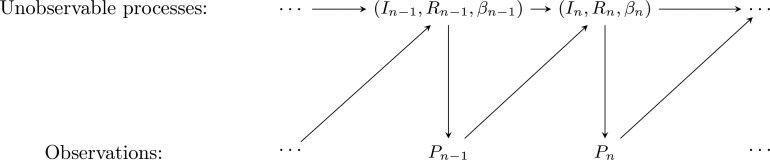 Figure 1
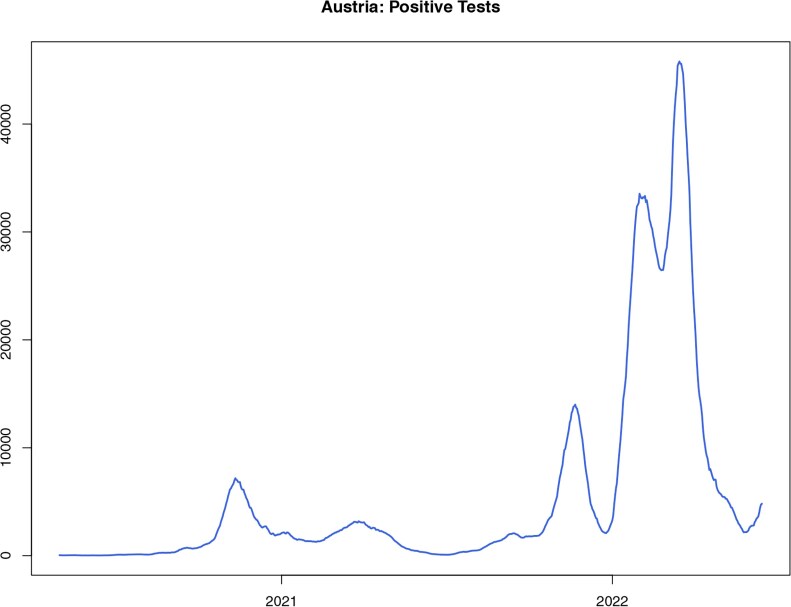 Figure 2
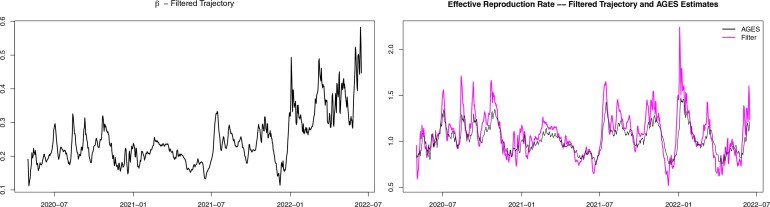 Figure 3
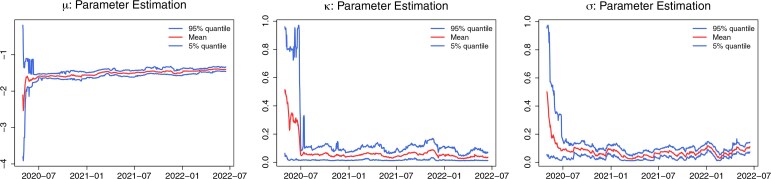 Figure 4
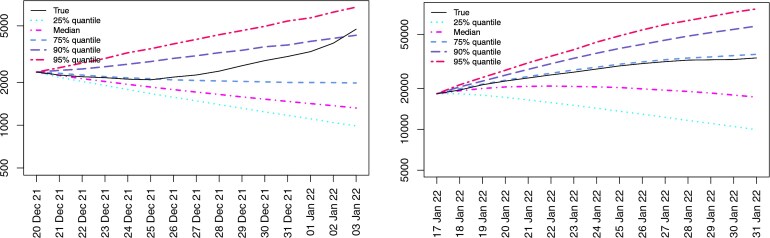 Figure 5
Peer Reviews
No public reviews on file for this paper yet. If you reviewed it on a platform where reviews are public (OpenReview, ICLR, NeurIPS, ICML), you can paste yours below so the community can read it here.
Videos
No videos yet. Explain this paper in a talk, walkthrough, or lecture? Add one.
Taxonomy
TopicsCOVID-19 epidemiological studies · SARS-CoV-2 detection and testing · SARS-CoV-2 and COVID-19 Research