The 5-min Apgar score and primary school performance: a Dutch nationwide cohort study
Flo Anema, Anita C. J. Ravelli, Wes Onland, Petra C. A. M. Bakker, Floris Groenendaal, Ageeth N. Rosman, Jasper V. Been, Carline E. Tacke, T. A. J. Antonius, T. A. J. Antonius, P. H. Dijk, K. P. Dijkman, S. Koole, R. F. Kornelisse, F. A. B. A. Schuerman, M. L. Tataranno

TL;DR
This study finds that lower 5-minute Apgar scores at birth are linked to poorer primary school performance and higher rates of special education use.
Contribution
The study shows that even moderate Apgar scores (7-9) are associated with increased risk of special education and lower academic track placement.
Findings
Children with Apgar scores of 0-3 had the highest rate of special education (14.3%) and lowest high track recommendation (40.7%).
Apgar scores of 7-9 showed significantly lower odds of high track recommendations compared to a score of 10.
Lower Apgar scores correlated with higher odds of needing special education, even after adjusting for confounding factors.
Abstract
The purpose of this study is to investigate the association between the 5-min Apgar score and primary school performance. The national cohort study involves singletons born between 35+ 0–42 + 6 weeks of gestation from 2000 to 2009. The Dutch Perinatal Registry was linked with Statistics Netherland’s database to study educational outcomes at primary school, focusing on special education use and a high track recommendation for secondary school at age 12. Multivariate (adjusted) logistic regression assessed the association between Apgar score (grouped as 0–3, 4–6, 7, 8, 9, and 10) and these outcomes. Of the 1,618,087 children available, a total of 6.4% attended special education at primary school. The highest rate of 14.3% was observed in the group with the lowest Apgar scores (0–3), gradually decreasing to the lowest rate of 6.0% in the group with the highest Apgar score. Compared with a…
Genes, proteins, chemicals, diseases, species, mutations and cell lines named across the full text — each resolved to its canonical identifier and authoritative record.
Click any figure to enlarge with its caption.
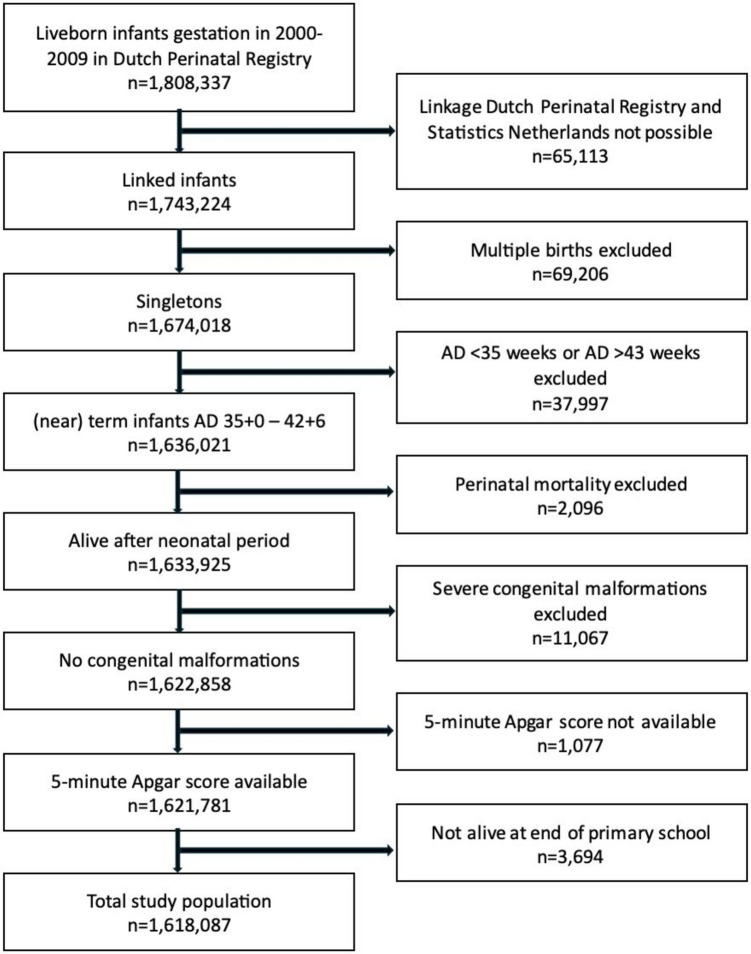 Figure 1
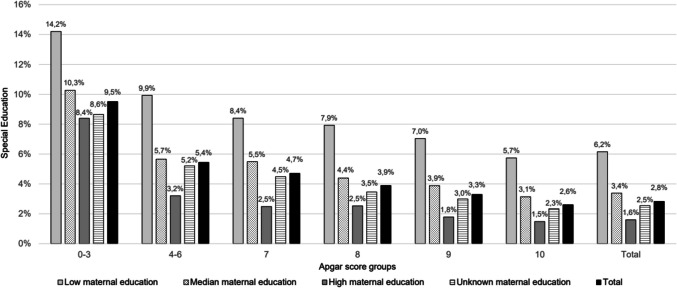 Figure 2
Peer Reviews
No public reviews on file for this paper yet. If you reviewed it on a platform where reviews are public (OpenReview, ICLR, NeurIPS, ICML), you can paste yours below so the community can read it here.
Videos
No videos yet. Explain this paper in a talk, walkthrough, or lecture? Add one.
Taxonomy
TopicsInfant Development and Preterm Care · Family and Disability Support Research · Neonatal and fetal brain pathology