Low incidence of venous thromboembolic complications following single-port robotic surgeries for upper and lower tract urological malignancies: a report from the Single-Port Advanced Research Consortium (SPARC)
Nicolas A. Soputro, Kennedy E. Okhawere, Yuzhi Wang, Michael E. Raver, Eugenio Bologna, Ruben Sauer Calvo, Elizabeth Snajdar, Narmina Khammandova, Jaya S. Chavali, Carter D. Mikesell, Adriana M. Pedraza, Indu Saini, Adam Lorentz, Bertram Yuh, Ryan J. Nelson, David I. Lee

TL;DR
This study found a very low risk of blood clots after single-port robotic surgeries for urological cancers, with risk tools like Caprini helping identify patients who might need extra care.
Contribution
The study provides the first multi-institutional data on venous thromboembolism (VTE) rates following single-port robotic surgeries for urological malignancies.
Findings
No venous thromboembolic events (VTE) occurred after single-port robotic partial nephrectomy (RAPN).
A 0.44% overall VTE incidence was observed across single-port robotic procedures for urological malignancies.
Higher Caprini scores correlated with increased odds of VTE following single-port robotic radical prostatectomy (RARP).
Abstract
With the increasing utility of the single-port (SP) robotic platform, there remains limited evidence surrounding the perioperative morbidity associated with the novel techniques. This study sought to evaluate the incidence of venous thromboembolic events (VTE) associated with the SP procedures for upper and lower tract urological malignancies, based on the multi-institutional experience of the Single-Port Advanced Research Consortium (SPARC), involving a total of 2286 patients. The group comprised 1886 (82.5%) and 400 (17.5%) cases of SP robotic radical prostatectomy (RARP) and SP robotic partial nephrectomy (RAPN) that were completed between 2018 and 2024. In addition to the perioperative variables, all patients were stratified into low, moderate, and high risk for VTE according to the Caprini scoring system. Notably, no cases of VTE were identified following SP-RAPN, while eight cases…
Genes, proteins, chemicals, diseases, species, mutations and cell lines named across the full text — each resolved to its canonical identifier and authoritative record.
Click any figure to enlarge with its caption.
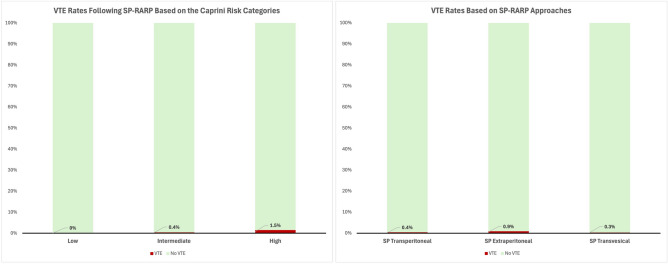 Figure 1
Peer Reviews
No public reviews on file for this paper yet. If you reviewed it on a platform where reviews are public (OpenReview, ICLR, NeurIPS, ICML), you can paste yours below so the community can read it here.
Videos
No videos yet. Explain this paper in a talk, walkthrough, or lecture? Add one.
Taxonomy
TopicsVenous Thromboembolism Diagnosis and Management · Vascular anomalies and interventions · Prostate Cancer Diagnosis and Treatment