Time Spent Thinking in Online Chess Reflects the Value of Computation
Evan M. Russek, Daniel Acosta‐Kane, Bas van Opheusden, Marcelo G. Mattar, Thomas L. Griffiths

TL;DR
This paper shows that people spend more time thinking in chess when it's more useful, suggesting they efficiently use mental resources.
Contribution
The study provides empirical evidence that human thinking time in chess correlates with the computational value of the situation.
Findings
Players spent more time thinking in board positions where additional computation was more beneficial.
Stronger players showed a stronger relationship between thinking time and computational benefit.
A simple model based on computational cost captured the observed patterns in thinking time.
Abstract
Human planning tends to be efficient, focusing on a relatively small number of options when considering future paths. Recent proposals have suggested that this efficiency reflects intelligent deployment of the limited resources available for planning. A prediction of this and related proposals is that when individuals spend time thinking should depend on the benefits and costs of additional computation. We tested this hypothesis by measuring how much time humans spent thinking before acting in over 12 million online chess games. Players spent more time thinking in board positions where additional computation was more beneficial. This relationship was greater in stronger players, and was strengthened by considering only the information available to the player at the time of choice. A simple model based on measuring the actual cost of spending time thinking in online chess was able to…
Genes, proteins, chemicals, diseases, species, mutations and cell lines named across the full text — each resolved to its canonical identifier and authoritative record.
Click any figure to enlarge with its caption.
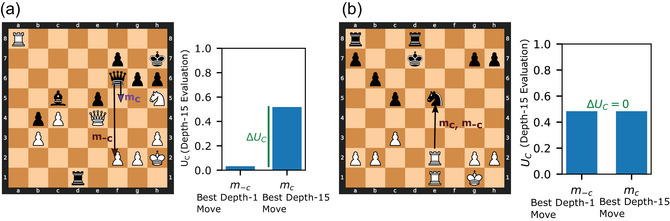 Figure 1
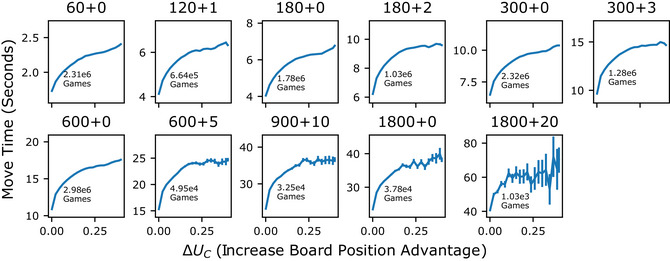 Figure 2
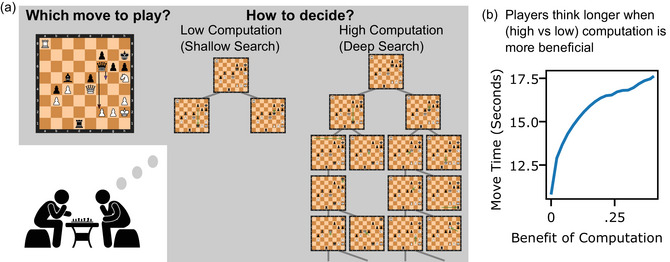 Figure 3
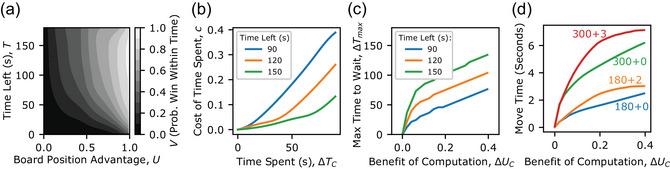 Figure 4
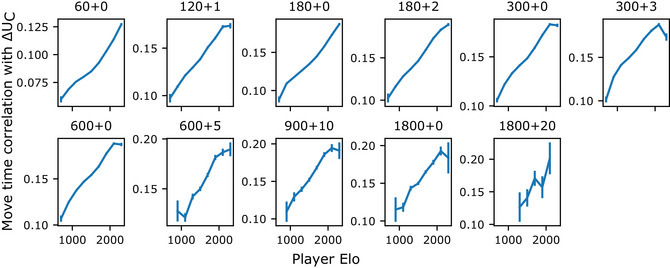 Figure 5
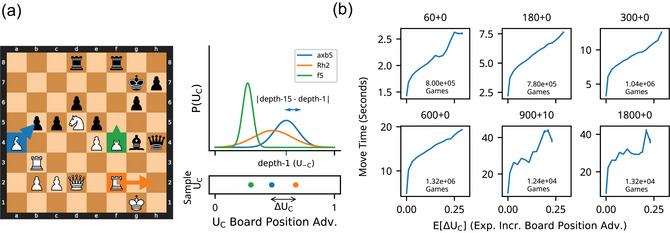 Figure 6
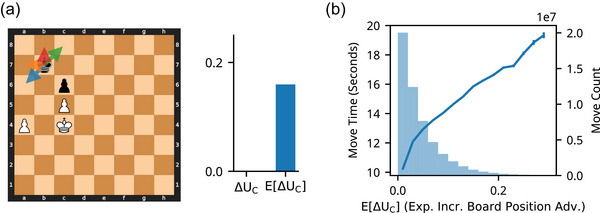 Figure 7
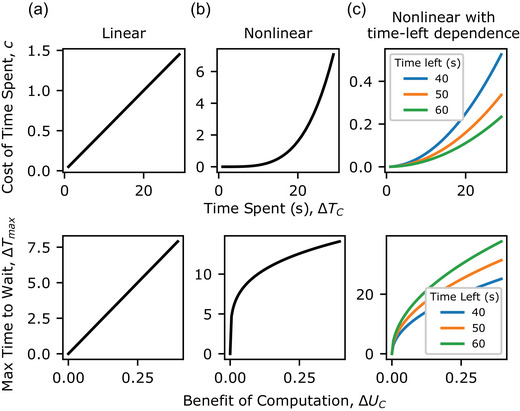 Figure 8
Peer Reviews
No public reviews on file for this paper yet. If you reviewed it on a platform where reviews are public (OpenReview, ICLR, NeurIPS, ICML), you can paste yours below so the community can read it here.
Videos
No videos yet. Explain this paper in a talk, walkthrough, or lecture? Add one.
Taxonomy
TopicsArtificial Intelligence in Games · Sports Analytics and Performance · Educational Games and Gamification