reDA: differential abundance testing on scATAC-seq data using random walk with restart
Zirui Chen, Jiao Hua, Lu Ba, Tianyun He, Boran Yang, Jing Qi, Shuilin Jin

TL;DR
reDA is a new method for analyzing scATAC-seq data that improves accuracy and efficiency in identifying cell states linked to diseases.
Contribution
reDA introduces a cluster-free framework using random walk with restart for differential abundance testing in scATAC-seq data.
Findings
reDA outperforms six baseline methods in accuracy and computational efficiency.
reDA captures disease-specific molecular signatures from scATAC-seq data.
reDA is compatible with existing scATAC-seq analysis workflows.
Abstract
Identifying cell states associated with disease progression or experimental perturbations from single-cell Assay for Transposase Accessible Chromatin using sequencing (scATAC-seq) data is critical for unraveling disease pathogenesis. However, the high dimensionality, extreme sparsity, and nearly binary nature of scATAC-seq data pose significant challenges. Here, we present reDA, a cluster-free computational framework that performs differential abundance testing based on the random walk with restart. Through comprehensive experiments on simulated and real datasets, reDA outperforms six baseline methods, demonstrating superior accuracy, computational efficiency, and the ability to capture disease-specific molecular signatures. The reDA along with detailed documentation is freely available at https://github.com/Jinsl-lab/reDA. It can be seamlessly integrated into existing scATAC-seq…
Genes, proteins, chemicals, diseases, species, mutations and cell lines named across the full text — each resolved to its canonical identifier and authoritative record.
Click any figure to enlarge with its caption.
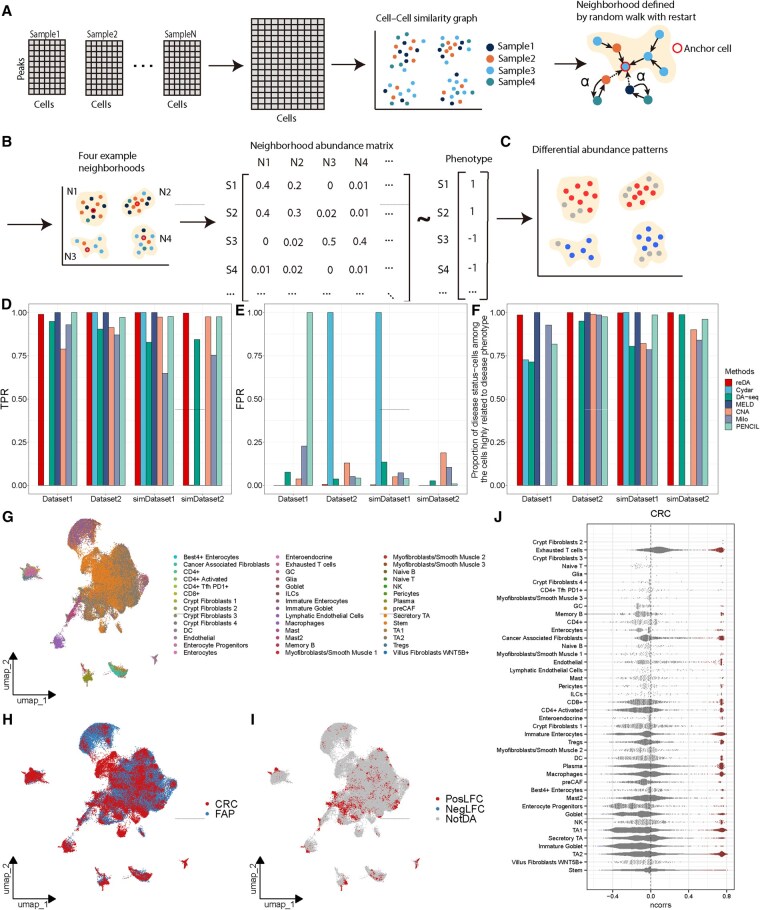 Figure 1
Peer Reviews
No public reviews on file for this paper yet. If you reviewed it on a platform where reviews are public (OpenReview, ICLR, NeurIPS, ICML), you can paste yours below so the community can read it here.
Videos
No videos yet. Explain this paper in a talk, walkthrough, or lecture? Add one.
Taxonomy
TopicsMolecular Biology Techniques and Applications · Gene expression and cancer classification · Single-cell and spatial transcriptomics