Computational Approaches Reveal Developmental Shifts in Exploratory Play
Joseph Colantonio, Ilona Bass, Yee Lee Shing, Sobanawartiny Wijeakumar, Courtney McKay, Eva Rafetseder, Allyson P. Mackey, Elizabeth Bonawitz

TL;DR
The paper uses computational models to show how children's exploratory play changes with age, revealing that older children explore more variably and less repetitively.
Contribution
A novel computational Markov modeling approach is introduced to quantify developmental shifts in children's exploratory play behavior.
Findings
Older children are less likely to perseverate and more likely to switch or end tasks during play.
Developmental effects are most consistent in novel toy tasks but vary across contexts.
The approach helps reconcile conflicting prior research by emphasizing task structure and exploratory strategy changes.
Abstract
Although exploratory play is considered a hallmark of cognitive development and learning, relatively few studies have been able to quantitatively characterize the shifts that may occur in children's approach to exploration. One reason for this gap is due to challenges coding and analyzing children's exploratory play behavior. In our paper, we employ a novel computational modeling approach to understand whether and how children's exploratory play patterns shift in early childhood (3‐ to 11‐years‐old). We analyze data from children (N = 432) across five different experiments that varied in the type of exploration task (including novel toys, novel topics, and novel envelopes). Children's behaviors were coded action‐by‐action according to whether children repeated an action on the same type of target, switched to a novel target, or terminated play. Our computational Markov model searches…
Genes, proteins, chemicals, diseases, species, mutations and cell lines named across the full text — each resolved to its canonical identifier and authoritative record.
Click any figure to enlarge with its caption.
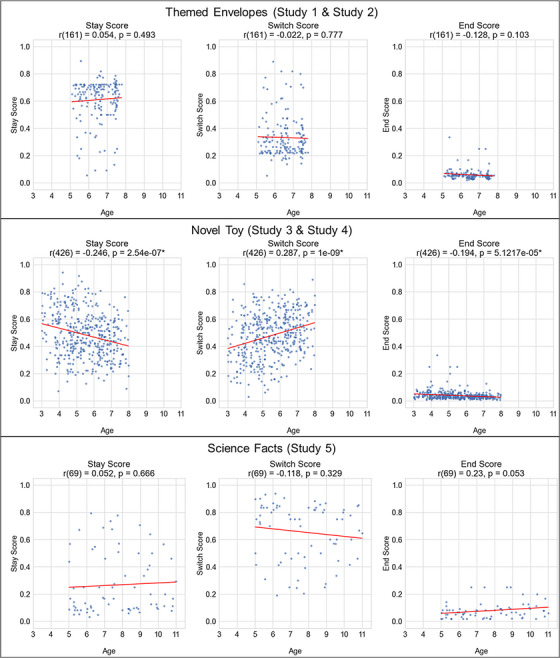 Figure 1
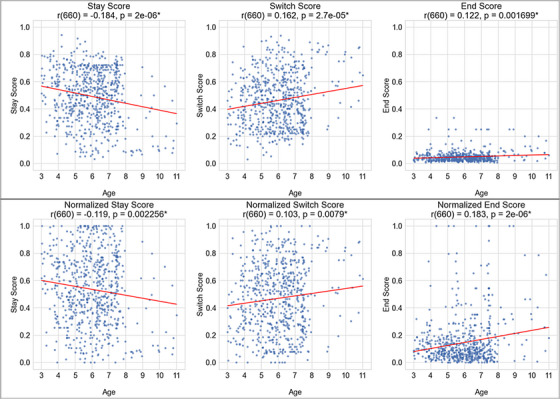 Figure 2
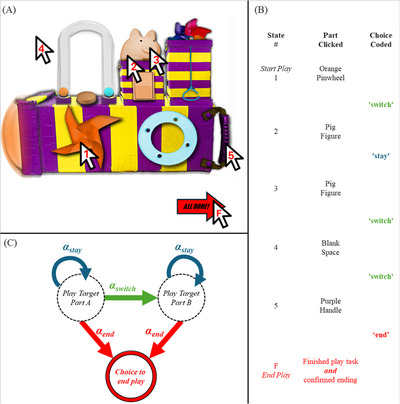 Figure 3
Peer Reviews
No public reviews on file for this paper yet. If you reviewed it on a platform where reviews are public (OpenReview, ICLR, NeurIPS, ICML), you can paste yours below so the community can read it here.
Videos
No videos yet. Explain this paper in a talk, walkthrough, or lecture? Add one.
Taxonomy
TopicsChild and Animal Learning Development · Child Development and Digital Technology · Psychological and Educational Research Studies