Bipolar Disorder VII: Family History and Its Relationship With Suicide Attempts, Severity, and the Prophylactic Effect of Lithium Treatment in a Long-Term Follow-Up Study of Bipolar Disorder
Per-Olof Nylander, Erik Lexne, Christer Lehman, Lars Brudin, Finn Bengtsson

TL;DR
This study shows that bipolar disorder patients with a family history of affective disorders experience more severe symptoms, earlier suicide attempts, and reduced lithium treatment effectiveness.
Contribution
The study identifies a distinct clinical course of bipolar disorder linked to family history of affective disorders, including lithium response and suicide risk patterns.
Findings
Patients with a family history of affective disorders had earlier age of onset and more frequent depressive episodes.
Suicide attempts were more common and occurred earlier in patients with a family history of affective disorders.
Lithium treatment was less effective in patients with a family history of affective disorders.
Abstract
Family history (FH) of affective disorders (ADs) is important for the course of bipolar disorder (BD). In a long-term study (mean 25 years), 192 patients with BD diagnosed by DSM-IV criteria were recruited from lithium dispensaries. Differences between patients with and without an FH of ADs were studied. Patients with an FH of AD had poorer lithium response (p = .027), earlier age of onset (AOO) (p < .001), were younger (p = .009), made suicide attempts (SAs) earlier after onset (p = .012), and had more episodes/year (p = .017) and depressive episodes/year (p = .010) before SA. SAs were more common (p = .028) in patients with an FH of AD. SAs were more common (p = .001) before lithium treatment, and SAs (p < .001) were only present in patients with an FH of AD within the first 5 years after AOO. Patients with an FH of AD had more episodes (p = .009), episodes/year (p = .002),…
Genes, proteins, chemicals, diseases, species, mutations and cell lines named across the full text — each resolved to its canonical identifier and authoritative record.
Click any figure to enlarge with its caption.
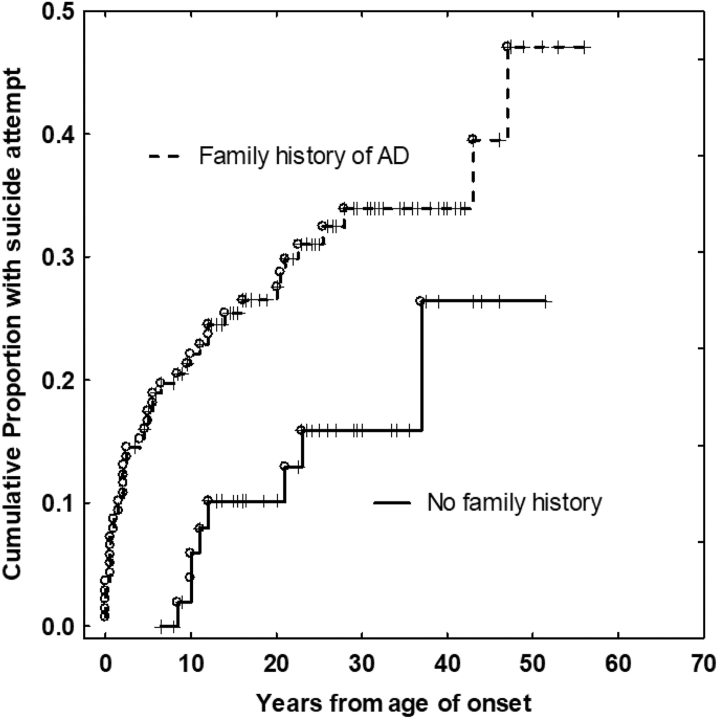 Figure 1
Peer Reviews
No public reviews on file for this paper yet. If you reviewed it on a platform where reviews are public (OpenReview, ICLR, NeurIPS, ICML), you can paste yours below so the community can read it here.
Videos
No videos yet. Explain this paper in a talk, walkthrough, or lecture? Add one.
Taxonomy
TopicsBipolar Disorder and Treatment · Child and Adolescent Psychosocial and Emotional Development · Family Support in Illness