Phytochemicals of Roman chamomile: Antioxidant, anti-aging, and whitening activities of distillation residues
Liyuan Sui, Ying Wang, Xiangyu Zhang, Min Yuan, Hong Ju, Jinlian Li

TL;DR
This study explores the value of Roman chamomile distillation residues by showing they have strong antioxidant, whitening, and anti-aging properties, making them useful for cosmetics.
Contribution
The study identifies and compares the bioactive fractions of Roman chamomile residue, revealing their enhanced functional properties over the crude extract.
Findings
The ethyl acetate fraction (EaF) showed significantly higher antioxidant, whitening, and anti-aging activities than the crude extract.
Rutin, quercetin, and luteolin in EaF increased 5.18, 7.29, and 10.58-fold, respectively, compared to the crude extract.
The n-butanol fraction (NbF) had lower IC50 values than EGCG for hyaluronidase and elastase inhibition.
Abstract
The large demand for Roman chamomile essential oil leads to nonnegligible residues in the process of steam distillation. It is an urgent problem to recycle these residues to solve the pollution in the ecological environment and enhance the industrial value. In this study, the components of different fractions extracted from the Roman chamomile residue were analyzed, and their antioxidant, whitening, and anti-aging activities were evaluated. It was found that the crude extract (CE) contained large amounts of polyphenols and flavonoids and displayed obvious antioxidant, whitening, anti-aging activities, and extremely low cytotoxicity. After fractional extraction, polyphenols and flavonoids were largely enriched in the ethyl acetate fraction (EaF), and total polyphenols and total flavonoids increased three- and fourfold, respectively, compared with CE. Especially, the rutin content…
Genes, proteins, chemicals, diseases, species, mutations and cell lines named across the full text — each resolved to its canonical identifier and authoritative record.
Click any figure to enlarge with its caption.
 Figure 1
 Figure 2
 Figure 3
 Figure 4
 Figure 5
 Figure 6
 Figure 7
 Figure 8
 Figure 9
 Figure 10
 Figure 11
 Figure 12
 Figure 13
 Figure 14
 Figure 15
 Figure 16
 Figure 17
 Figure 18
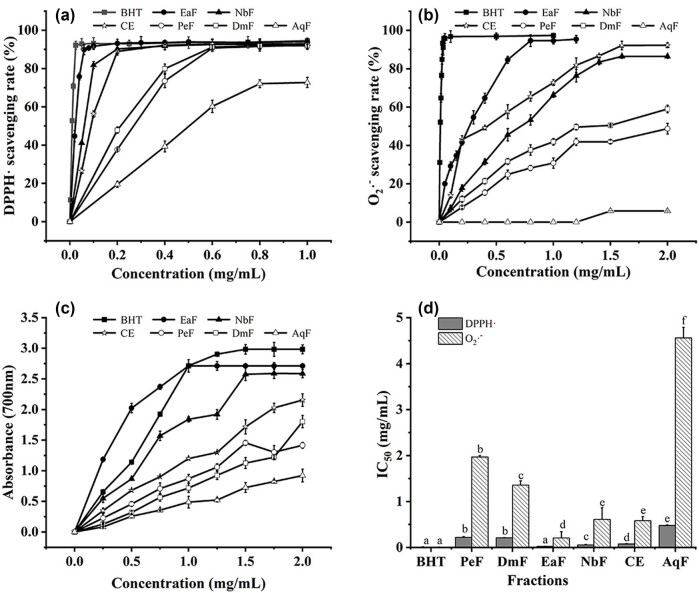 Figure 1
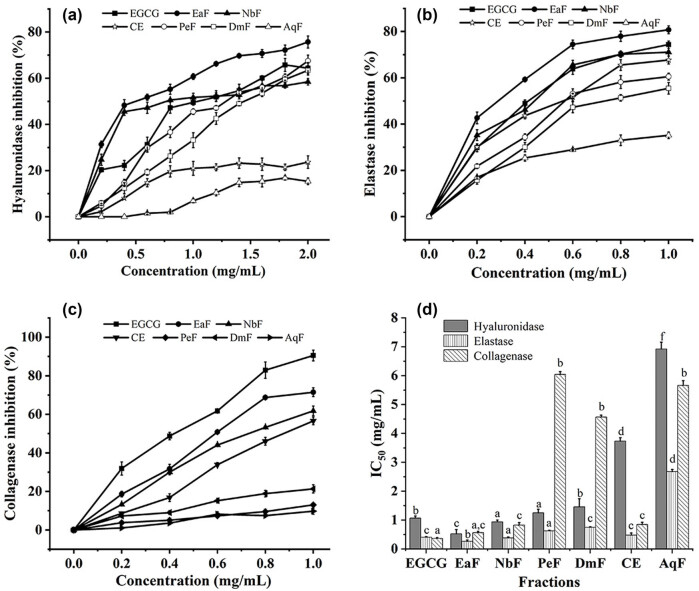 Figure 2
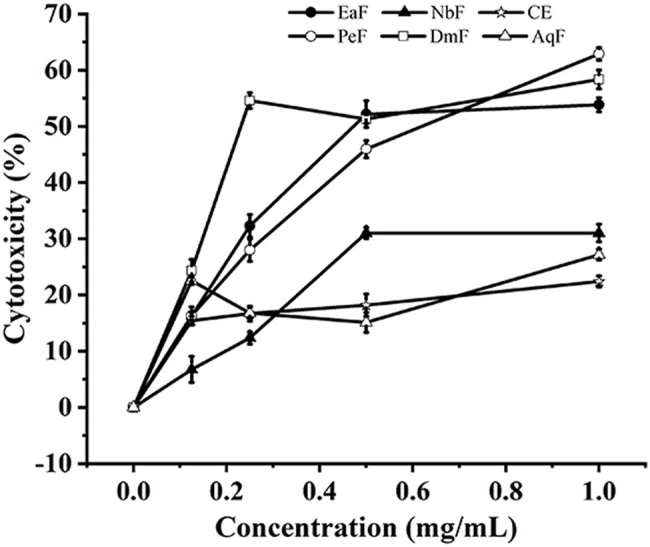 Figure 3
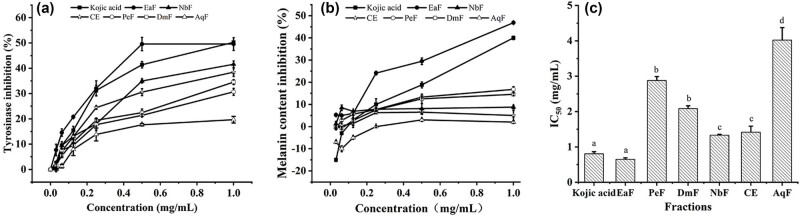 Figure 4
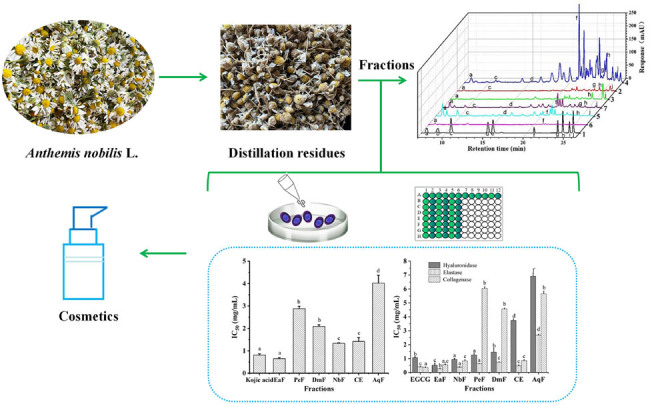 Figure 23
Peer Reviews
No public reviews on file for this paper yet. If you reviewed it on a platform where reviews are public (OpenReview, ICLR, NeurIPS, ICML), you can paste yours below so the community can read it here.
Videos
No videos yet. Explain this paper in a talk, walkthrough, or lecture? Add one.
Taxonomy
Topicsmelanin and skin pigmentation · Edible Oils Quality and Analysis · Essential Oils and Antimicrobial Activity