Understanding Patient Perceptions of Bacterial Vaginosis Treatments: Mixed Methods Sentiment Analysis Study of Online Drug Review Forums
Eren Watkins, Andrea N Cimino, Curtis Culbertson, Juliana Raymaker, Jennifer R Amico

TL;DR
This study explores how patients feel about bacterial vaginosis treatments by analyzing online reviews, finding that vaginal clindamycin is preferred for its effectiveness and ease of use.
Contribution
The study provides new insights into patient preferences and experiences with FDA-approved bacterial vaginosis treatments using mixed methods analysis of online reviews.
Findings
Vaginal clindamycin received higher star ratings and more positive sentiment compared to oral and vaginal metronidazole.
Patients valued treatments that were easy to use, effective, and had minimal side effects.
Qualitative analysis revealed a need for better medical education on BV treatment for both patients and providers.
Abstract
Bacterial vaginosis (BV) is the most common cause of vaginal discharge in people of childbearing age in the United States. More information about what patients do and do not like about the most common BV products and the extent to which they reduce BV symptoms is important for understanding patients’ health and the current treatment landscape for BV. Using data from online drug review forums, this study’s objectives were to (1) quantitatively characterize the patient voice via sentiments (positive to negative) and emotions about the three most common Food and Drug Administration (FDA)–approved treatments for BV—oral metronidazole (OM), vaginal metronidazole (VM), vaginal clindamycin (VC)—and (2) qualitatively summarize themes characterizing the patient-perceived impact of BV and BV products. Data for this mixed methods descriptive study came from 1645 users’ reviews of BV products…
Genes, proteins, chemicals, diseases, species, mutations and cell lines named across the full text — each resolved to its canonical identifier and authoritative record.
Click any figure to enlarge with its caption.
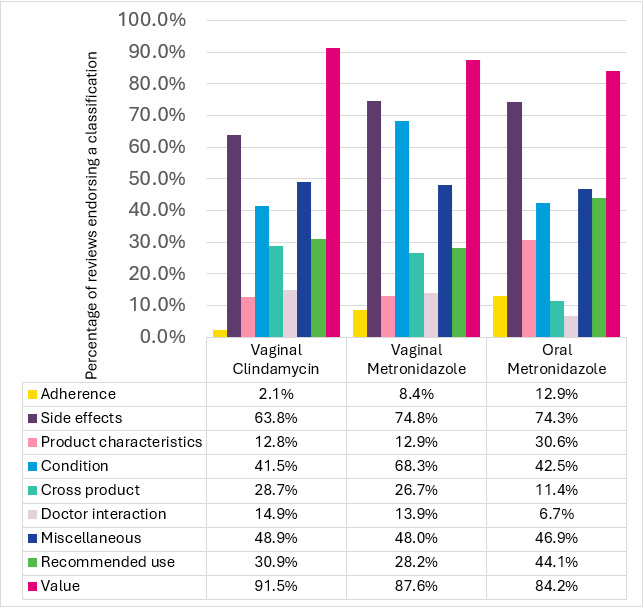 Figure 1
 Figure 2
 Figure 3
 Figure 4
 Figure 5
Peer Reviews
No public reviews on file for this paper yet. If you reviewed it on a platform where reviews are public (OpenReview, ICLR, NeurIPS, ICML), you can paste yours below so the community can read it here.
Videos
No videos yet. Explain this paper in a talk, walkthrough, or lecture? Add one.
Taxonomy
TopicsReproductive tract infections research · Syphilis Diagnosis and Treatment · Adolescent Sexual and Reproductive Health