Ravulizumab stabilizes life-threating intravascular hemolysis following delayed hemolytic transfusion reaction due to alloantibodies anti-e and anti-Jka: the first successful administration
Zoe Bezirgiannidou, Iliana Stamatiou, Theodoros M. Theodoridis, Eftychia Kontekaki, Emmanouil Panagiotopoulos, Christina Misidou, George Vrachiolias, Bouse Malkots, Menelaos Papoutselis, Ioannis Kotsianidis, Emmanouil Spanoudakis, Konstantinos Liapis

TL;DR
A new treatment using ravulizumab successfully stabilized a patient with severe blood cell destruction caused by a transfusion reaction.
Contribution
The first successful use of ravulizumab to treat intravascular hemolysis due to delayed hemolytic transfusion reaction.
Findings
Ravulizumab rapidly improved a patient's condition with life-threatening hemolysis after a blood transfusion.
The patient achieved full hematologic and biochemical recovery within three weeks of treatment.
The case suggests complement inhibitors like ravulizumab may be effective in severe complement-mediated hemolysis.
Abstract
This report describes the first successful administration of ravulizumab, a C5 complement inhibitor, in the treatment of life-threatening intravascular hemolysis (IVH) caused by delayed hemolytic transfusion reaction (DHTR) in a 22-year-old woman. The patient developed acute IVH with severe anemia and hemodynamic instability seven days after receiving a blood transfusion for posthemorrhagic anemia following a missed abortion. Laboratory investigations revealed anti-e and anti-Jka alloantibodies consistent with DHTR. Despite treatment, her hemoglobin level declined further, raising concerns for hyperhemolytic syndrome. After the administration of ravulizumab, her condition improved rapidly, and she was discharged with stable hemoglobin levels. Within three weeks there was full hematologic and biochemical recovery. This case demonstrates the therapeutic potential of ravulizumab in the…
Genes, proteins, chemicals, diseases, species, mutations and cell lines named across the full text — each resolved to its canonical identifier and authoritative record.
Click any figure to enlarge with its caption.
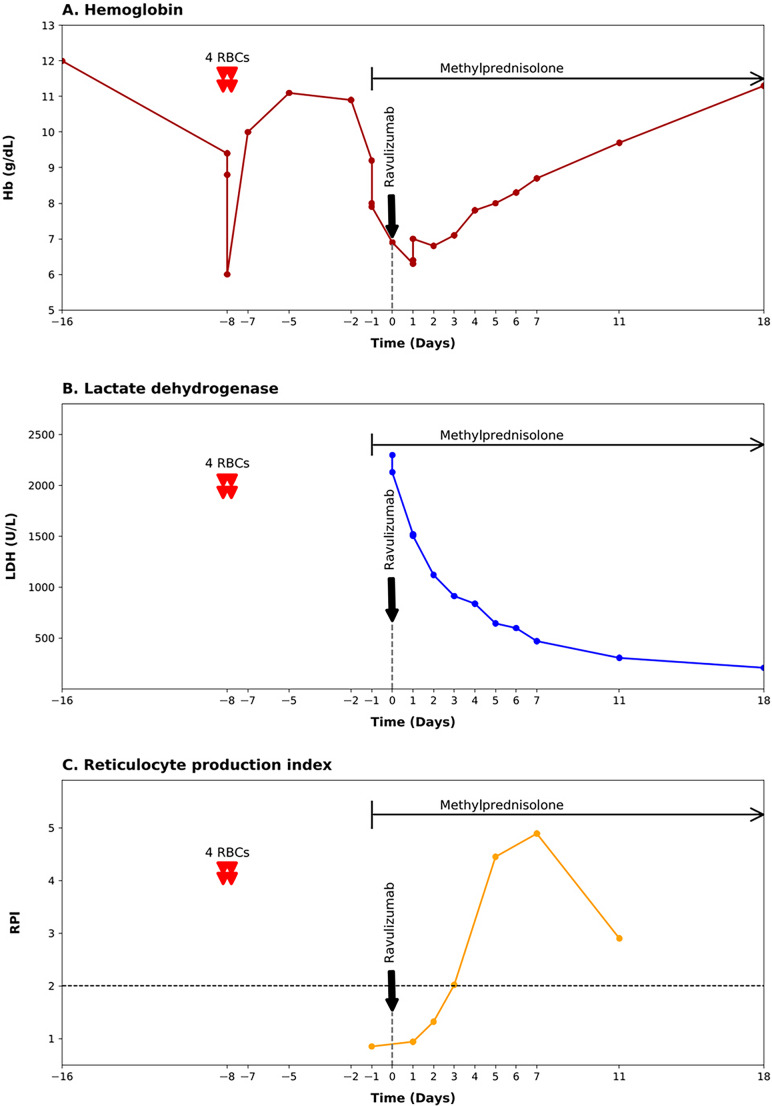 Figure 1
Peer Reviews
No public reviews on file for this paper yet. If you reviewed it on a platform where reviews are public (OpenReview, ICLR, NeurIPS, ICML), you can paste yours below so the community can read it here.
Videos
No videos yet. Explain this paper in a talk, walkthrough, or lecture? Add one.
Taxonomy
TopicsBlood groups and transfusion · Complement system in diseases · Hemoglobinopathies and Related Disorders