Random Zero-Sum Dynamic Games on Infinite Directed Graphs
Luc Attia, Lyuben Lichev, Dieter Mitsche, Raimundo Saona, Bruno Ziliotto

TL;DR
This paper studies random two-player zero-sum games on infinite graphs, showing how the game's value converges as it lasts longer.
Contribution
The paper introduces new convergence rates for game values on different types of infinite graphs.
Findings
On acyclic graphs with sub-exponential expansion, game values converge exponentially as duration increases.
On infinite d-ary trees, convergence happens at a double-exponential rate.
Abstract
We consider random two-player zero-sum dynamic games with perfect information on a class of infinite directed graphs. Starting from a fixed vertex, the players take turns to move a token along the edges of the graph. Every vertex is assigned a payoff known in advance by both players. Every time the token visits a vertex, Player 2 pays Player 1 the corresponding payoff. We consider a distribution over such games by assigning i.i.d. payoffs to the vertices. On the one hand, for acyclic directed graphs of bounded degree and sub-exponential expansion, we show that, when the duration of the game tends to infinity, the value converges almost surely to a constant at an exponential rate dominated in terms of the expansion. On the other hand, for the infinite d-ary tree (that does not fall into the previous class of graphs), we show convergence at a double-exponential rate.
Genes, proteins, chemicals, diseases, species, mutations and cell lines named across the full text — each resolved to its canonical identifier and authoritative record.
Click any figure to enlarge with its caption.
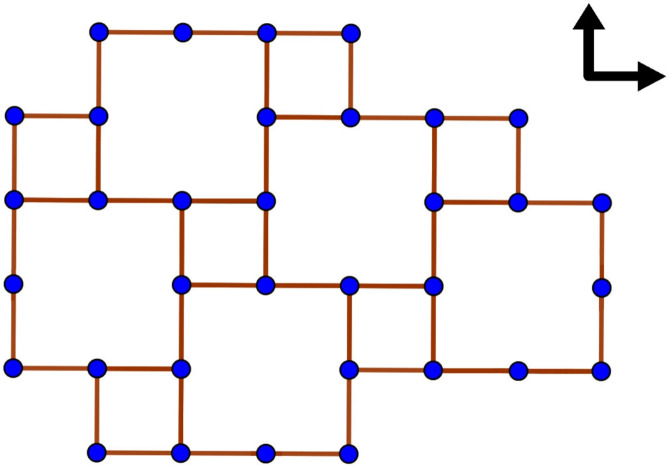 Figure 1
Peer Reviews
No public reviews on file for this paper yet. If you reviewed it on a platform where reviews are public (OpenReview, ICLR, NeurIPS, ICML), you can paste yours below so the community can read it here.
Videos
No videos yet. Explain this paper in a talk, walkthrough, or lecture? Add one.
Taxonomy
TopicsGame Theory and Applications · Game Theory and Voting Systems · Opinion Dynamics and Social Influence