Baseline risk variability by eligibility criteria in Cohort 1 of the monarchE trial for high-risk HR-positive, HER2-negative breast cancer
Mai Hoshino, Tatsunori Shimoi, Taro Yamanaka, Rui Kitadai, Munehiro Ito, Ayumi Saito, Shosuke Kita, Asuka Kawachi, Hitomi Sumiyoshi Okuma, Aiko Maejima, Yuki Kojima, Kazuki Sudo, Emi Noguchi, Yasuhiro Fujiwara, Jun Kato, Kan Yonemori

TL;DR
This study shows that high-risk breast cancer patients in the monarchE trial have varying recurrence risks based on specific criteria, which could help tailor treatment.
Contribution
The study identifies distinct prognostic differences among high-risk breast cancer subgroups in the monarchE trial criteria.
Findings
5-year iDFS rates varied significantly across subgroups, with ≥N2 having the lowest at 77.3%.
N1 + G3, ≥N2, and neoadjuvant chemotherapy were identified as poor prognostic factors.
The study emphasizes the need for individualized risk assessment to optimize treatment benefits.
Abstract
Baseline recurrence risk increasingly guides adjuvant endocrine therapy for hormone receptor (HR)-positive, human epidermal growth factor receptor 2 (HER2)-negative early breast cancer (BC). The monarchE trial demonstrated the benefits of adding abemaciclib to endocrine therapy for high-risk patients. However, differences in baseline recurrence risks within monarchE Cohort 1 subgroups and their impact on absolute benefit remain unclear. This study assessed these prognostic differences. We retrospectively analysed 989 patients with HR-positive, and HER2-negative BC who underwent surgery between January 2017 and August 2019 at our institution. Patients were categorised into four groups: non-eligible (not meeting monarchE criteria), N1 + >5 cm (1–3 lymph node metastases with tumours >5 cm), N1 + G3 (1–3 lymph node metastases with Grade 3 tumours), and ≥N2 (≥4 lymph node metastases).…
Genes, proteins, chemicals, diseases, species, mutations and cell lines named across the full text — each resolved to its canonical identifier and authoritative record.
Click any figure to enlarge with its caption.
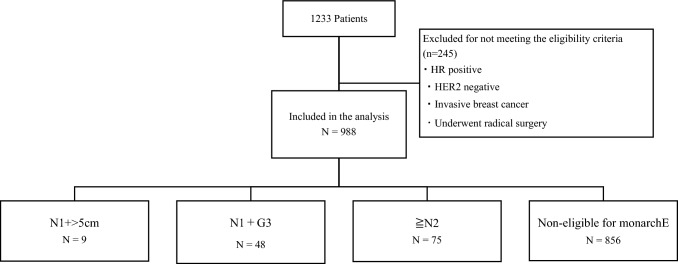 Figure 1
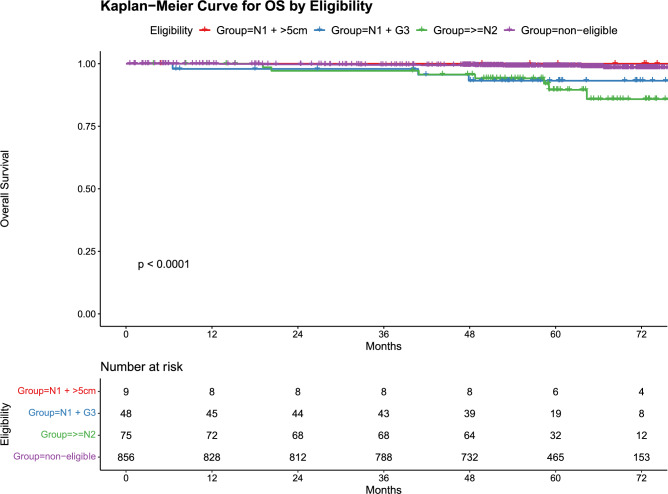 Figure 2
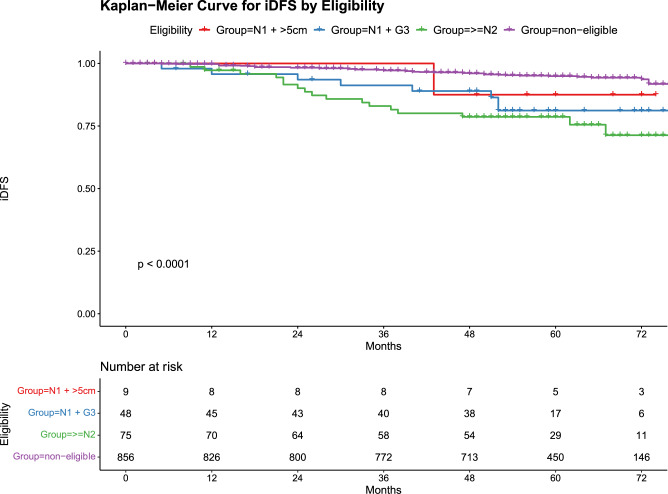 Figure 3
Peer Reviews
No public reviews on file for this paper yet. If you reviewed it on a platform where reviews are public (OpenReview, ICLR, NeurIPS, ICML), you can paste yours below so the community can read it here.
Videos
No videos yet. Explain this paper in a talk, walkthrough, or lecture? Add one.
Taxonomy
TopicsAdvanced Breast Cancer Therapies · Breast Cancer Treatment Studies · HER2/EGFR in Cancer Research