Impact of best response to ibrutinib plus Bendamustine and rituximab on PFS in MCL: a secondary analysis of SHINE
Yuko Mishima, Daigo Hashimoto, Michiko Ichii, Noriko Fukuhara, Toshiki Uchida, Koji Kato, Ai Omi, Yosuke Koroki, Kaname Shiga, Dai Maruyama

TL;DR
This study found that achieving a complete response in mantle cell lymphoma treatment is linked to longer survival, and adding ibrutinib improves chances of a complete response.
Contribution
The study shows that complete response, not just treatment type, strongly impacts long-term survival in mantle cell lymphoma patients.
Findings
Patients achieving complete response had significantly longer progression-free survival than those with partial or stable disease.
Ibrutinib plus BR increased the likelihood of complete response compared to placebo plus BR.
Long-term benefits were observed in patients who achieved complete response regardless of treatment arm.
Abstract
Ibrutinib is a first-in-class oral inhibitor of Bruton’s tyrosine kinase, which was investigated for the first-line treatment of mantle cell lymphoma (MCL) in the randomized, double-blind, phase 3 SHINE study. In SHINE, ibrutinib plus bendamustine and rituximab (BR) demonstrated superior progression-free survival (PFS) versus placebo plus BR in patients aged ≥ 65 years with previously untreated stage II–IV MCL. In this secondary efficacy analysis of SHINE, we assessed the correlation between best response and PFS (n = 523; 70% male; median age 71.0 years). After a median follow-up of 94.5 months, patients achieving complete response (CR) had longer median PFS in the ibrutinib (97.8 months) and placebo (87.9 months) arms than those with partial response (PR; 27.6 and 16.7 months, respectively) or progressive/stable disease (2.9 and 3.4 months, respectively). In the multivariate logistic…
Genes, proteins, chemicals, diseases, species, mutations and cell lines named across the full text — each resolved to its canonical identifier and authoritative record.
Click any figure to enlarge with its caption.
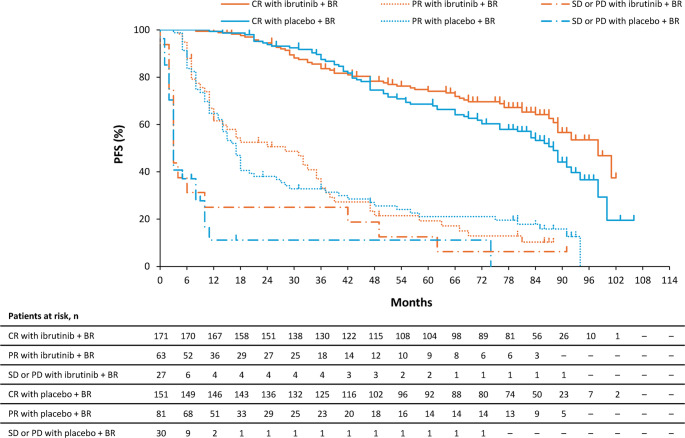 Figure 1
Peer Reviews
No public reviews on file for this paper yet. If you reviewed it on a platform where reviews are public (OpenReview, ICLR, NeurIPS, ICML), you can paste yours below so the community can read it here.
Videos
No videos yet. Explain this paper in a talk, walkthrough, or lecture? Add one.
Taxonomy
TopicsChronic Lymphocytic Leukemia Research · Lymphoma Diagnosis and Treatment · Chronic Myeloid Leukemia Treatments