Conventional partial pancreatoduodenectomy versus an uncinate first, extended partial pancreatoduodenectomy approach for the resection of pancreatic head cancer: the randomized, controlled PancER trial
Patrick Heger, Markus K. Diener, Manuel Feißt, Matthias M. Gaida, Christina Klose, Phillip Knebel, Rosa Klotz, Colette Dörr-Harim, André L. Mihaljevic

TL;DR
This study compares two surgical approaches for pancreatic cancer and finds that a more radical procedure does not significantly improve cancer removal rates but is being used to develop an even more extensive technique.
Contribution
The study introduces a more radical PD approach along the SMA and serves as pilot data for a new TRIANGLE operation trial.
Findings
Extended PD increased R0 resection rates by 10% but not significantly.
Extended PD led to more reported diarrhea symptoms after 30 days.
The TRIANGLE operation is now being evaluated based on this trial's findings.
Abstract
After pancreatoduodenectomy (PD) due to pancreatic cancer, recurrence is frequent in almost half of the patients. The rate of R0 resections is associated with the probability of local recurrence and overall survival. A potential intervention to improve the rate of R0 resections is a more radical resection along the superior mesenteric artery (SMA); however, randomized data of such an approach are lacking. Therefore, we conducted the randomized, controlled PancER trial to evaluate the effect of an extended PD compared with conventional PD. Patients were randomized to either an extended PD consisting of a modified Kocher maneuver with partial resection of the prerenal fascia, an uncinate process first approach with systematic mesopancreatic dissection along the SMA equivalent to level III dissection according to Inoue, or conventional PD. The primary endpoint, rate of R0 resections, and…
Genes, proteins, chemicals, diseases, species, mutations and cell lines named across the full text — each resolved to its canonical identifier and authoritative record.
Click any figure to enlarge with its caption.
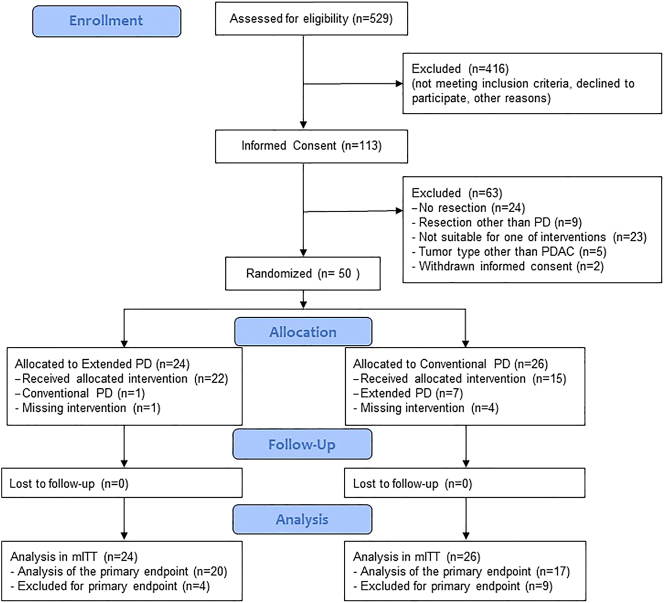 Figure 1
Peer Reviews
No public reviews on file for this paper yet. If you reviewed it on a platform where reviews are public (OpenReview, ICLR, NeurIPS, ICML), you can paste yours below so the community can read it here.
Videos
No videos yet. Explain this paper in a talk, walkthrough, or lecture? Add one.
Taxonomy
TopicsPancreatic and Hepatic Oncology Research · Neuroendocrine Tumor Research Advances · Renal cell carcinoma treatment