Illuminating calcium and potassium dynamics with red fluorescent sensors
Lan Geng, Yulong Li

TL;DR
New red fluorescent sensors allow better tracking of calcium and potassium in living brains.
Contribution
Development of red fluorescent genetically encoded indicators for calcium and potassium.
Findings
Red fluorescent indicators for calcium and potassium were engineered.
These indicators extend the optical toolkit for studying ion dynamics in the brain.
Abstract
A pair of recent studies in PLOS Biology introduces red fluorescent genetically encoded indicators for calcium and potassium, extending the optical toolkit for tracking these essential signals in the living brain. Despite recent advances in green genetically encoded ion indicators, developments in red-shifted indicators have been slower. This Primer explores two recent studies in PLOS Biology that engineer red fluorescent indicators for visualizing potassium and calcium ion dynamics in culture and in vivo.
Genes, proteins, chemicals, diseases, species, mutations and cell lines named across the full text — each resolved to its canonical identifier and authoritative record.
Click any figure to enlarge with its caption.
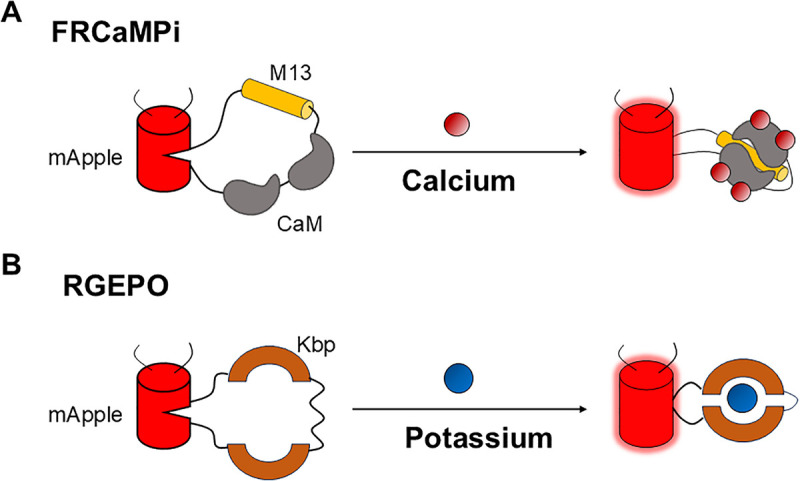 Figure 1
Peer Reviews
No public reviews on file for this paper yet. If you reviewed it on a platform where reviews are public (OpenReview, ICLR, NeurIPS, ICML), you can paste yours below so the community can read it here.
Videos
No videos yet. Explain this paper in a talk, walkthrough, or lecture? Add one.
Taxonomy
TopicsAdvanced biosensing and bioanalysis techniques · Photoreceptor and optogenetics research · Advanced Fluorescence Microscopy Techniques