Paradoxical Hyperreactivity in Bilateral Carotid Stenosis as a Potential Mechanism for Convexity Subarachnoid Hemorrhage: A Case Report
Matteo Paolucci, Giacomo Urbinati, Ludovica Migliaccio, Simone Galluzzo, Mauro Gentile, Stefano Merolla, Luana Gentile, Salvatore Isceri, Laura Piccolo, Luigi Simonetti, Andrea Zini

TL;DR
A patient with severe carotid artery narrowing had a rare type of brain bleed, possibly due to unusual blood vessel overreactivity, which improved after treatment.
Contribution
This case report presents paradoxical hyperreactivity as a novel potential mechanism for convexity subarachnoid hemorrhage in carotid stenosis.
Findings
Bilateral carotid stenosis was associated with paradoxical hyperreactivity in cerebral vasoreactivity.
Vasoreactivity normalized after stenting, suggesting a compensatory mechanism for chronic hypoperfusion.
Hyperreactivity may have contributed to the subarachnoid hemorrhage in this patient.
Abstract
While internal carotid artery (ICA) stenosis is typically linked to ischemic stroke, some patients may present with convexity subarachnoid haemorrhage (cSAH). Usually, carotid stenosis leads to decreased vasoreactivity due to chronic hypoperfusion; an exhausted reactivity has been proposed as a causative mechanism for cSAH in these patients. We present a case of cSAH with paradoxically increased vasoreactivity. A 65-year-old male presented with a headache and was diagnosed with bilateral cSAH and severe bilateral ICA stenosis (right near-occlusion, 85% left). MRI showed recent small asymptomatic ischemic lesions in the left hemisphere. Pre-stenting transcranial Doppler (TCD) revealed marked asymmetry in cerebral flow velocities (left > right) and a blunted waveform on the right MCA. Vasoreactivity testing demonstrated bilateral hyperreactivity (breath-holding index (BHI) >2.5). The…
Genes, proteins, chemicals, diseases, species, mutations and cell lines named across the full text — each resolved to its canonical identifier and authoritative record.
Click any figure to enlarge with its caption.
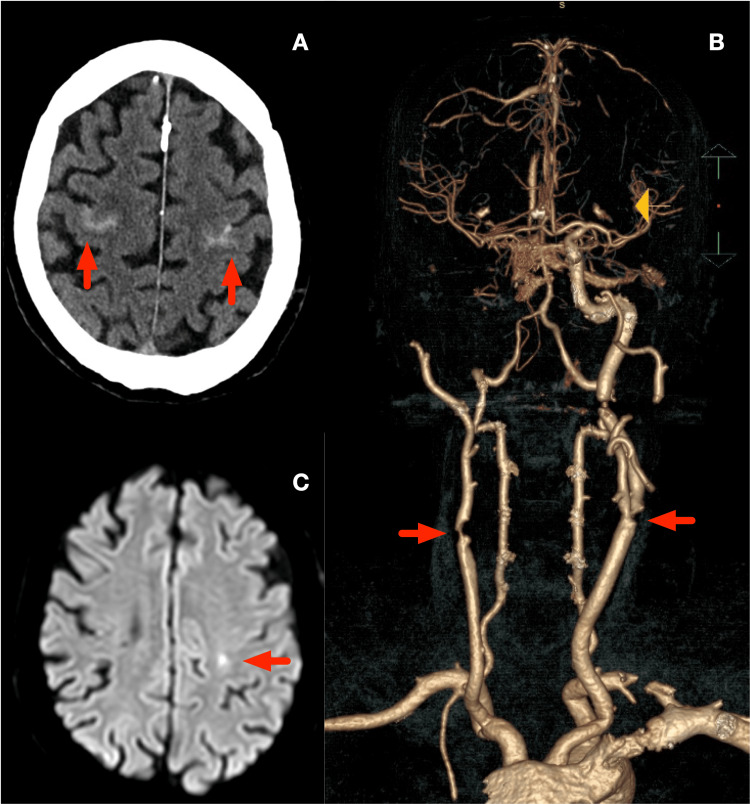 Figure 1
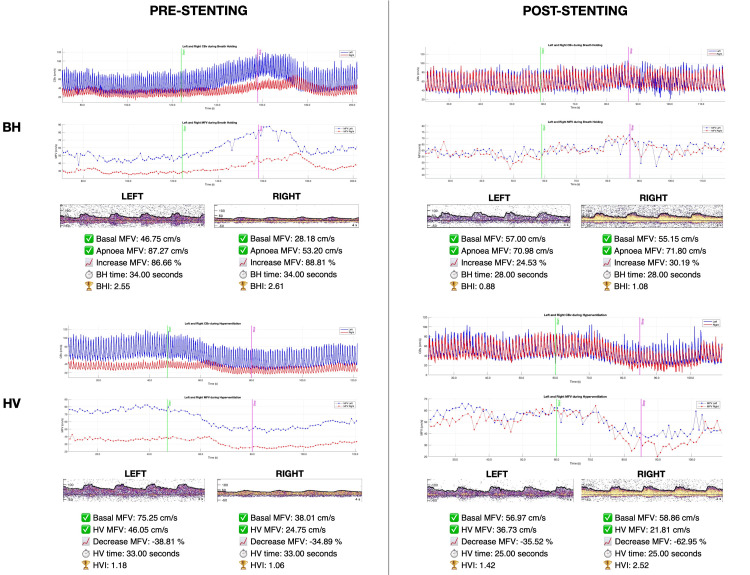 Figure 2
Peer Reviews
No public reviews on file for this paper yet. If you reviewed it on a platform where reviews are public (OpenReview, ICLR, NeurIPS, ICML), you can paste yours below so the community can read it here.
Videos
No videos yet. Explain this paper in a talk, walkthrough, or lecture? Add one.
Taxonomy
TopicsIntracranial Aneurysms: Treatment and Complications · Cerebrovascular and Carotid Artery Diseases · Acute Ischemic Stroke Management