High-performance room-temperature molecular switches enabled by resonant tunnelling in dithia-porphyrins
Kavita Garg, Nikshay Bisht, Praveen C. Ramamurthy

TL;DR
Researchers developed a new type of molecular switch using dithia-porphyrins that works reliably at room temperature, offering better performance and stability than traditional designs.
Contribution
Core-modified dithia-porphyrins are introduced as a new design paradigm for room-temperature molecular switches with enhanced performance and stability.
Findings
N2S2-porphyrins exhibit room-temperature bistable I–V behavior with ON/OFF ratios >20.
The modified porphyrins show narrow SET thresholds (∼0.6 V) and stability over 1000 cycles.
DFT–NEGF calculations confirm the superiority of core-modified dithia-porphyrins over conventional porphyrins.
Abstract
Achieving stable and reproducible single-molecule switches at room temperature remains a key challenge in molecular electronics. Conventional porphyrins, while attractive for their conjugated framework and versatile redox chemistry, often exhibit wide HOMO–LUMO gaps, weaker electrode coupling, and unstable redox states, limiting their switching performance. Here, we demonstrate that core-modified 21,23-dithia-porphyrins (N2S2-porphyrins) overcome these limitations by introducing sulfur atoms into the porphyrin core. This strategic modification lowers the HOMO–LUMO gap (better conduction), enhances orbital coupling with soft Hg electrodes, and, most importantly, stabilizes redox states that act as reliable molecular switching centers. When integrated as self-assembled monolayers on silicon, N2S2-porphyrins produce small-area MMS junctions that exhibit room-temperature bistable I–V…
Genes, proteins, chemicals, diseases, species, mutations and cell lines named across the full text — each resolved to its canonical identifier and authoritative record.
Click any figure to enlarge with its caption.
 Figure 1
 Figure 2
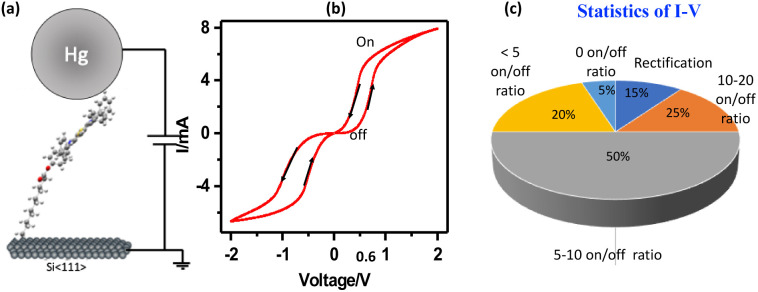 Figure 3
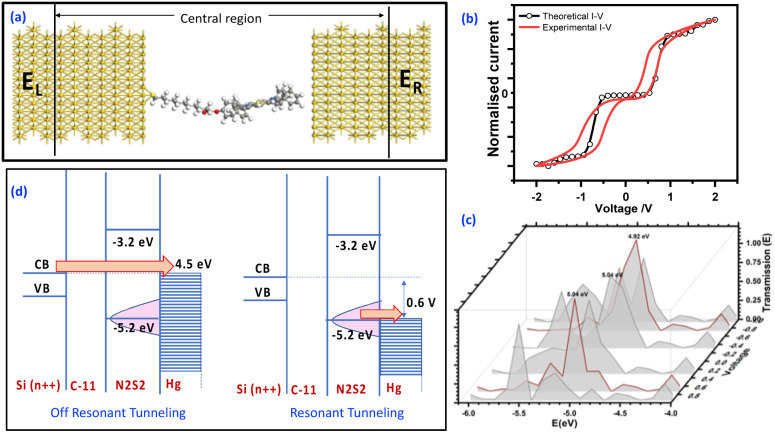 Figure 4
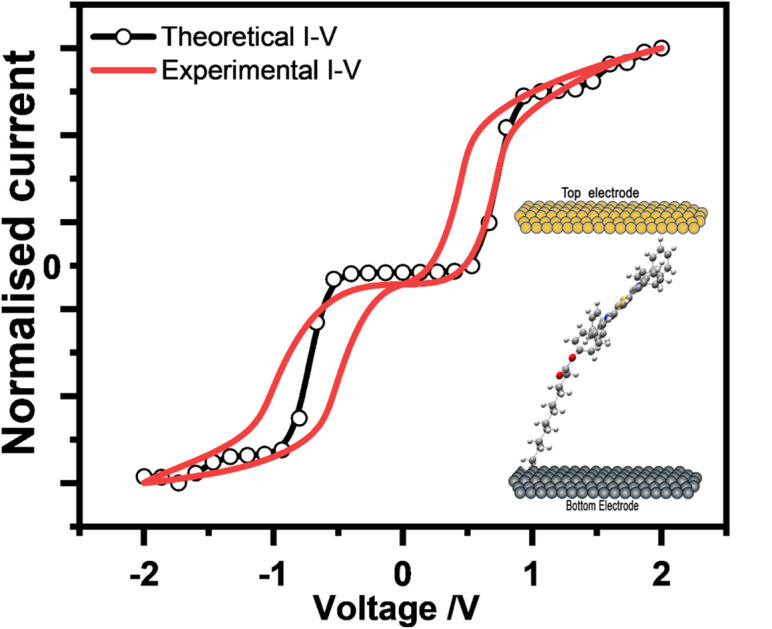 Figure 5
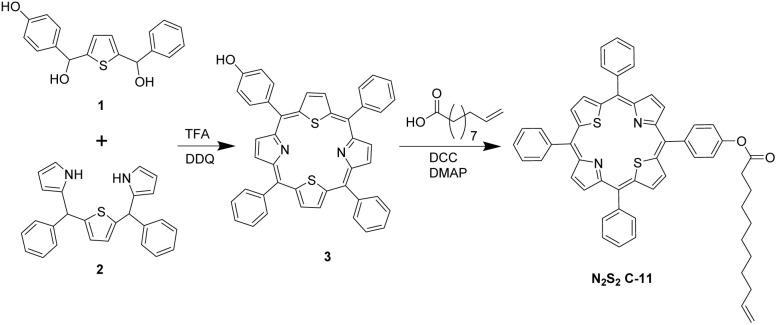 Figure 6
Peer Reviews
No public reviews on file for this paper yet. If you reviewed it on a platform where reviews are public (OpenReview, ICLR, NeurIPS, ICML), you can paste yours below so the community can read it here.
Videos
No videos yet. Explain this paper in a talk, walkthrough, or lecture? Add one.
Taxonomy
TopicsMolecular Junctions and Nanostructures · Photoreceptor and optogenetics research · Mechanical and Optical Resonators