Comparative evaluation of normal tissue objective functions in robotic radiosurgery planning for solitary brain tumors
Nadine Sonntag, Markus Eichner, Michael Judge, Martin Kocher, Daniel Ruess, Maximilian I Ruge, Stefan Hunsche

TL;DR
This study compares two planning methods for robotic radiosurgery in brain tumor treatment, finding that one reduces healthy tissue dose exposure without increasing treatment time.
Contribution
The paper introduces and evaluates a novel normal tissue objective function as an alternative to traditional Auto-shells in CyberKnife radiosurgery planning.
Findings
NTO reduced healthy brain tissue dose exposure (V12Gy and V5Gy) by up to 14% compared to Auto-shells.
For meningiomas and metastases, NTO reduced the gradient index (GI) by up to 7%.
Conformity (nCI) remained comparable between the two methods, within 2%.
Abstract
The normal tissue objective (NTO) is an inverse planning approach in radiosurgery, also available for the CyberKnife system. By employing a model function, it aims to achieve precise control over the global dose fall‐off in healthy tissue. As a novel technique, NTO can serve as an alternative to the established method, which utilizes layered contours around the target to shape dose gradients and enhance conformity, referred to as Auto‐shells in CyberKnife systems. This study compares the dose distribution achieved with NTO and Auto‐shells to evaluate their respective advantages in CyberKnife treatment planning. A total of 45 patients with brain tumors—including 15 vestibular schwannomas, 15 meningiomas, and 15 metastases, all of whom had previously been treated using an Auto‐shells‐generated plan, were analyzed. For each case, an alternative NTO‐based plan was generated and compared…
Genes, proteins, chemicals, diseases, species, mutations and cell lines named across the full text — each resolved to its canonical identifier and authoritative record.
Click any figure to enlarge with its caption.
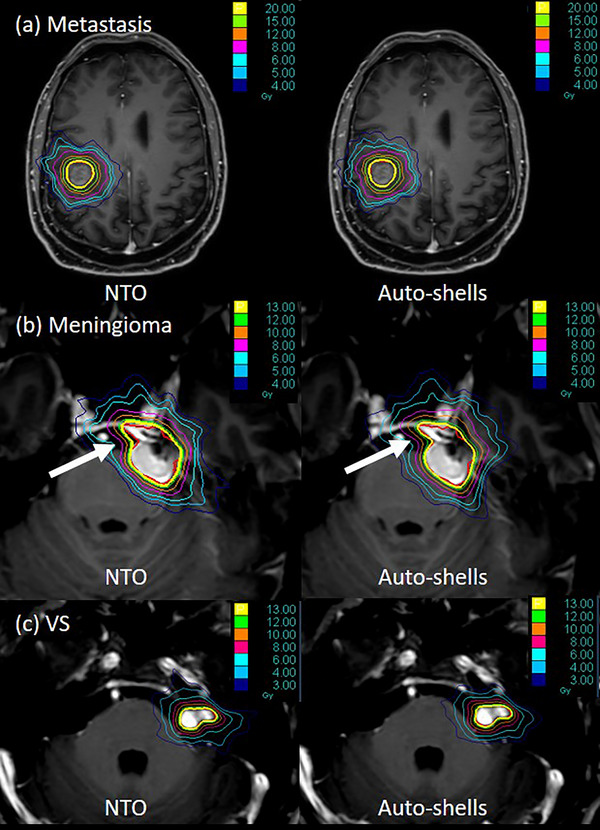 Figure 1
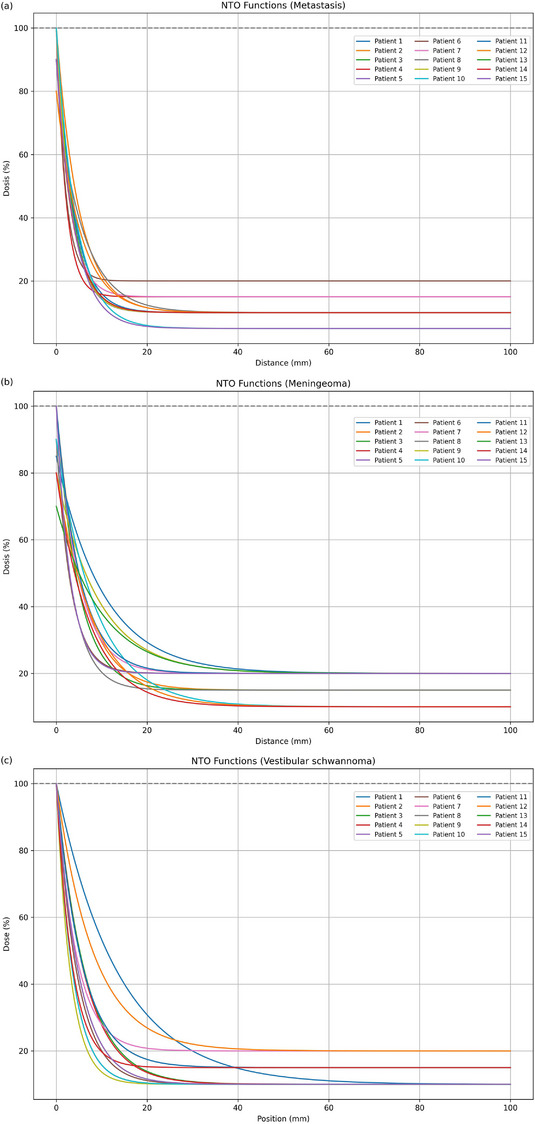 Figure 2
Peer Reviews
No public reviews on file for this paper yet. If you reviewed it on a platform where reviews are public (OpenReview, ICLR, NeurIPS, ICML), you can paste yours below so the community can read it here.
Videos
No videos yet. Explain this paper in a talk, walkthrough, or lecture? Add one.
Taxonomy
TopicsAdvanced Radiotherapy Techniques · Glioma Diagnosis and Treatment · Meningioma and schwannoma management