Chasing Waterfalls: A Cascade Mechanism to Generate Triplets from 2LMCT States
Alexandra T. Barth, Felix N. Castellano

TL;DR
This paper explores how LMCT chromophores in donor-acceptor dyads can efficiently form triplet states through an electron transfer pathway.
Contribution
The study introduces a cascade mechanism for generating triplets from 2LMCT states using earth-abundant materials.
Findings
LMCT chromophores enable efficient triplet state formation via electron transfer.
The cascade mechanism enhances the generation of triplets from 2LMCT states.
Abstract
Earth-abundant ligand-to-metal charge transfer (LMCT) chromophores in donor–acceptor dyads unlock an electron transfer pathway for efficient triplet state formation.
Genes, proteins, chemicals, diseases, species, mutations and cell lines named across the full text — each resolved to its canonical identifier and authoritative record.
Click any figure to enlarge with its caption.
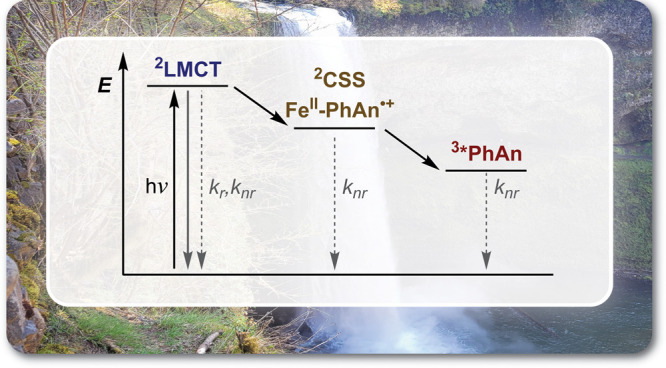 Figure 1
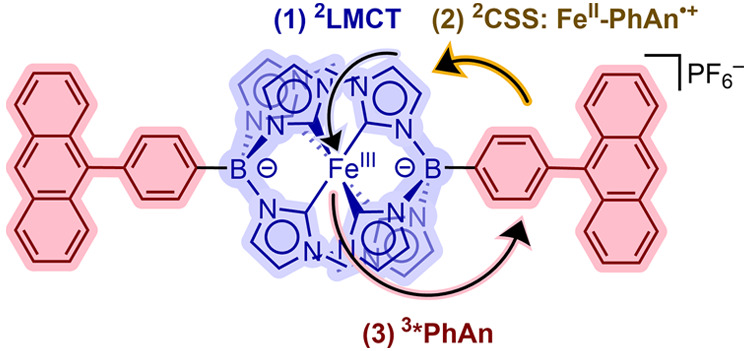 Figure 2
Peer Reviews
No public reviews on file for this paper yet. If you reviewed it on a platform where reviews are public (OpenReview, ICLR, NeurIPS, ICML), you can paste yours below so the community can read it here.
Videos
No videos yet. Explain this paper in a talk, walkthrough, or lecture? Add one.
Taxonomy
TopicsPorphyrin and Phthalocyanine Chemistry · Luminescence and Fluorescent Materials · Magnetism in coordination complexes
Light-activated molecules that generate value-added materials offer a bright alternative to nonrenewable fuels in tackling the sustainable energy crisis. However, one central challenge is identifying earth-abundant materials that can efficiently harvest solar light for difficult photochemical transformations. To address this problem, in this issue of ACS Central Science, Felix Glaser, Alejandro Cadranel, Ludovic Troian-Gautier, and co-workers offer a new strategy to utilize the short excited-state lifetimes of Fe^III^ complexes in donor–acceptor systems.? While investigating the excited state properties of Fe^III^ metal–chromophore dyads, their work reveals that chromophore triplet formation occurs through an electron transfer intermediate. This enables the intermediate state energy to be tuned through solvent selection, providing environmental control over intramolecular charge transfer efficiency and dynamics.
Long-lived photosensitizers often rely on noble metals such as Ir^III^ and Ru^II^ to efficiently harvest solar light. Synthetic approaches have broadened the availability of chromophores for photochemistry, especially by utilizing ligand-to-metal charge transfer (LMCT) activation of earth-abundant early transition metals and open-shell species. ?,? LMCT chromophores represent a growing frontier in earth-abundant photocatalysis. Among the few known examples, Fe^III^ N-heterocyclic carbenes exhibit desirable properties for photochemistry, including emissive ^2^LMCT excited states.? This chromophore class has already been shown to mediate electron transfer reactions using green light.?
The authors overcome the photophysical limitations of LMCT chromophores by developing a molecular dyad that pairs an Fe^III^ photosensitizer with an anthracene quencher. Their previous report on this molecule revealed that this dyad has improved photophysical properties when compared to the bare Fe^III^ photosensitizer, generating an 11.5 μs anthracene-localized triplet lifetime and an order-of-magnitude increase in cage escape yields.? However, their prior study assigned that a doublet-triplet energy transfer (DTET) mechanism mediates this charge reorganization.
Here, this assignment was further probed using ultrafast transient absorption spectroscopy. Instead of observing direct energy transfer from the initial *Fe^III^ state, a multistep process was revealed. After light absorption (^2^LMCT, ∼2.15 eV), ultrafast intramolecular electron transfer generates a new short-lived excited state intermediate, assigned as a charge-separated state (^2^CSS, ∼1.9–2.1 eV). This intermediate, which forms within nanoseconds, then rapidly converts into the persistent, triplet state localized onto the 9-phenylanthracene (^3^*PhAn, ∼1.8 eV) subunit, as shown in Figure. This is akin to experimental results in biological photosynthetic systems ?,? and synthetic analogues of these systems, ?,? which implicate photoinduced charge recombination in generating triplet states. The final ^3^*PhAn triplet state is nonemissive, long-lived, and chemically reactive.? While the absorption and photoluminescence emission spectra are unaffected by solvent choice, the solvent polarity influences the ^3^*PhAn formation quantum yield and ^2^CSS lifetime, implying that the ^2^CSS energy is indeed sensitive to solvent changes.
In noble metal d^6^ metal–chromophore dyads, it is typical for energy transfer to be mediated by the long-lived ^3^MLCT state, which is accessed through intersystem crossing within the MLCT manifold. For 3d metal complexes, the inaccessibility of intersystem crossing being competitive with other excited state decay processes represents a significant barrier to maintaining long-lived excited states. However, within this work, the LMCT chromophore dyad utilizes the short-lived (∼ns) excited states of the parent complex to mediate efficient electron transfer, overcoming both intermediate energy-loss pathways and diffusional limitations. This mechanism enables large quantum yields of triplet formation, ranging from 5% in acetonitrile to 75% in dichloromethane, dependent on the relative polarity of the solvent.
Instead of trying to extend the lifetimes of Fe^III^ chromophores to drive excited-state electron transfer, the current strategy enables rapid and efficient unimolecular triplet-state generation using energetically matched chromophores. While these efficiency gains hinge on direct covalent attachment, as demonstrated in this work, this result is still a major step forward toward designing tunable photosensitizers from iron, Earth’s most abundant transition metal element.
The reference list from the paper itself. Each links out to its DOI / PubMed record.
- 1Glaser F.Beneventi G. M.Cadranel A.Troian-Gautier L.Beyond Common Energy Transfer: Intramolecular Electron Transfer Cascade Controls Triplet Population of a Long-Lived Iron-Anthracene Molecular Dyad ACS Cent. Sci.2025 n/a 10.1021/acscentsci.5c 01040 · doi ↗
- 2JuliáF.Ligand-to-Metal Charge Transfer (LMCT) Photochemistry at 3d-Metal Complexes: An Emerging Tool for Sustainable Organic Synthesis Chem Cat Chem.202214 e 20220091610.1002/cctc.202200916 · doi ↗
- 3Barth A. T.Pyrch A. J.Mc Cormick C. T.Danilov E. O.Castellano F. N.Excited State Bond Homolysis of Vanadium(V) Photocatalysts for Alkoxy Radical Generation J. Phys. Chem. A 20241287609761910.1021/acs.jpca.4c 0425039213596 · doi ↗ · pubmed ↗
- 4Kjær K. S.Kaul N.Prakash O.Chábera P.Rosemann N. W.Honarfar A.Gordivska O.Fredin L. A.Bergquist K.-E.Häggström L.Ericsson T.Lindh L.Yartsev A.Styring S.Huang P.Uhlig J.Bendix J.Strand D.Sundström V.Persson P.Lomoth R.Wärnmark K.Luminescence and Reactivity of a Charge-Transfer Excited Iron Complex with Nanosecond Lifetime Science 201936324925310.1126/science.aau 716030498167 · doi ↗ · pubmed ↗
- 5Aydogan A.Bangle R. E.Cadranel A.Turlington M. D.Conroy D. T.Cauët E.Singleton M. L.Meyer G. J.Sampaio R. N.Elias B.Troian-Gautier L.Accessing Photoredox Transformations with an Iron(III) Photosensitizer and Green Light J. Am. Chem. Soc.2021143156611567310.1021/jacs.1c 0608134529421 · doi ↗ · pubmed ↗
- 6Glaser F.De Kreijger S.Troian-Gautier L.Two Birds, One Stone: Microsecond Dark Excited-State Lifetime and Large Cage Escape Yield Afforded by an Iron–Anthracene Molecular Dyad J. Am. Chem. Soc.20251478559856710.1021/jacs.4c 1716740020218 · doi ↗ · pubmed ↗
- 7Thurnauer M. C.Katz J. J.Norris J. R.The Triplet State in Bacterial Photosynthesis: Possible Mechanisms of the Primary Photo-Act Proc. Natl. Acad. Sci. U.S.A.1975723270327410.1073/pnas.72.9.327016592270 PMC 432970 · doi ↗ · pubmed ↗
- 8Leslie Dutton P.Leigh J. S.Seibert M.Primary Processes in Photosynthesis: Insitu ESR Studies on the Light Induced Oxidized and Triplet State of Reaction Center Bacteriochlorophyll BBRC 19724640641310.1016/S 0006-291X(72)80153-04333414 · doi ↗ · pubmed ↗