Downhill Danger: A Rare Case of Esophageal Varices From Hiatal Hernia-Induced Compression
Miguel E. Gomez, Harmeet Malhi, Douglas Simonetto

Abstract
Genes, proteins, chemicals, diseases, species, mutations and cell lines named across the full text — each resolved to its canonical identifier and authoritative record.
Click any figure to enlarge with its caption.
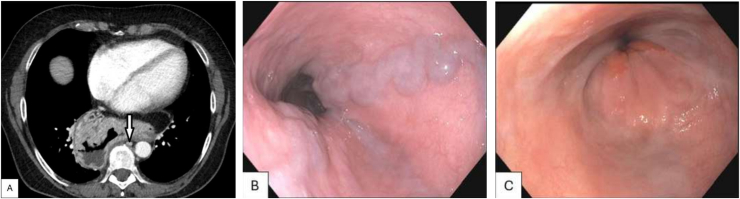 Figure 1
Peer Reviews
No public reviews on file for this paper yet. If you reviewed it on a platform where reviews are public (OpenReview, ICLR, NeurIPS, ICML), you can paste yours below so the community can read it here.
Videos
No videos yet. Explain this paper in a talk, walkthrough, or lecture? Add one.
Taxonomy
TopicsGastroesophageal reflux and treatments · Esophageal and GI Pathology · Congenital Diaphragmatic Hernia Studies
This is a 63-year-old female presenting to clinic with worsening epigastric pressure and heartburn. She had been diagnosed on esophagogastroduodenoscopy (EGD) with a large hiatal hernia and esophageal varices at an outside hospital. EGD was repeated and she was found to have 2 large columns of isolated distal esophageal varices (Figure B). Hepatic venous gradient was normal. Liver biopsy reported normal lobular architecture with minimal steatosis and no fibrosis. Additionally, pathological inflammation, Mallory-Denk Bodies, and ballooning degeneration were absent in the liver biopsy. Trichrome stain was normal. Superior vena cava obstruction was ruled out with computed tomography venogram, which showed a large hiatal hernia with extrinsic compression of the azygos vein (Figure A, demonstrated by arrow). Patient underwent robotic assisted laparoscopic paraoesophageal hernia repair with partial fundoplication with thoracic surgery for symptom management. Clinic visit after surgery showed 50% reduction in reflux and pressure-like symptoms. Repeat EGD showed significantly decreased size of varices (Figure C). Therefore, leading hypothesis on cause of her isolated esophageal varices was mass effect from her large hiatal hernia resulting in azygous vein compression.