To shock or not to shock?
Mónica Dias, Bárbara Antunes Rocha, Sérgia Rocha, Rui Files Flores

Abstract
Genes, proteins, chemicals, diseases, species, mutations and cell lines named across the full text — each resolved to its canonical identifier and authoritative record.
Click any figure to enlarge with its caption.
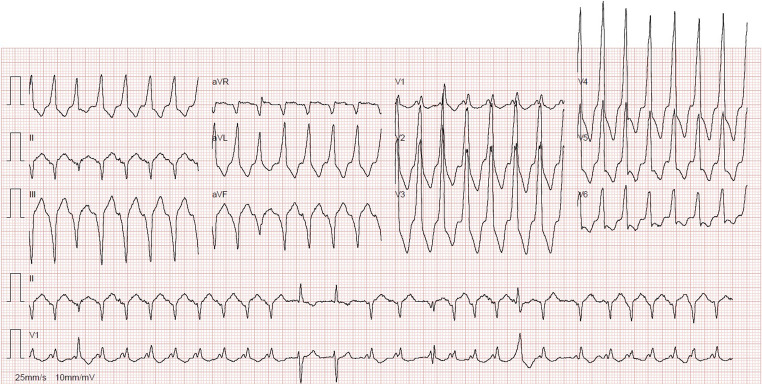 Figure 1
Peer Reviews
No public reviews on file for this paper yet. If you reviewed it on a platform where reviews are public (OpenReview, ICLR, NeurIPS, ICML), you can paste yours below so the community can read it here.
Videos
No videos yet. Explain this paper in a talk, walkthrough, or lecture? Add one.
Taxonomy
TopicsTrauma, Hemostasis, Coagulopathy, Resuscitation · Science, Research, and Medicine · Cardiac Arrest and Resuscitation
Question
A 70-year-old male patient with liver steatosis and prostatic carcinoma presented to the emergency department with pre-syncope and symptoms of congestive heart failure.
Initial evaluation revealed tachycardia, normal blood pressure, and signs of pulmonary congestion. Blood analyses showed elevated natriuretic peptides, with no other significant alterations.
A 12-lead ECG was performed (Fig. 1). What is the diagnosis, and should we shock it or not?Fig. 112-lead ECG. To shock or not to shock?
Answer
You will find the answer elsewhere in this issue.