Potential Off-Target Interaction of the Amyloid PET Imaging Tracer PiB with Acetylcholinesterase
Alberto Granzotto, Rosa Fullone, Ludovico Miccoli, Manuela Bomba, Claudia Di Marzio, Stefano Delli Pizzi, Giuseppe Floresta, Stefano L. Sensi

TL;DR
This study shows that the Alzheimer's PET tracer PiB can bind to an enzyme called acetylcholinesterase, which may affect how PiB PET scans are interpreted.
Contribution
The novel finding is that PiB interacts with acetylcholinesterase, suggesting off-target effects that could influence PET signal interpretation in Alzheimer's disease.
Findings
PiB binds to the peripheral anionic site of acetylcholinesterase with energy comparable to known ligands.
In vitro assays confirmed PiB's interaction with acetylcholinesterase, implicating the peripheral anionic site.
This off-target interaction may affect PiB-PET signal interpretation in brain regions with altered acetylcholinesterase levels.
Abstract
Pittsburgh compound B (PiB) is a widely used Positron Emission Tomography (PET) tracer for detecting amyloid-β (Aβ) deposits in Alzheimer’s disease (AD). While PiB is assumed to bind selectively to Aβ, emerging evidence suggests off-target interactions that may complicate PET signal interpretation. Here, we report that PiB can interact with acetylcholinesterase (AChE), a key enzyme in the cholinergic system. Similarity screening identified the AChE ligand thioflavin T (ThT) as the top structural analogue of PiB. Docking studies and molecular dynamics simulations showed that PiB stably binds the peripheral anionic site (PAS) of AChE, with binding energies comparable to ThT and clinically relevant AChE inhibitors. In vitro fluorescence-based assays confirmed this interaction and suggest an involvement of the PAS. These findings indicate a plausible, stable off-target interaction between…
Genes, proteins, chemicals, diseases, species, mutations and cell lines named across the full text — each resolved to its canonical identifier and authoritative record.
Click any figure to enlarge with its caption.
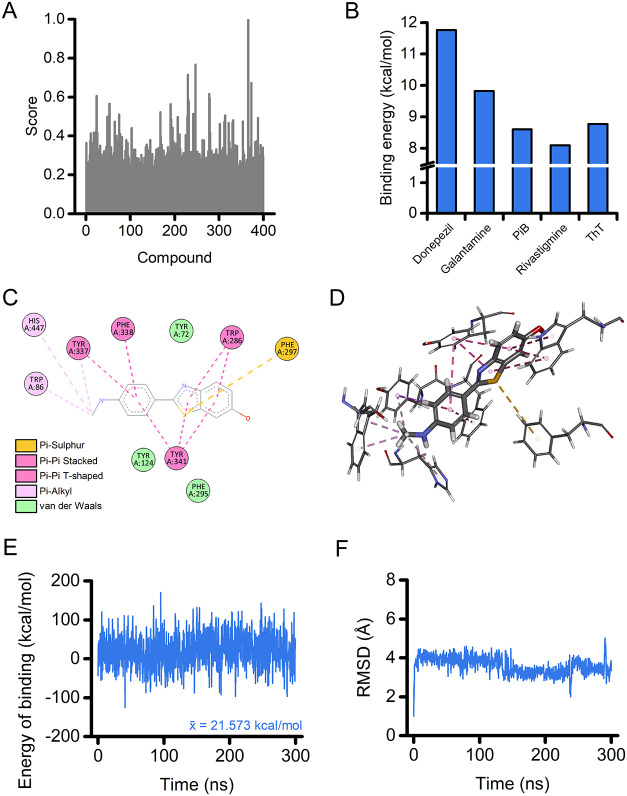 Figure 1
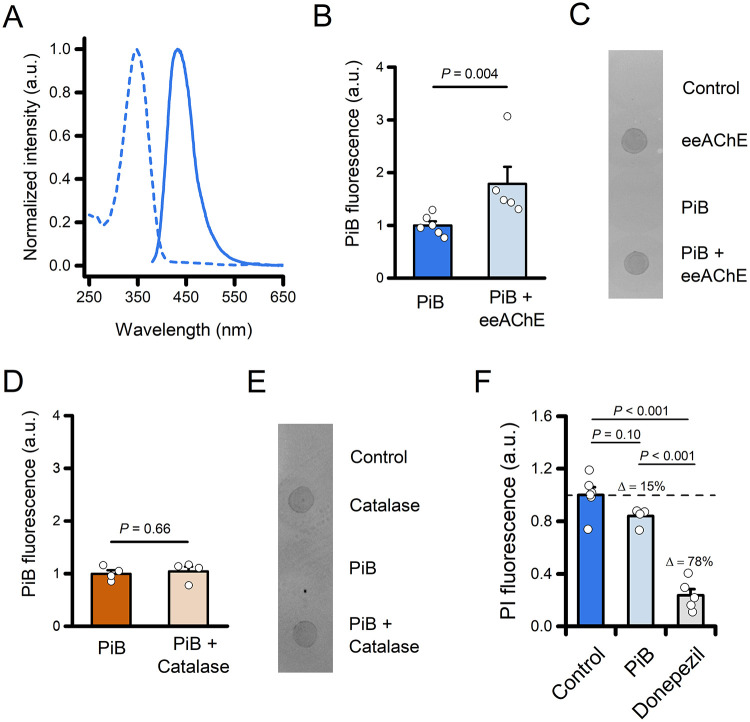 Figure 2
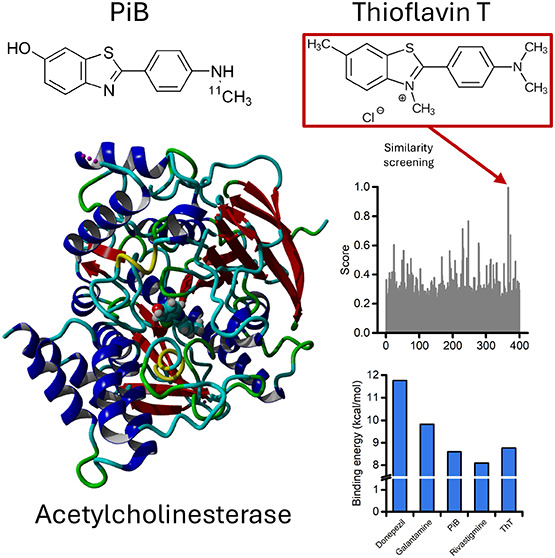 Figure 3
 Figure 4
Peer Reviews
No public reviews on file for this paper yet. If you reviewed it on a platform where reviews are public (OpenReview, ICLR, NeurIPS, ICML), you can paste yours below so the community can read it here.
Videos
No videos yet. Explain this paper in a talk, walkthrough, or lecture? Add one.
Taxonomy
TopicsComputational Drug Discovery Methods · Cholinesterase and Neurodegenerative Diseases · Alzheimer's disease research and treatments