Optimizing a C. elegans whole organism screen biased for chemicals that target the nematode clade specific receptor EAT-2
Henry Atemnkeng Nvenankeng, Jim Goodchild, Philippa Harlow, Vincent O'Connor, Lindy Holden-Dye

TL;DR
The paper describes a method to find chemicals that target a specific receptor in C. elegans, which could lead to new ways to control parasitic nematodes.
Contribution
The study introduces a screening platform focused on the EAT-2 receptor in C. elegans to identify potential nematicide compounds.
Findings
Screening for chemicals that inhibit C. elegans pharyngeal pumping in lev-1(x427) identifies lead compounds modulating EAT-2 function.
The EAT-2 receptor is a potential target for novel nematicides based on its role in nematode feeding behavior.
Abstract
Pesticides are important resources in the control of pests and pathogens of plants and animals. Unfortunately, there are concerns around their broad impacts on non-target organisms and the environment. In this study we optimize a platform biased for the nicotinic acetylcholine receptor EAT-2 , a physiological regulator of feeding in C. elegans . We show that by screening for chemicals that inhibit C. elegans pharyngeal pumping in lev-1 ( x427 ) , we can identify lead compounds that modulate EAT-2 function. This provides a motivation for further studies to investigate the role of EAT-2 in parasitic nematodes and their potential as a target for novel nematicides.
Genes, proteins, chemicals, diseases, species, mutations and cell lines named across the full text — each resolved to its canonical identifier and authoritative record.
Click any figure to enlarge with its caption.
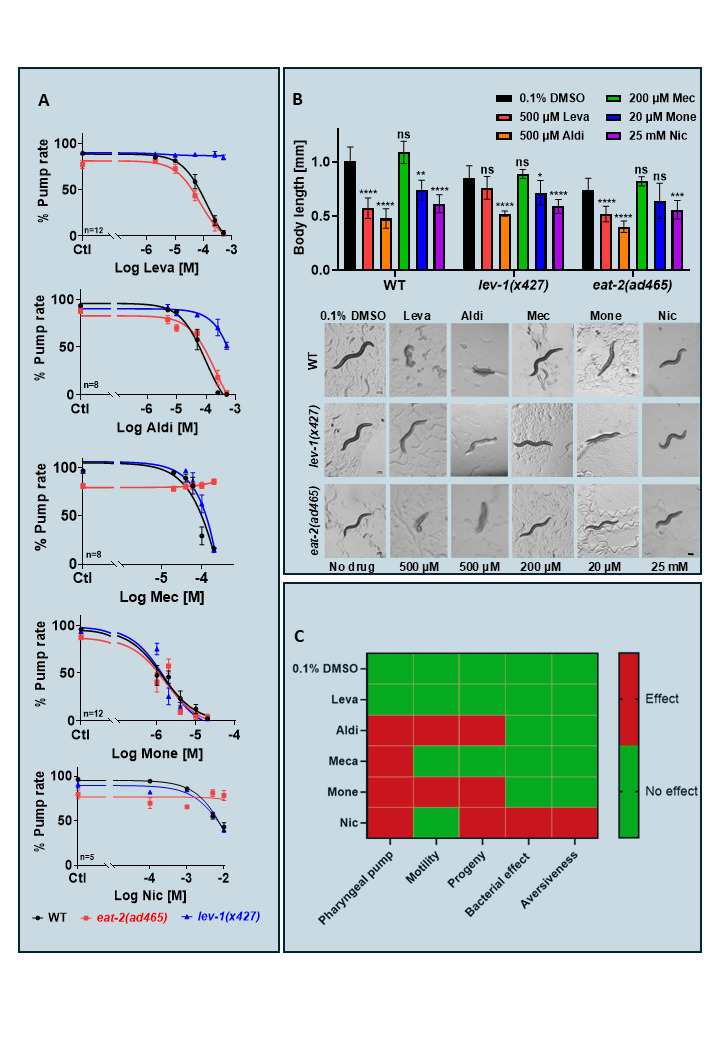 Figure 1
Peer Reviews
No public reviews on file for this paper yet. If you reviewed it on a platform where reviews are public (OpenReview, ICLR, NeurIPS, ICML), you can paste yours below so the community can read it here.
Videos
No videos yet. Explain this paper in a talk, walkthrough, or lecture? Add one.
Taxonomy
TopicsGenetics, Aging, and Longevity in Model Organisms · Nicotinic Acetylcholine Receptors Study · Receptor Mechanisms and Signaling