Assessment of Lectin Staining Biomarkers using a Murine Model of GNE Myopathy
Olivia Parker, Jordyn Woods, Max Rothkopf, Daniel Drach, Hanna N. Wetzel, Kelly E. Crowe

TL;DR
Researchers tested lectin biomarkers in a mouse model of GNE myopathy to detect sialic acid levels, finding Peanut Agglutinin as a potential tool for identifying hyposialylation.
Contribution
Identified Peanut Agglutinin as a promising lectin for detecting hyposialylation in murine GNE myopathy tissues.
Findings
No lectins effectively differentiated Gne M743T/M743T from wild type tissues.
Peanut Agglutinin showed differential binding in sialidase-treated tissues, indicating potential for detecting hyposialylation.
Abstract
GNE myopathy (GNEM) is a rare myopathy caused by mutations in the UDP-GlcNAc epimerase/ManNAc-6 kinase (GNE) gene, which reduce sialic acid (SA) biosynthesis and impair muscle through unclear mechanisms. As development of SA-restoring GNEM gene therapies is underway, it is essential to develop SA-detecting biomarkers in preclinically-relevant murine tissues. Here, we assess skeletal muscle staining of the Gne M743T/M743T GNEM model with four sialylation-detecting lectins. While no tested lectins could effectively differentiate between Gne M743T/M743T and wild type tissues, Peanut Agglutinin (PNA) showed differential binding in tissues with and without SA-removing sialidase treatment, indicating its promise in detecting hyposialylation in murine tissues.
Genes, proteins, chemicals, diseases, species, mutations and cell lines named across the full text — each resolved to its canonical identifier and authoritative record.
Click any figure to enlarge with its caption.
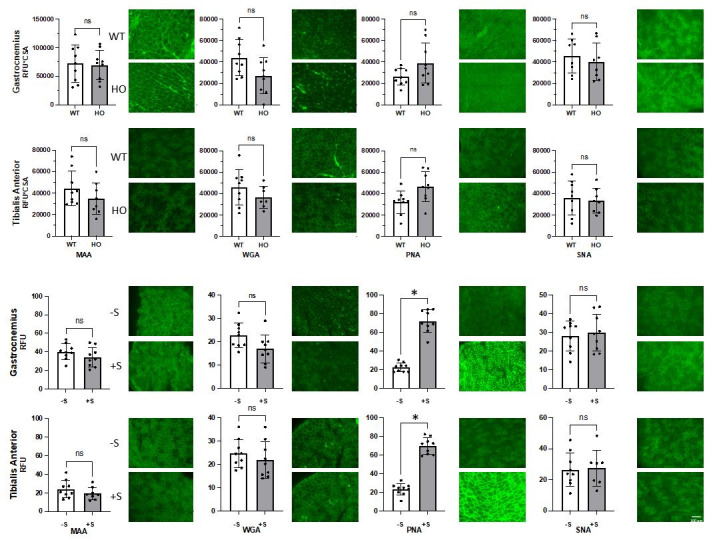 Figure 1
Peer Reviews
No public reviews on file for this paper yet. If you reviewed it on a platform where reviews are public (OpenReview, ICLR, NeurIPS, ICML), you can paste yours below so the community can read it here.
Videos
No videos yet. Explain this paper in a talk, walkthrough, or lecture? Add one.
Taxonomy
TopicsInflammatory Myopathies and Dermatomyositis · Cardiomyopathy and Myosin Studies · Glycogen Storage Diseases and Myoclonus