Variation in Small Mammal Species Composition and the Occurrence of Parasitic Mites in Two Landscapes in a Scrub Typhus Endemic Region of Western Yunnan Province, China
Yun‐Yan Luo, Jia‐Xiang Yin, Zong‐Ti Shao, Zeng‐Kan Liu, Shou‐Qin Yin, Jiang‐Li Lu, Jin‐Chun Li, Rong Wei, Alan Frederick Geater

TL;DR
This study examines how different landscapes and host species affect parasitic mite infestations in small mammals in a scrub typhus endemic region of China.
Contribution
The study identifies landscape-specific and host-specific factors influencing mite infestation prevalence and intensity in small mammals.
Findings
Infestation prevalence was higher in farmland compared to forest edge landscapes.
Adult mammals and larger body dimensions were associated with higher infestation prevalence.
Mite intensity was highest in Neotetracus sinensis and not related to host characteristics.
Abstract
Western Yunnan Province is a scrub typhus endemic region, providing optimal environments for small mammal hosts and mite vectors. This study explored the association between mite occurrence on small mammals and landscape and host characteristics in this region. Two landscapes, farmland and forest edge, in four locations in Tengchong City were sampled for capturing small mammals and collecting mites. Associations among host, vector, and landscape were analyzed using hurdle negative binomial mixed models. Among 279 small mammals captured, ninety‐five individuals were infested with a total of 8308 mites. Infestation prevalence was higher in farmland than in the forest edge. Mean mite intensity was 87.5/infested mammal. The highest mite intensity was seen in Neotetracus sinensis . Rattus tanezumi , Suncus murinus , Rattus rattus , and Mus pahari were dominant species. Differences in…
Genes, proteins, chemicals, diseases, species, mutations and cell lines named across the full text — each resolved to its canonical identifier and authoritative record.
Click any figure to enlarge with its caption.
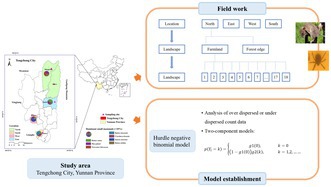 Figure 1
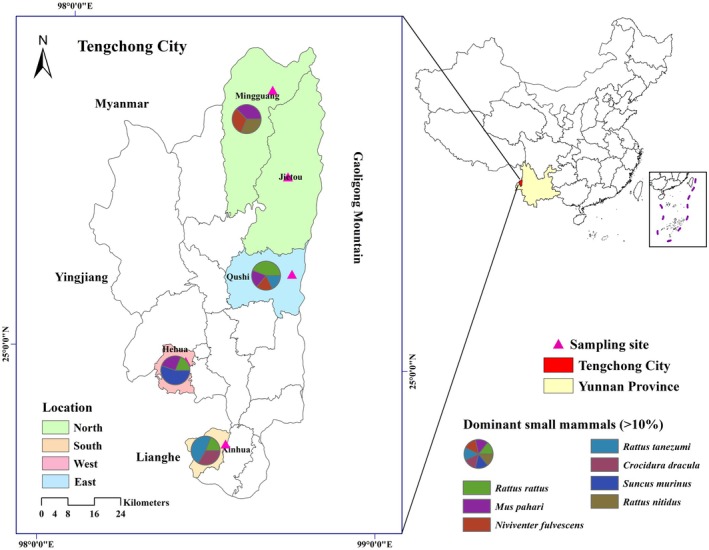 Figure 2
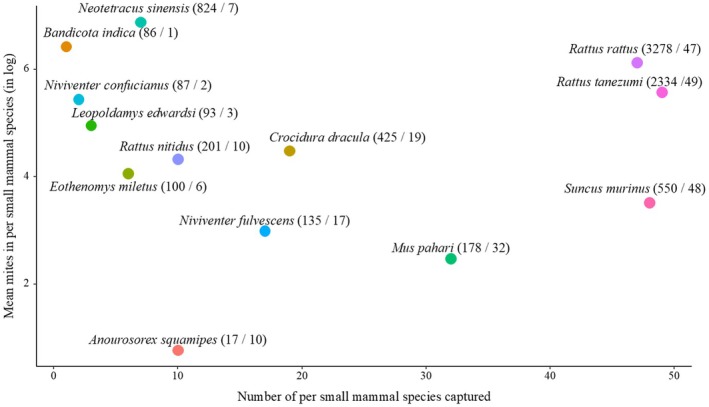 Figure 3
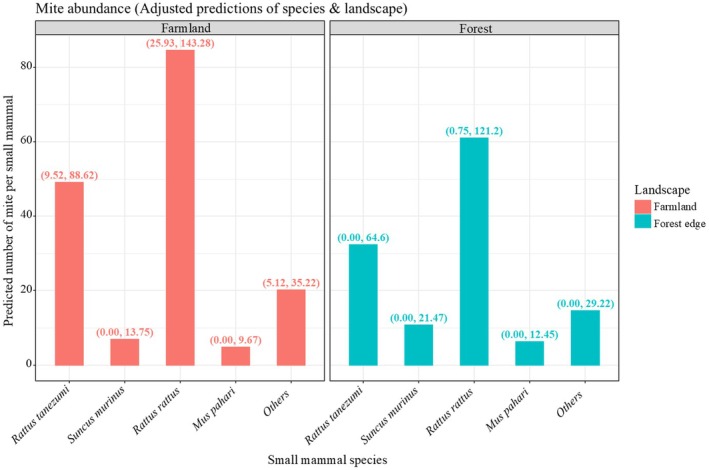 Figure 4
Peer Reviews
No public reviews on file for this paper yet. If you reviewed it on a platform where reviews are public (OpenReview, ICLR, NeurIPS, ICML), you can paste yours below so the community can read it here.
Videos
No videos yet. Explain this paper in a talk, walkthrough, or lecture? Add one.
Taxonomy
TopicsVector-borne infectious diseases · Yersinia bacterium, plague, ectoparasites research · Parasite Biology and Host Interactions