Functional mapping of auditory responses to complex sounds under light anesthesia in rhesus macaques
Régis Trapeau, Luc Renaud, Melina Cordeau, Yoan Esposito, Pascal Belin, Alix Trouillet, Kirill V Nourski, Emily Dappen, Mathilda Froesel

TL;DR
This study shows that light anesthesia preserves basic auditory processing in macaques but alters higher-order voice perception, affecting how brain regions respond to vocalizations.
Contribution
The study introduces a near-awake anesthesia protocol for fMRI that preserves primary auditory function while revealing altered higher-order processing in vocalization-sensitive regions.
Findings
Primary and belt auditory cortices showed robust activation to complex sounds under anesthesia.
Voice-sensitive responses in anterior temporal voice areas were absent, but emerged in ventral premotor and prefrontal cortices.
Anesthetized fMRI is suitable for studying basic auditory functions but may not capture higher-order voice perception accurately.
Abstract
We investigated the auditory responses of anesthetized rhesus macaques to complex natural sounds using functional magnetic resonance imaging (fMRI) and a near-awake anesthesia protocol combining low-dose sevoflurane and dexmedetomidine. Eleven animals were scanned while listening to macaque vocalizations and non-vocal sounds. Robust activation was observed in primary and belt auditory cortices as well as subcortical structures, indicating preserved auditory responsiveness under anesthesia. However, unlike in awake animals, selective responses to vocalizations in anterior temporal voice areas (aTVAs) were absent. Instead, vocalization sensitivity emerged in the ventral premotor cortex, prefrontal cortex, and posterior middle temporal gyrus, regions associated with the dorsal auditory stream and multisensory integration. These findings suggest that while anesthesia preserves basic…
Genes, proteins, chemicals, diseases, species, mutations and cell lines named across the full text — each resolved to its canonical identifier and authoritative record.
Click any figure to enlarge with its caption.
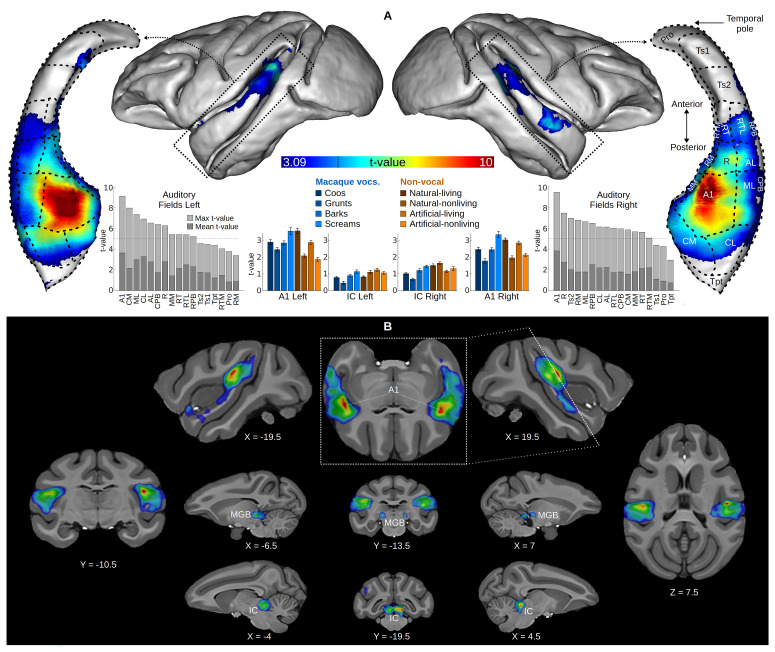 Figure 1
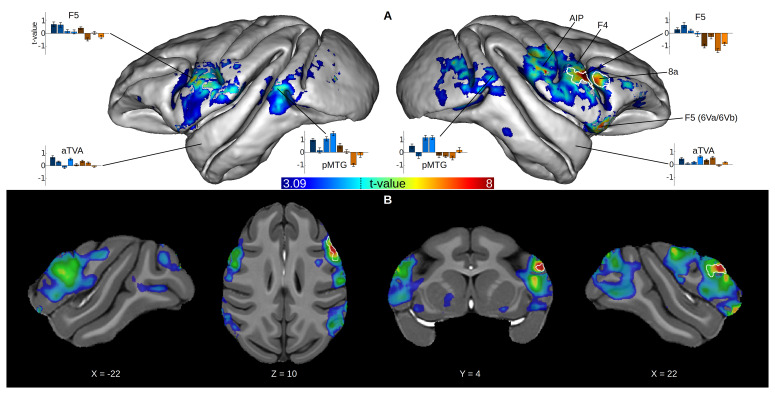 Figure 2
Peer Reviews
No public reviews on file for this paper yet. If you reviewed it on a platform where reviews are public (OpenReview, ICLR, NeurIPS, ICML), you can paste yours below so the community can read it here.
Videos
No videos yet. Explain this paper in a talk, walkthrough, or lecture? Add one.
Taxonomy
TopicsNeural dynamics and brain function · Multisensory perception and integration · Neuroscience and Music Perception