Children's Judgments of Possibility Align With Their Judgments of Actuality
Mopreet Pabla, Andrew Shtulman, Ori Friedman

TL;DR
Young children often judge immoral or improbable events as both impossible and not having happened, suggesting they use consistent reasoning for possibility and actuality.
Contribution
The study shows children's possibility denials are consistent with their judgments of actuality, indicating a unified reasoning process.
Findings
Children aged 4–7 judged immoral events as both impossible and nonactual.
Responses to improbable events were mostly negative across possibility and actuality judgments.
Children's possibility denials reflect genuine reasoning, not just question interpretation quirks.
Abstract
Children often say that possible events are impossible, and only gradually come to see these events as possible. For instance, they often deny that people could do unusual things, like own a pet peacock, or immoral things, like stealing or lying. These possibility denials are surprising. For instance, children have first‐hand experience with the very moral violations they say are impossible. In two experiments (total N = 220), we provide evidence that children's possibility denials can nonetheless be taken at face value and do not merely arise from quirks in how children understand questions about possibility. We do this by showing that these denials also arise in children's judgments of actuality—their judgments about what has actually happened and about which assertions of actual events could be true. In Experiment 1, children aged 4–7 judged whether ordinary, immoral, and improbable…
Genes, proteins, chemicals, diseases, species, mutations and cell lines named across the full text — each resolved to its canonical identifier and authoritative record.
Click any figure to enlarge with its caption.
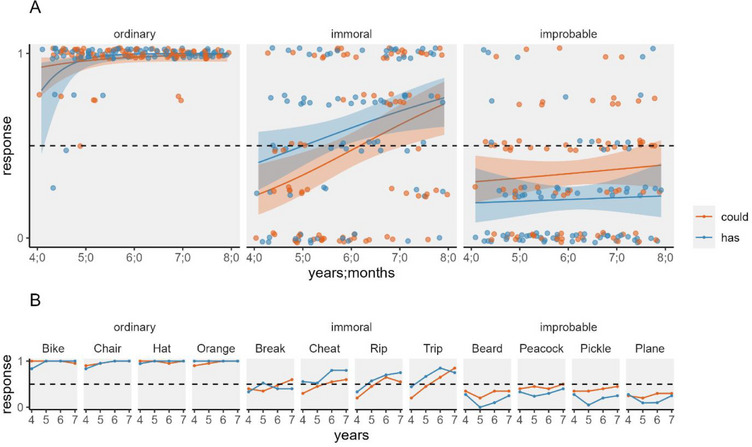 Figure 1
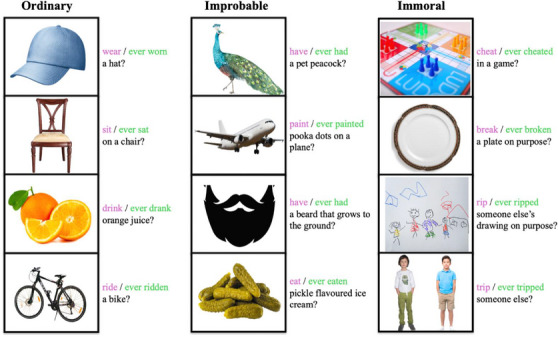 Figure 2
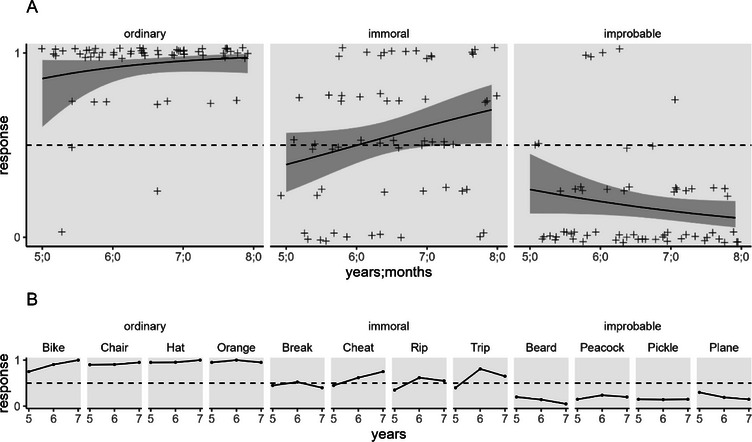 Figure 3
Peer Reviews
No public reviews on file for this paper yet. If you reviewed it on a platform where reviews are public (OpenReview, ICLR, NeurIPS, ICML), you can paste yours below so the community can read it here.
Videos
No videos yet. Explain this paper in a talk, walkthrough, or lecture? Add one.
Taxonomy
TopicsPsychology of Moral and Emotional Judgment · Child and Animal Learning Development · Misinformation and Its Impacts