Increased dipeptidyl peptidase 4 in patients with concomitant transthyretin cardiac amyloidosis and severe aortic stenosis
Margrethe Flesvig Holt, Annika E. Michelsen, August Flø, Kristoffer Russell, Jan Otto Beitnes, Sophie Foss Kløve, Anders Hodt, Lars Gullestad, Pål Aukrust, Einar Gude, Kaspar Broch, Thor Ueland

TL;DR
This study found that higher levels of DPP4 in the blood may help identify patients with both aortic stenosis and ATTR-CM, and are linked to better heart function.
Contribution
The study identifies DPP4 as a potential biomarker for detecting ATTR-CM in patients with severe aortic stenosis.
Findings
DPP4 levels were significantly higher in patients with both ATTR-CM and aortic stenosis compared to those with only aortic stenosis or healthy controls.
Lower DPP4 levels were associated with worse heart function and more severe aortic stenosis symptoms.
High DPP4 levels were linked to better cardiac function in all aortic stenosis patients, regardless of ATTR-CM status.
Abstract
Due to overlapping symptoms and signs, it can be challenging to diagnose transthyretin amyloid cardiomyopathy (ATTR-CM) in the setting of concomitant aortic stenosis. Biomarkers may discriminate between heart failure with ATTR-CM and heart failure without ATTR-CM, but it is not known if these markers can differentiate between AS with and AS without concomitant ATTR-CM. In 9 patients with ATTR-CM and AS, 161 patients with lone AS, and 23 healthy controls, we measured 8 plasma proteins previously identified by proteomic analysis as potential candidates for diagnosing ATTR-CM. We assessed differences between groups and association with indices of heart failure and AS severity. Plasma levels of dipeptidyl peptidase 4 (DPP4) were significantly higher in patients with AS and ATTR-CM than in patients with lone AS and in healthy controls. Lower levels of DPP4 were also associated with worse…
Genes, proteins, chemicals, diseases, species, mutations and cell lines named across the full text — each resolved to its canonical identifier and authoritative record.
Click any figure to enlarge with its caption.
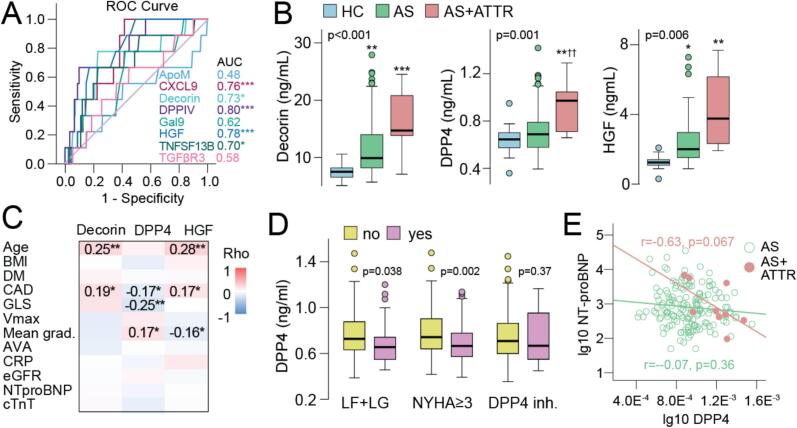 Figure 1
Peer Reviews
No public reviews on file for this paper yet. If you reviewed it on a platform where reviews are public (OpenReview, ICLR, NeurIPS, ICML), you can paste yours below so the community can read it here.
Videos
No videos yet. Explain this paper in a talk, walkthrough, or lecture? Add one.
Taxonomy
TopicsPeptidase Inhibition and Analysis · Diabetes Treatment and Management · Cardiovascular Function and Risk Factors