Analytical and numerical properties of an extended angiogenesis PDEs model
Pasquale De Luca, Livia Marcellino

TL;DR
This paper introduces a new mathematical model for tumor angiogenesis that includes oxygen dynamics and proves its mathematical properties.
Contribution
The novel contribution is extending an angiogenesis model with oxygen dynamics and proving its mathematical properties.
Findings
The model establishes existence, uniqueness, and boundedness of solutions.
A stable numerical scheme with convergence properties is developed.
Numerical experiments show biologically plausible vascular formation regulated by oxygen.
Abstract
This paper presents an extended mathematical model for tumor angiogenesis incorporating oxygen dynamics as a main regulator. We enhance a five-component PDE system describing endothelial cells, proteases, inhibitors, extracellular matrix, and oxygen concentration, with a focus on their spatiotemporal interactions. We establish existence, uniqueness, and boundedness of solutions through a mathematical analysis. A numerical scheme using method of lines and fourth-order Runge-Kutta methods is developed, with proven stability constraints and convergence properties. Numerical experiments demonstrate biologically plausible vascular formation with oxygen-mediated regulation.
Genes, proteins, chemicals, diseases, species, mutations and cell lines named across the full text — each resolved to its canonical identifier and authoritative record.
Click any figure to enlarge with its caption.
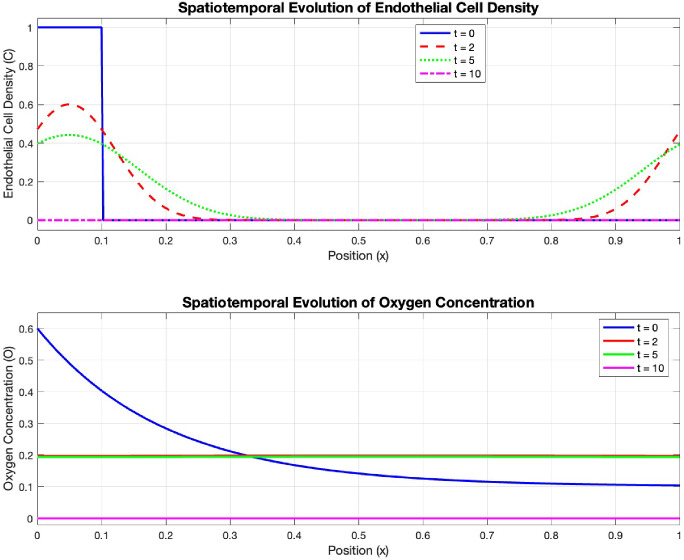 Figure 1
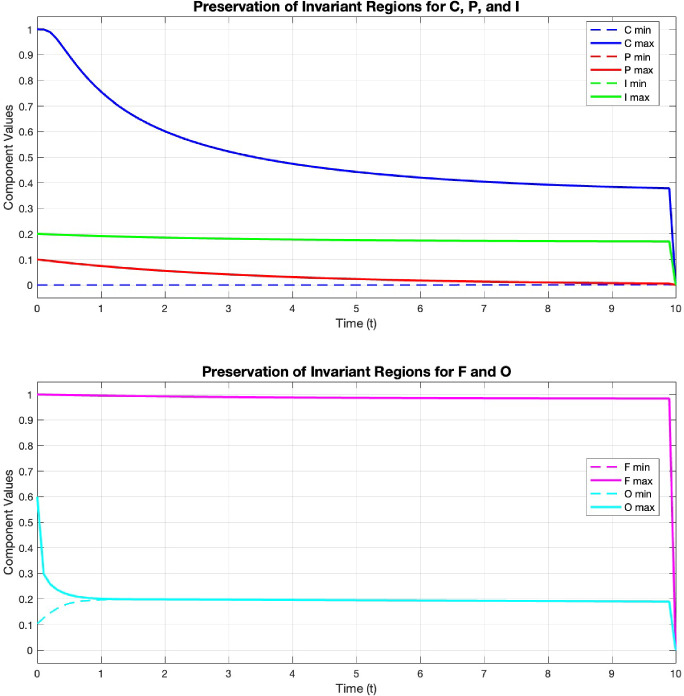 Figure 2
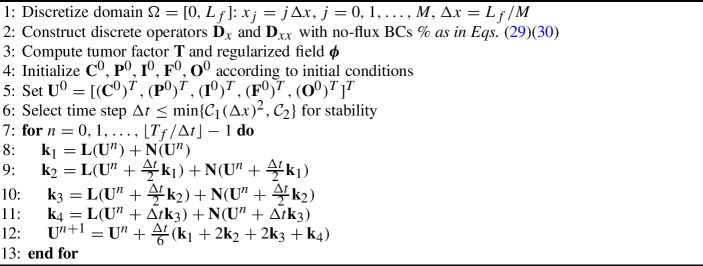 Figure 3
Peer Reviews
No public reviews on file for this paper yet. If you reviewed it on a platform where reviews are public (OpenReview, ICLR, NeurIPS, ICML), you can paste yours below so the community can read it here.
Videos
No videos yet. Explain this paper in a talk, walkthrough, or lecture? Add one.
Taxonomy
TopicsMathematical Biology Tumor Growth · Kruppel-like factors research · Angiogenesis and VEGF in Cancer