Adult Type II diastematomyelia with tethered cord and associated spinal anomalies: A case report
Sachchu Thapa, Bijay Kunwar, Anup Ghimire, Atul Mainali, Pujan Pandey, Jagdish Kunwar, Roshna Adhikari

TL;DR
A 23-year-old man with a rare spinal condition called Type II diastematomyelia and related anomalies is reported, highlighting the importance of MRI in diagnosis and management.
Contribution
This case report presents a rare adult instance of complex spinal dysraphism with multiple coexisting anomalies and minimal symptoms.
Findings
Type II diastematomyelia with tethered cord and neural lipoma was diagnosed via MRI in an asymptomatic adult.
The patient had a complex combination of spinal anomalies including hemimyelocele and dorsal dermal sinus tract.
Conservative management was chosen despite the radiological complexity, with no neurological deterioration observed.
Abstract
Spinal dysraphism consists a group of congenital anomalies due to defective neural tube closure, among which diastematomyelia or split cord malformation is rare. Split cord malformation is classified into Type I and Type II, with Type II being less common and often asymptomatic. These anomalies may coexist with various spinal anomalies, as tethered cord, neural lipoma, hemimyelocele, and dorsal dermal sinus, forming a complex spectrum. Adult presentations are particularly uncommon and usually incidental. We herein report a 23-year-old male with chronic low back pain and a congenital midline lumbar swelling. Neurological examination and routine investigations were unremarkable. Magnetic resonance imaging revealed Type II diastematomyelia with two hemicords within a single dural sac from L4 to L5, low-lying conus medullaris, hemimyelocele with neural lipoma at L5-S1, tethered cord with…
Genes, proteins, chemicals, diseases, species, mutations and cell lines named across the full text — each resolved to its canonical identifier and authoritative record.
Click any figure to enlarge with its caption.
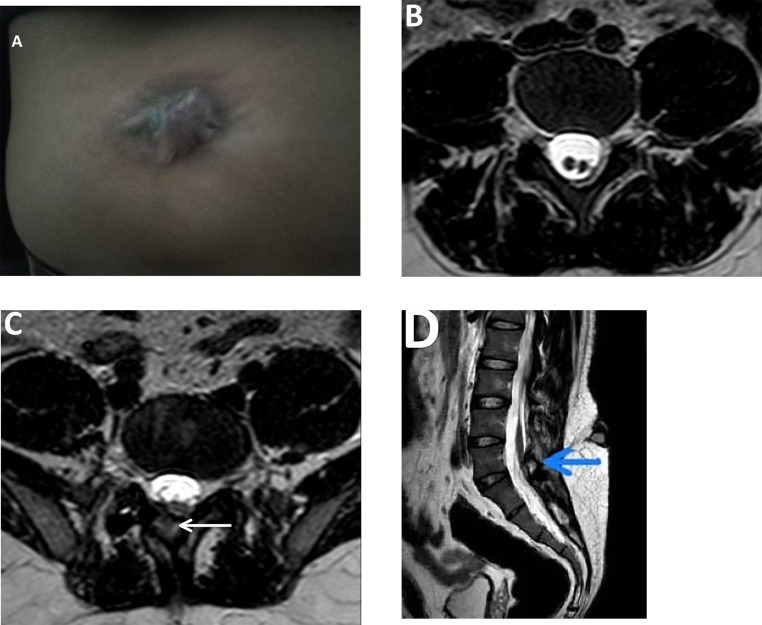 Figure 1
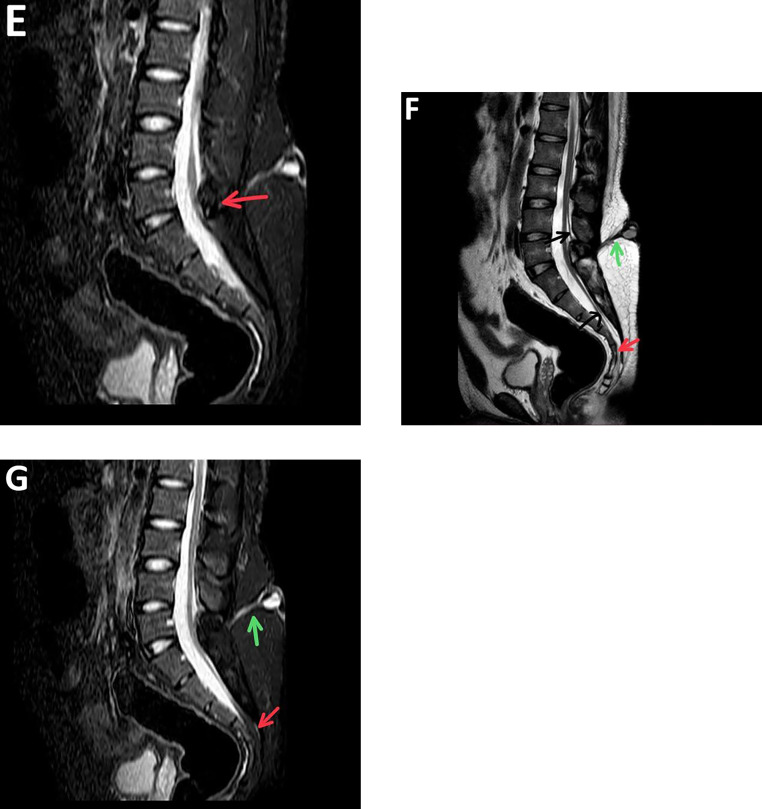 Figure 2
Peer Reviews
No public reviews on file for this paper yet. If you reviewed it on a platform where reviews are public (OpenReview, ICLR, NeurIPS, ICML), you can paste yours below so the community can read it here.
Videos
No videos yet. Explain this paper in a talk, walkthrough, or lecture? Add one.
Taxonomy
TopicsSpinal Dysraphism and Malformations · Cerebrospinal fluid and hydrocephalus · Assisted Reproductive Technology and Twin Pregnancy