The use of artificial intelligence in the prevention and management of bleeding disorders: a systematic review
Fathima Raahima Riyas Mohamed, Ziyad Aldabbagh, Wael Kalou, Khaled Hamsho, Anwar Aldabbagh, Adel Kalou, Muhammad Raihan Sajid

TL;DR
This paper reviews how artificial intelligence can improve the diagnosis and treatment of bleeding disorders like hemophilia and ITP by using machine learning models to predict disease severity and personalize care.
Contribution
The study systematically evaluates AI applications in bleeding disorders, highlighting novel uses of machine learning for early detection and treatment optimization.
Findings
AI models using genetic and clinical data show improved diagnostic accuracy for bleeding disorders.
Variables like Factor VIII activity and patient history enhance risk assessment and treatment planning.
Challenges include dataset fragmentation and limited model validation in real-world settings.
Abstract
Bleeding disorders, including hemophilia, von Willebrand disease (VWD), and immune thrombocytopenia (ITP), pose significant diagnostic and therapeutic challenges due to their heterogeneous presentations and complex underlying mechanisms. Traditional diagnostic methods rely on clinical assessments and laboratory tests, which can be time-consuming and prone to misdiagnosis, particularly in resource-limited settings. Artificial intelligence (AI) has emerged as a transformative tool in healthcare, leveraging machine learning (ML) algorithms and predictive analytics to enhance diagnostic accuracy, risk stratification, and personalized treatment approaches. This systematic review explores the role of AI in the prevention, diagnosis, and management of bleeding disorders. Specifically, it assesses AI-driven models in identifying key predictors, optimizing risk assessment, and improving…
Genes, proteins, chemicals, diseases, species, mutations and cell lines named across the full text — each resolved to its canonical identifier and authoritative record.
Click any figure to enlarge with its caption.
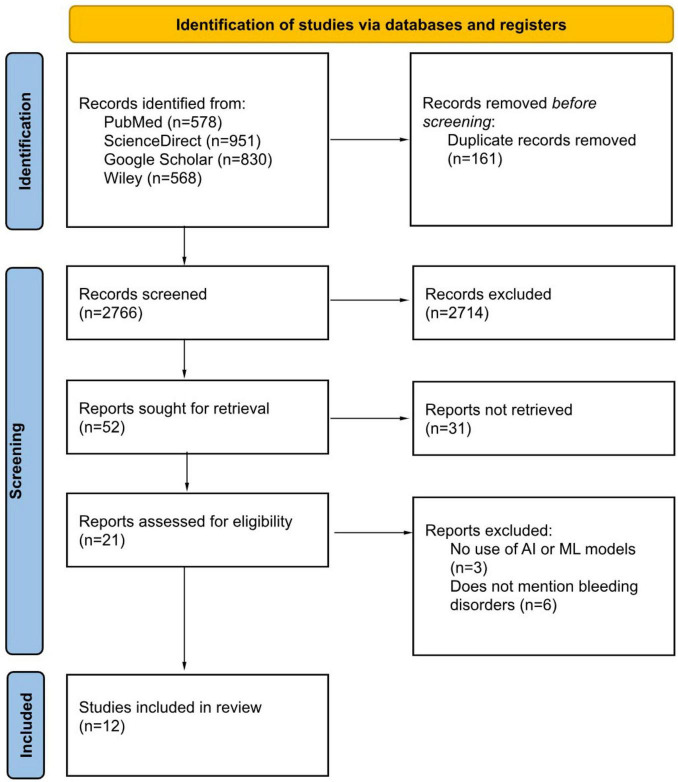 Figure 1
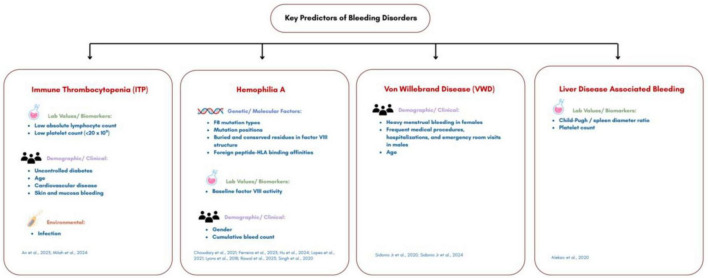 Figure 2
Peer Reviews
No public reviews on file for this paper yet. If you reviewed it on a platform where reviews are public (OpenReview, ICLR, NeurIPS, ICML), you can paste yours below so the community can read it here.
Videos
No videos yet. Explain this paper in a talk, walkthrough, or lecture? Add one.
Taxonomy
TopicsHeparin-Induced Thrombocytopenia and Thrombosis · Platelet Disorders and Treatments · Imbalanced Data Classification Techniques