Substitution of ifosfamide for cyclophosphamide in the TI-CE regimen: pharmacology and dose justification in a patient with refractory metastatic germ-cell tumor post-nephrectomy—A case report
Lotte M. G. Hulskotte, Loek A. W. de Jong, Alwin D. R. Huitema, Joost Sijm, Ingrid Desar, Minke Smits, Nielka P. van Erp

TL;DR
A patient with a kidney tumor successfully underwent a modified chemotherapy regimen that replaced a harmful drug to protect their remaining kidney.
Contribution
This case report demonstrates cyclophosphamide as a viable and less nephrotoxic substitute for ifosfamide in the TI-CE regimen for patients post-nephrectomy.
Findings
The TC-CE regimen achieved sufficient stem cell harvest and normalized tumor markers in a post-nephrectomy patient.
Renal function remained stable and no tumor remnants were detected two months post-treatment.
One year after therapy, the patient showed no signs of disease recurrence.
Abstract
High-dose chemotherapy (HDCT) combined with autologous stem cell transplantation (ASCT) rescue is an effective treatment option for relapsed or refractory germ-cell tumors. The TI-CE regimen, consisting of paclitaxel and ifosfamide for stem cell mobilization followed by high dose carboplatin and etoposide with ASCT rescue, is frequently used in the treatment of refractory disease. This regimen is challenging in patients who have undergone unilateral nephrectomy, since potential nephrotoxicity of ifosfamide poses a serious risk for permanent damage of the preserved kidney. Currently, the literature lacks data on the substitution of ifosfamide in the TI-CE regimen for an alternative chemotherapeutic agent with equivalent potency while being less nephrotoxic. We present a case of a patient with refractory progressive metastatic germ-cell tumor who underwent nephrectomy and was…
Genes, proteins, chemicals, diseases, species, mutations and cell lines named across the full text — each resolved to its canonical identifier and authoritative record.
Click any figure to enlarge with its caption.
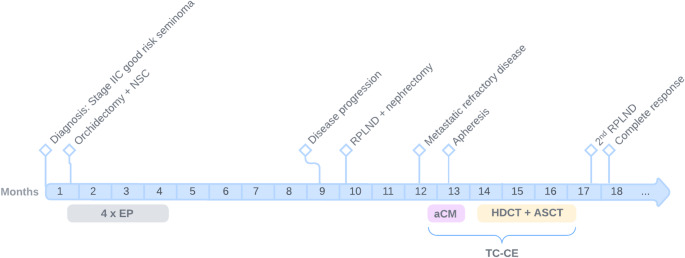 Figure 1
Peer Reviews
No public reviews on file for this paper yet. If you reviewed it on a platform where reviews are public (OpenReview, ICLR, NeurIPS, ICML), you can paste yours below so the community can read it here.
Videos
No videos yet. Explain this paper in a talk, walkthrough, or lecture? Add one.
Taxonomy
TopicsChemotherapy-induced organ toxicity mitigation · Testicular diseases and treatments · Hematopoietic Stem Cell Transplantation