Correlation of tear cortisol levels with morphological and biomechanical parameters of keratoconus
Xiaorui Zhao, Tong Sun, Yifei Yuan, Yu Zhang, Yueguo Chen, Jing Hong

TL;DR
This study finds that tear cortisol levels are higher in people with keratoconus and correlate with specific corneal changes, suggesting a possible role in the disease's development.
Contribution
The study identifies a novel correlation between tear cortisol levels and corneal parameters in keratoconus, offering new insights into its pathogenesis.
Findings
Tear cortisol levels were significantly higher in keratoconus patients compared to controls.
Tear cortisol positively correlated with several corneal parameters like BAD-D, IS-value, and KI.
Tear cortisol negatively correlated with central and thinnest corneal thickness.
Abstract
Keratoconus (KC) is a vision-threatening corneal disorder predominantly affecting young males, significantly impairing their quality of life. We aim to evaluate tear cortisol levels in KC and compare with controls, and to determine the correlation of tear cortisol levels with morphological and biomechanical parameters of KC. Age- and sex-matched 42 eyes of 42 patients were enrolled. The levels of tear cortisol were obtained by liquid chromatography–tandem mass spectrometry. Pentacam HR and Corvis ST II were used to detect the corneal morphological and biomechanical parameters. Spearman correlations between tear cortisol levels and corneal parameters were calculated for all patients. Comparing with the control group, the level of tear cortisol significantly increased in the KC group (1660.95 [1175.01–2408.81] vs. 945.60 [550.36–1699.32], p = 0.023). It was positively correlated with…
Genes, proteins, chemicals, diseases, species, mutations and cell lines named across the full text — each resolved to its canonical identifier and authoritative record.
Click any figure to enlarge with its caption.
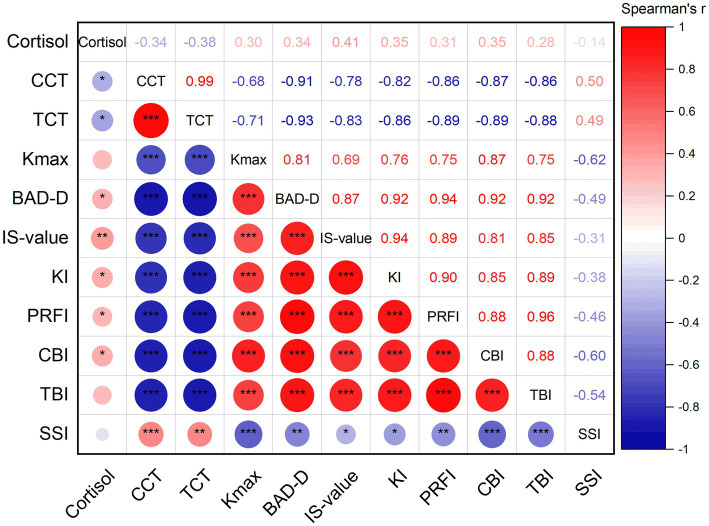 Figure 1
Peer Reviews
No public reviews on file for this paper yet. If you reviewed it on a platform where reviews are public (OpenReview, ICLR, NeurIPS, ICML), you can paste yours below so the community can read it here.
Videos
No videos yet. Explain this paper in a talk, walkthrough, or lecture? Add one.
Taxonomy
TopicsCorneal surgery and disorders · Ocular Surface and Contact Lens · Glaucoma and retinal disorders