The hidden costs of automation: does robot adoption affect children’s mental health?
Yueqing Zou, Jiaxin Wang, Liang Wang

TL;DR
This study explores how robot adoption in the workplace may negatively affect children's mental health through increased academic pressure and reduced family interactions.
Contribution
The study introduces new evidence that automation's effects extend to children's mental health, mediated by labor market competition and family dynamics.
Findings
A one-standard deviation increase in robot adoption raises the likelihood of severe depression in Chinese children by 0.75 percentage points.
Adverse effects are mediated by heightened academic pressure and reduced positive parent-child interactions.
The negative impact is stronger for girls and children in urban areas.
Abstract
Industrial automation is profoundly transforming the labor market, yet it may also impose hidden costs beyond economic outcomes. In particular, heightened labor market competition caused by robot adoption may create intergenerational costs, such as adverse effects on children’s mental health. This study combines survey data from the 2012-2020 China Family Panel Studies with robot data from the International Federation of Robotics to investigate the impact of automation on the mental health of Chinese children. To address endogeneity concerns, we construct an instrumental variable for domestic robot adoption using U.S. robot data and employ a two-stage least squares (2SLS) approach. The findings reveal that a one-standard deviation increase in robot adoption (0.414 robots per thousand workers) increases the likelihood of severe depression among Chinese children by 0.75 percentage…
Genes, proteins, chemicals, diseases, species, mutations and cell lines named across the full text — each resolved to its canonical identifier and authoritative record.
Click any figure to enlarge with its caption.
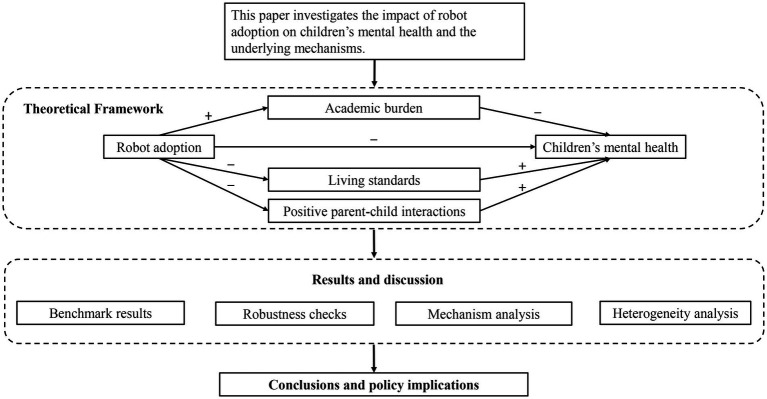 Figure 1
Peer Reviews
No public reviews on file for this paper yet. If you reviewed it on a platform where reviews are public (OpenReview, ICLR, NeurIPS, ICML), you can paste yours below so the community can read it here.
Videos
No videos yet. Explain this paper in a talk, walkthrough, or lecture? Add one.
Taxonomy
TopicsPsychological Well-being and Life Satisfaction · Employment and Welfare Studies