The relationship between college students’ autonomous fitness behavior and mental health literacy: chain mediating effect test
Chunping Chen, Bin Wang

TL;DR
This study shows that college students who engage in autonomous fitness behavior have better mental health literacy, partly due to improved self-control and a stronger exercise identity.
Contribution
The study identifies direct and chain mediating effects of self-control and exercise identity on the relationship between autonomous fitness behavior and mental health literacy.
Findings
Autonomous fitness behavior directly and positively predicts mental health literacy.
Self-control and exercise identity act as independent and chain mediators between fitness behavior and mental health literacy.
The total indirect effect accounts for a significant portion of the overall relationship.
Abstract
This study aimed to explore the effect of autonomous fitness behavior on college students’ mental health literacy, and the mediating roles of self-control and exercise identity. A cross-sectional survey using cluster sampling was conducted among 974 college students from Shandong Province, China. Data on autonomous fitness behavior, mental health literacy, self-control, and exercise identity were collected using standardized scales (Cronbach’s α: 0.722–0.949). SPSS 26.0 (PROCESS Macro Model 6) and AMOS 26.0 were used for statistical analyses, including correlation, regression, and mediation effect tests with 5,000 Bootstrap samples. (1) Autonomous fitness behavior positively predicted mental health literacy (β = 0.416, p < 0.001), self-control (β = 0.301, p < 0.001), and exercise identity (β = 0.198, p < 0.001); self-control also positively predicted exercise identity (β = 0.281, p <…
Genes, proteins, chemicals, diseases, species, mutations and cell lines named across the full text — each resolved to its canonical identifier and authoritative record.
Click any figure to enlarge with its caption.
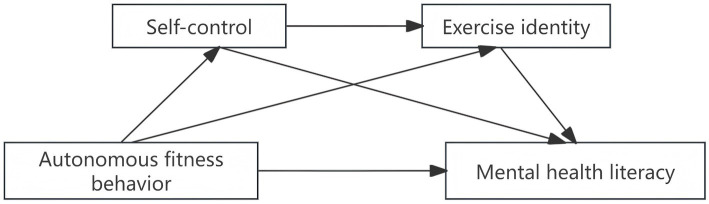 Figure 1
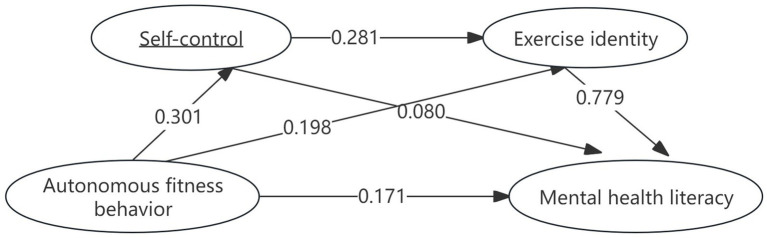 Figure 2
Peer Reviews
No public reviews on file for this paper yet. If you reviewed it on a platform where reviews are public (OpenReview, ICLR, NeurIPS, ICML), you can paste yours below so the community can read it here.
Videos
No videos yet. Explain this paper in a talk, walkthrough, or lecture? Add one.
Taxonomy
TopicsBehavioral Health and Interventions · Impact of Technology on Adolescents · Media Influence and Health