Genomic Insights Into Respiratory Syncytial Virus Circulation Patterns and Neutralization by Anti‐F Monoclonal Antibodies in Panama (2018–2024)
Danilo Franco, Stephanie Goya, Alexander Martínez, Vicente Mas, Brechla Moreno, Elimelec Valdespino, Melissa Gaitán, Lisseth Sáenz, Claudia González, Ambar Moreno, Zeuz Capitan‐Barrios, Jean Paul Carrera, Sandra López‐Vergès, Juan Miguel Pascale, Yadira Moltó, Lourdes Moreno

TL;DR
This study analyzes RSV virus patterns in Panama from 2018 to 2024 and tests how monoclonal antibodies neutralize the virus.
Contribution
The study provides genomic insights into RSV lineages in Panama and evaluates monoclonal antibody neutralization efficacy.
Findings
RSV-A and RSV-B subgroups alternated dominance from 2018 to 2024 with distinct lineage shifts.
Monoclonal antibodies like MEDI8897* effectively neutralized RSV strains in assays.
The study establishes a baseline for RSV evolution before potential preventive therapies in Panama.
Abstract
Respiratory syncytial virus (RSV) is a leading cause of lower respiratory tract infections and hospitalization in infants and children. Whole genome sequencing (WGS) plays a critical role in understanding the evolution and epidemiology of RSV. Limited studies have been conducted in Central America and the Caribbean, and none have specifically focused on lineages involved in recent outbreaks. Furthermore, no assays currently exist to evaluate the sensitivity of the RSV fusion protein to monoclonal antibodies. In Panama, an epidemiological surveillance system tracks RSV activity through the collection of nasopharyngeal samples from patients with acute respiratory infections. Between January 2018 and July 2024, 303 RSV‐positive samples were analyzed by RT‐qPCR. RSV‐B was the dominant subgroup in 2018, but following years had alternating dominance between RSV‐A and RSV‐B. Of the 303…
Genes, proteins, chemicals, diseases, species, mutations and cell lines named across the full text — each resolved to its canonical identifier and authoritative record.
Click any figure to enlarge with its caption.
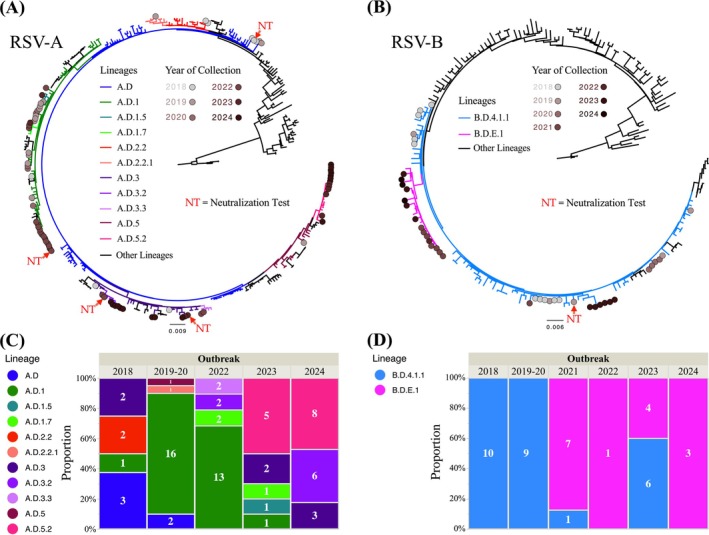 Figure 1
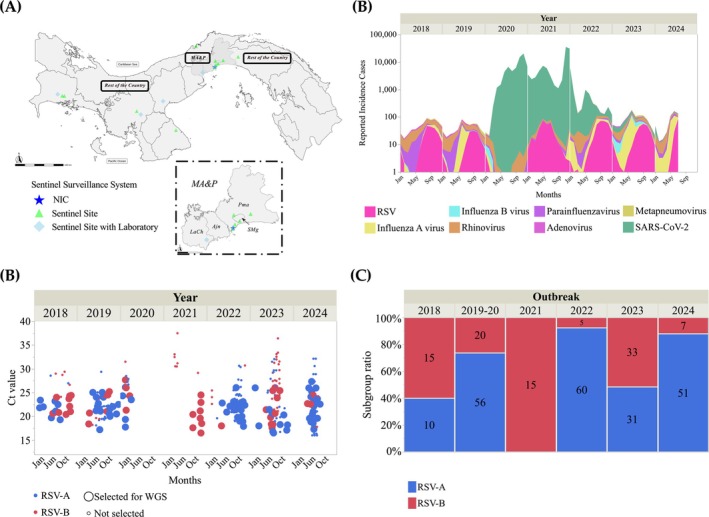 Figure 2
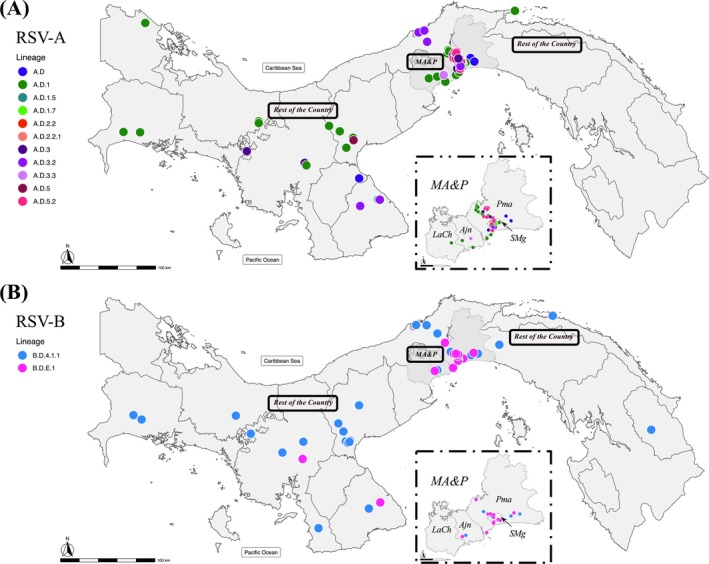 Figure 3
Peer Reviews
No public reviews on file for this paper yet. If you reviewed it on a platform where reviews are public (OpenReview, ICLR, NeurIPS, ICML), you can paste yours below so the community can read it here.
Videos
No videos yet. Explain this paper in a talk, walkthrough, or lecture? Add one.
Taxonomy
TopicsRespiratory viral infections research