Gastrochilus jiuzhaigouensis (Orchidaceae, Epidendroideae), a new epiphytic orchid from Jiuzhaigou World Heritage Site, China

Abstract
Genes, proteins, chemicals, diseases, species, mutations and cell lines named across the full text — each resolved to its canonical identifier and authoritative record.
Click any figure to enlarge with its caption.
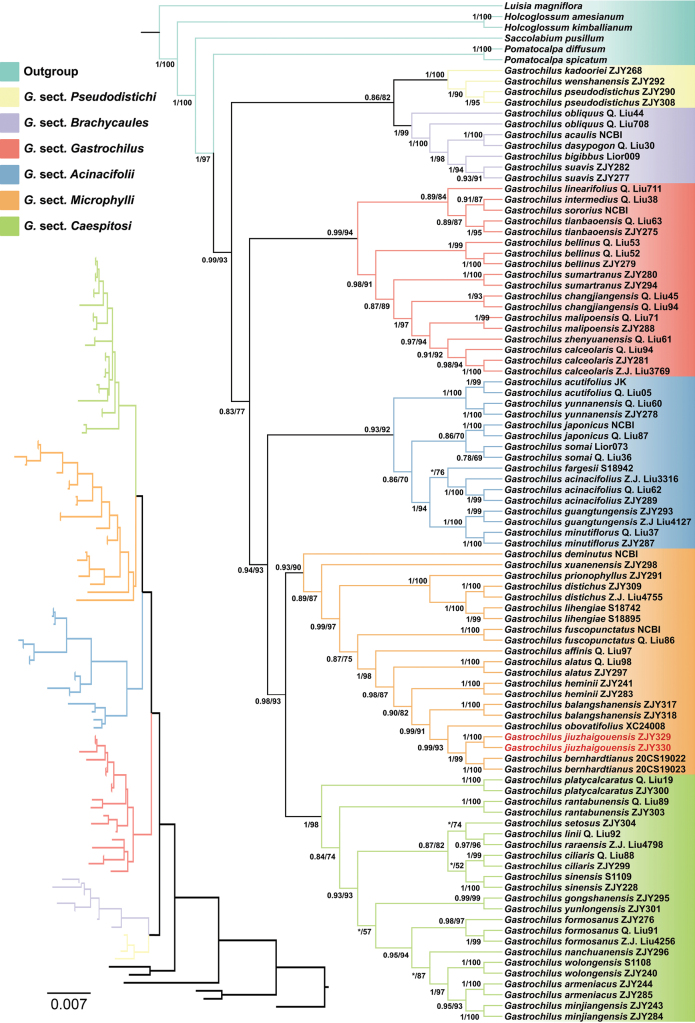 Figure 1
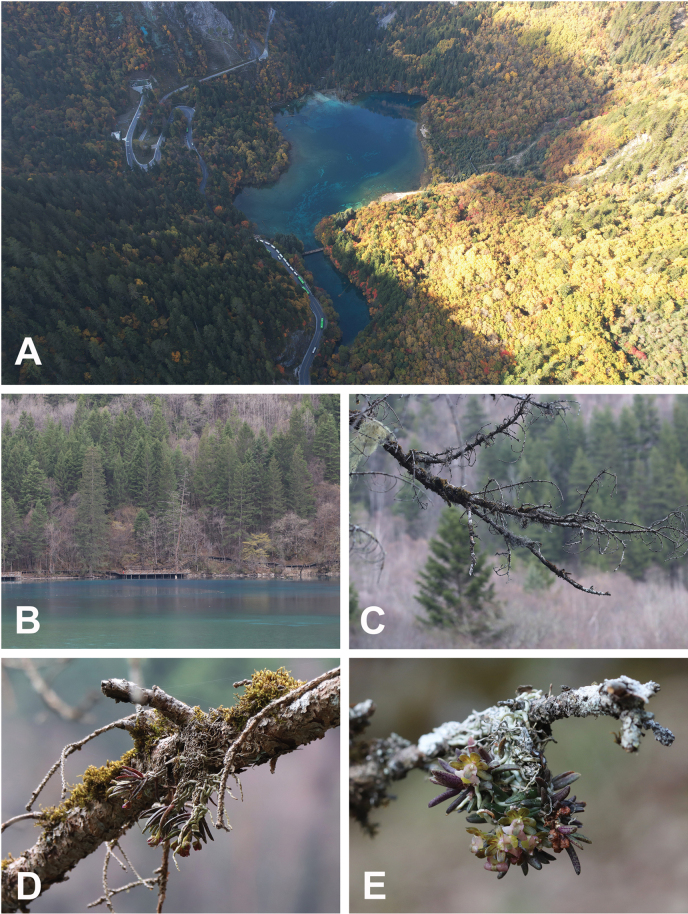 Figure 2
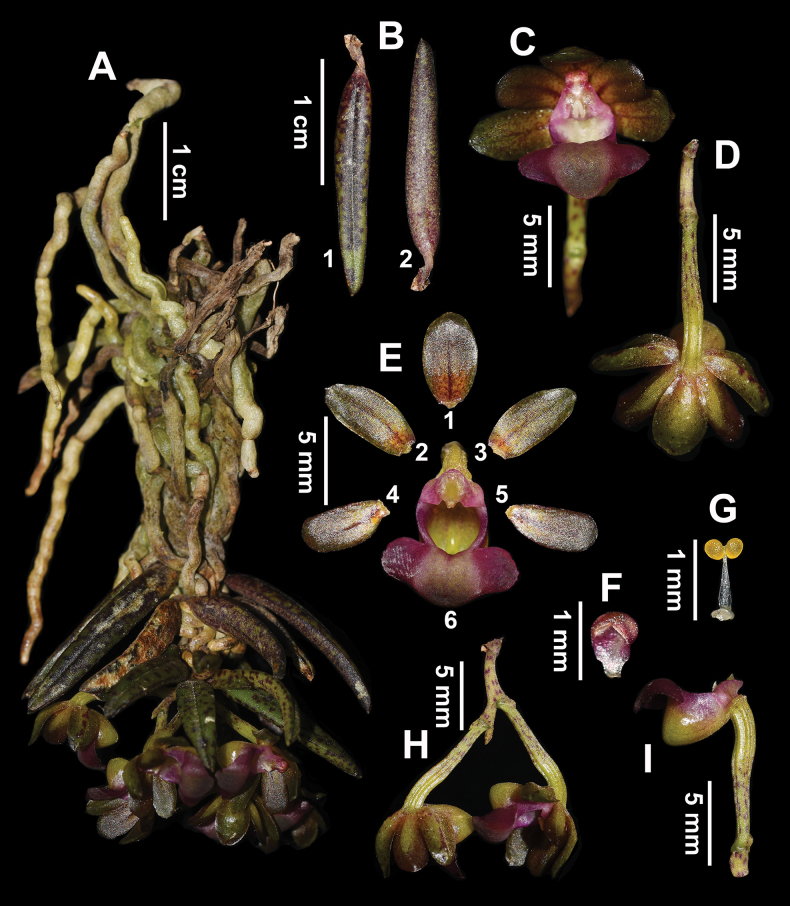 Figure 3
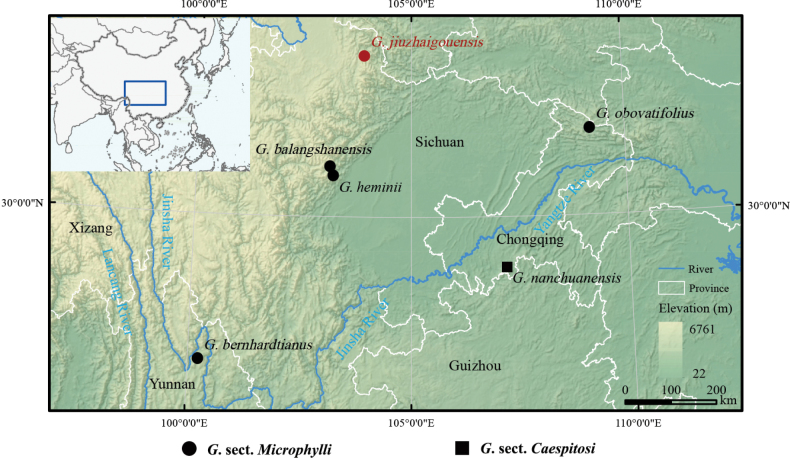 Figure 4
| Character |
|
|
|
|
|---|---|---|---|---|
| Stem length | 0.5–1.2 cm | ca. 5.0 cm | 1.5–3.5 cm | ca. 5.0 cm |
| Leaves | obliquely linear-lanceolate, 1.2–2.4 × 0.3–0.6 cm | oblong-lanceolate,1.8–2.5 × 0.4–0.7 cm | nearly elliptic, 0.9–1.5 × 0.4–0.8 cm | obovate, 1.4–1.6 × 0.6–0.8 cm |
| Dorsal sepal | 4.8–6.0 × 3.6–4.2 mm | ca. 5.2 × 3.4 mm | ca. 5.6–6.4 × 4.8–5.2 mm | ca. 5.0 × 4.0 mm |
| Lateral sepals | oblong, 5.0–6.8 × 3.0–4.0 mm | narrowly ovate, 5.5 × 2.8 mm | oblong, 5.0–5.8 × 4.0–4.4 mm | elliptic, slightly oblique, ca. 5.0 × 3.0 mm |
| Petals | obovate, 4.0–5.8 × 3.0–4.0 mm | narrowly oblong, ca. 5.2 × 2.7 mm | oblong, 5.0–5.8 × 4.0–4.4 mm | oblong, ca. 6.0 × 3.0 mm |
| Epichile (lip lamina) | reniform, revolute, 8.0–10.0 × 4.2–5.5 mm, central thickened purple-yellow thickening smooth without ornamentation | transversely oblong, spread, ca. 8.0 × 2.8 mm, central thickened yellow-green mat with 2 conic calli near its base | reniform, revolute, 10.0–12.0 × 5.5–6.5 mm, central thickened purple-red mat with two inconspicuous ridges | reniform, revolute, 10.0–12.0 × 6.0–8.0 mm, revolute, margin erose, median patch dark purple with 2 low ridges |
| Hypochile | sub-hemispherical, 4.0–5.0 × 3.8–5.4 mm, dorsally compressed, obtuse-rounded at the apex | subconical, ca. 5.1 × 3.8 mm, dorsally compressed splits into two conical sacs at the apex | sub-hemispherical, 6.0–8.0 × 5.8–7.5 mm, dorsally compressed, obtuse-rounded at the apex | sub-hemispherical, 4.0–4.5 × 4.0–4.2 mm, dorsally compressed, slightly bent outward, obtuse at the apex |
| Distribution | Jiuzhaigou, North Sichuan | Yulong, NE. Yunnan | Wenchuan, Central Sichuan | Chengkou, NE. Chongqing |
Peer Reviews
No public reviews on file for this paper yet. If you reviewed it on a platform where reviews are public (OpenReview, ICLR, NeurIPS, ICML), you can paste yours below so the community can read it here.
Videos
No videos yet. Explain this paper in a talk, walkthrough, or lecture? Add one.
Taxonomy
TopicsPlant and animal studies · Plant and Fungal Species Descriptions · Biological and pharmacological studies of plants
Introduction
The vandoid genus Gastrochilus D.Don (Orchidaceae, Epidendroideae; Don 1825) includes about 80 epiphytic species distributed in tropical and subtropical Asia (Don 1825; Tsi 1996, 1999; Liu et al. 2019; Govaerts et al. 2021; Zhou et al. 2021; Zhang et al. 2022; Ya et al. 2023; Zhang et al. 2024a, b; Xiong et al. 2025). The generic morphological characters were mainly defined by the enlarged and saccate hypochile, and two sub-globose pollinia borne on a slender stipe (Tsi 1996; Pridgeon et al. 2014; Liao et al. 2022; Zhang et al. 2024a). Incorporated with the recently molecular phylogenetic resolved six clades, it was subdivided into six sections using characters of leaf shape and length, margin of the epichile, and indumentum on the surface of epichile (Zhang et al. 2024a). However, the diversity of this genus is far from well documented, with continuous new discoveries, especially in the Hengduan Mountains (Liu et al. 2019; Rao et al. 2019; Wu et al. 2019; Chen et al. 2022; Liao et al. 2022; Zhang et al. 2022; Nguyen et al. 2022; Lee et al. 2023; Liu et al. 2023; Ya et al. 2023; Zhang et al. 2024a, b; Zhou et al. 2024).
The Jiuzhaigou World Heritage Site is part of the Min Mountains of the Hengduan Mountains. The Min Mountains are one of Southwest China’s most important biodiversity hotspots (Tang et al. 2006). In April 2024, during a field trip in Jiuzhaigou National Park (part of the Jiuzhaigou World Heritage Site in Jiuzhaigou County, Sichuan Province, China), we encountered a unique Gastrochilus species with distichously alternate linear-lanceolate leaves and small flowers with a reniform epichile. It could be assigned to G. sect. Microphylli (Benth. & Hook.f.) Z.H.Tsi (Tsi 1996; Zhang et al. 2024a) based on its general leaf morphology and floral characters. However, it does not match any known species in the Chinese floras (e.g., Tsi 1999; Chen et al. 2009) and superficially resembles G. bernhardtianus J.D.Ya & D.Z.Li, recently described from Lijiang, Northwest Yunnan (Ya et al. 2023). We hereafter suppose it to be a new species and have named it G. jiuzhaigouensis. To test its systematic position and to determine whether this plant is sufficiently distinct from other known species of Gastrochilus to merit a status of new species, we conducted morphological comparisons and molecular phylogenetic analyses.
Materials and methods
Morphological analyses
Herbarium specimens and silica-gel-dried leaves of this new Gastrochilus plant were collected in the field at Wuhuahai (the Colorful Lake) in Jiuzhaigou National Park, Jiuzhaigou County, Sichuan Province, Southwest China. Morphological measurements were based on both living plants and dried herbarium specimens deposited at CDBI (herbarium acronyms follow Thiers 2025). The terminology proposed by Beentje (2016) was followed. The sequence of the taxonomic description was referred to the style of the Flora of China (Chen et al. 2009). Detailed morphological characters of G. bernhardtianus, G. balangshanensis Jun Y. Zhang, Bo Xu & Yue H. Cheng (Zhang et al. 2024b), and this species were compared by reviewing type materials at CDBI and KUN (by Jun Yi Zhang and Min Liao).
DNA extraction, amplification, and sequencing
Total DNA was extracted exclusively from silica-gel-dried leaves using a Plant DNA Isolation Kit (Cat. No. DE-06111). Based on the phylogenetic studies of Gastrochilus by Liu et al. (2019) and Zhang et al. (2024a, b), we applied the same primers to amplify the nuclear ribosomal internal transcribed spacer (nrITS) and four chloroplast DNA fragments (matK, psbA-trnH, psbM-trnD, and trnL-F) through polymerase chain reaction (PCR). All DNA samples were sequenced by TSINGKE Biotech Co. Ltd. (Chengdu, China). The final manually corrected sequences were submitted to GenBank (Table A1).
Phylogenetic analyses
The sequences of 58 species included in the molecular phylogenetic analysis, originally published in Liu et al. (2019), Ya et al. (2023), Zhang et al. (2024a, b), and Xiong et al. (2025), were retrieved from GenBank, except for those obtained from two individuals of the novelty, which were newly generated in this study. Detailed information concerning the DNA markers, sampled taxa, voucher collections, and GenBank accession numbers is listed in Table A1.
All sequences were edited using Sequencher v4.1.4 (Gene Codes, Ann Arbor, Michigan, USA) and aligned using MAFFT v7.475 (Katoh and Standley 2013) with default parameters. Phylogenetic analyses were performed based on the combined dataset of nuclear ribosomal internal transcribed spacer (nrITS) and the four chloroplast DNA fragments, after checking for congruence, with six Aeridinae species in the genera Luisia Gaudich., Saccolabium Blume, Holcoglossum Schltr., and Pomatocalpa Breda as outgroups (Liu et al. 2019; Zhang et al. 2024a). The nucleotide substitution model for the data matrix was estimated using jModelTest v2.1.6 (Posada 2008), and the best-fit evolutionary model (GTR+F+I+G4) was selected using the corrected Akaike Information Criterion (AICc). Maximum likelihood (ML) and Bayesian inference (BI) methods were employed for phylogenetic tree reconstruction. The BI analysis was conducted using MrBayes v3.2.7a (Ronquist and Huelsenbeck 2003) with two separate Markov chain Monte Carlo (MCMC) runs (20,000,000 generations, sampled every 1,000 generations). The first 25% of the trees were discarded as burn-in, and the remaining trees were used to generate a majority-rule consensus tree. The ML analysis was performed using IQ-TREE v1.4.2 (Nguyen et al. 2014), with branch support estimated using 2,000 replicates. The resulting phylogenetic trees were visualized using Chiplot (Xie et al. 2023).
Results
The aligned nrITS dataset is 684 nucleotides long with 197 variable sites, and the combined four plastid markers dataset included 3,448 nucleotides in length with 212 variable sites, consists of 805 bp for matK, 676 bp for psbA-trnH, 943 bp for psbM-trnD, and 1,024 bp for trnL-F. Consistent with previous studies, Gastrochilus is resolved as a strongly supported monophyly with high posterior probabilities (PP) and bootstrap probabilities (BP). It also agrees with the previous subdivision within the genus in that the clades corresponding to the six sections are well supported (Fig. 1). The two accessions of G. jiuzhaigouensis cluster in one lineage (BI/ML = 1/100; Fig. 1), which is a sister lineage to the two accessions of G. bernhardtianus J.D.Ya & D.Z.Li (BI/ML = 1/99; Fig. 1). These two species are more closely related to G. obovatifolius C. Xiong, X.Y. Fu & S.R. Yi and G. balangshanensis, among others that can be grouped within G. sect. Microphylli (Fig. 1).
Maximum likelihood phylogenetic tree of Gastrochilus, including 53 taxa, based on the combined nrITS and four-plastid (matK, psbA–trnH, psbM–trnD, and trnL–F) markers. Values before the slash indicate Bayesian posterior probabilities, and numbers after the slash indicate ML bootstrap supports for major lineages. An asterisk () indicates that a node is not supported in the analysis. The two accessions of the inferred new species are highlighted in red, and the colors of the terminal nodes correspond to the six sections of Gastrochilus defined in Zhang et al. (2024a).*
Gastrochilus bernhardtianus shows similarity to G. jiuzhaigouensis in plant size, distichous leaves, and gross floral characters, but they mainly differ in stem length and lip morphology. The general morphology of G. balangshanensis and G. obovatifolius is more distinguishable from G. jiuzhaigouensis, and their detailed morphological comparisons are summarized in Table 1.
Table 1.: Morphological comparisons of Gastrochilus jiuzhaigouensis with three related species of G. sect. Microphylli.
Discussion
Our phylogenetic analysis and morphological comparison with similar species support that Gastrochilus jiuzhaigouensis is a distinct species meriting description. Notably, we found plants of this species only as epiphytes on dieback branches of four trees immediately on the bank of the Colorful Lake (Fig. 3C–E). Falling of these branches may destroy its habitat. However, because the Colorful Lake is located in a deep valley, a more extensive investigation is necessary to assess its population size and conservation status. Since the Colorful Lake attracts thousands of sightseeing visitors daily, the introduction of this new epiphytic orchid will arouse public awareness of the protection of species diversity in Jiuzhaigou National Park. Discovery of this species increases the number of species in G. sect. Microphylli to 16 species, and it also represents the northernmost extension of the generic distribution in China (Chen et al. 2009; Zhang et al. 2024b; Xiong et al. 2025; Fig. 4).
Interestingly, the recently added four species—G. bernhardtianus, G. obovatifolius, G. balangshanensis, and G. heminii M.Liao, Bo Xu & Yue H.Cheng (Liao et al. 2022)—together with this new species were all resolved in one clade. This grouping was also reached by Xiong et al. (2025), using the accessions of the former four species, and by Ya et al. (2023), including accessions of only G. bernhardtianus and G. heminii. This implies that they may all radiate from an ancestral lineage. Concerning the phylogenetic relationship among these five species, our resolution showed higher support at each node by adding the accession of G. jiuzhaigouensis, compared with the results of Xiong et al. (2025). When revised circumscriptions were made for the subdivisions of Gastrochilus, G. sect. Microphylli was defined as having leaves narrow and less than 5 cm in length (Zhang et al. 2024a). The leaves of G. jiuzhaigouensis meet this criterion, showing even narrower linear-lanceolate outlines. It is worth noting that G. balangshanensis and G. obovatifolius extend leaf variation in this section to oblong and obovate forms (Zhang et al. 2024b; Xiong et al. 2025; Table 1).
With respect to geographical distribution (Fig. 4), the most recently discovered and closely related species are assumed to be either endemic to the Hengduan Mountains in Southwest China (Liao et al. 2022; Ya et al. 2023; Zhang et al. 2024b) or to the Qinling–Dabashan Mountains (Xiong et al. 2025). In southwestern China, mountainous areas around the Sichuan Basin (Fig. 4) could provide suitable habitats for these epiphytic orchids. Extensive investigations may override the apparently disjunct distributions of these species, especially the phylogenetically close ones. Concerning the recently described oblong or obovate leaves of species in G. sect. Microphylli, a species endemic to Nanchuan, Chongqing (cited as “Sichuan” before July 1997), also has oblong or ovate leaves (Tsi 1996, 1999; Chen et al. 2009). Though there are several gatherings deposited at PE and IMC, all were collected from one locality, with elevations variably documented from 750 m to 1,200 m. In agreement with previous studies (e.g., Ya et al. 2023; Zhang et al. 2024a), our present phylogenetic analysis (Fig. 1) resolved it in a clade composed of other species in G. sect. Caespitosi Z.H.Tsi (Tsi 1996), though it was originally ascribed to G. sect. Microphylli (Tsi 1996, 1999). The flower color, hairy epichile, and phenology (flowering in December), among other characters, are very different from G. jiuzhaigouensis and its closely related species. However, future studies may help to close the distributional gaps of Gastrochilus species, and increased sampling might also blur the presently resolved sectional boundaries.
Taxonomic treatment
Gastrochilus
jiuzhaigouensis
Taxon classificationPlantaeAsparagalesOrchidaceae
Jun Y.Zhang, D.L.Zhu & Y.Zhang sp. nov.
30AC946F-6AC7-5E7E-90A0-077F1AD0670F
urn:lsid:ipni.org:names:77370514-1
Type.
China • Sichuan: Jiuzhaigou, Wuhuahai (the Colorful Lake), lake bank trees at border of subalpine mixed coniferous forest, on dieback tree branches, elev. ca. 2,478 m, in flower, 23 April 2024, Jun-Yi Zhang & Da-Lin Zhu ZJY195 (Holotype CDBI!; Isotype CDBI!).
Diagnosis.
It is most similar to G. bernhardtianus, but it can be distinguished by its shorter stem (0.5–1.2 vs. ca. 5.0 cm), obliquely linear-lanceolate leaves (vs. oblong-lanceolate leaves), reniform and revolute epichile (vs. transversely oblong and spread) without ornamentation (vs. two conic calli near its base), and absence of middle ridge (vs. distinctly ridged) at the middle of central callus on the epichile.
Habitat and habit of Gastrochilus jiuzhaigouensis in situ. A, B. Habitat; C–E. Flowering plants of G. Jiuzhaigouensis growing on tree branches. [Images A–E. Photographed by Da-Lin Zhu].
Description.
Miniature branch epiphyte, pendent, 2.0–4.0 cm tall. Roots vermiform, 3.0–5.0 cm long, ca. 1.2 mm in diameter. Stem unbranched, 0.5–1.2 cm long, ca. 1.2 mm in diameter. Leaves thickly leathery (with fleshy mesophyll), tinged with purplish-red spots, closely arranged, distichous, alternate; blade obliquely linear-lanceolate, 1.2–2.4 × 0.3–0.6 cm, base slightly asymmetry, apex acute and ended with one lobule, lobes setaceous. Inflorescence a 1- or 2-flowered on a short rachis; peduncle curved upward and thickened, 3.0–6.0 mm long, proximally covered with one sheath; floral bracts ovate-lanceolate, 0.6–1.0 mm long, apex acute; pedicel and ovary connate, 0.8–1.1 cm long. Flowers spreading, ca. 0.8 × 1.2 cm; sepals and petals yellow-green on both sides; dorsal sepals elliptic, 4.8–6.0 × 3.6–4.2 mm, apex obtuse; lateral sepals oblong, 5.0–6.8 × 3.0–4.0 mm, apex obtuse; petals obovate, 4.0–5.8 × 3.0–4.0 mm, apex obtuse, base narrowed; lip with a reniform epichile, revolute, purplish-red, 8.0–10.0 × 4.2–5.5 mm, margin entire, smooth and glabrous above, centra thickened purple-yellow without ornamentation; hypochile sub-hemispherical, yellowish-green, 4.0–5.0 × 3.8–5.4 mm, dorsally compressed, obtuse-rounded at the apex; column cylindrical, ca. 1.0 mm; anther cap galeate with two chambers, ca. 0.8 × 0.5 mm; rostellum bilobed; pollinarium ca. 0.3 mm long; pollinia 2, ca. 0.3 × 0.2 mm, yellow, subglobular, porate; stigma deeply sunken, inverted V-shaped, ca. 0.5 mm long, white; rostellum bilobed. Fruits not mature.
Gastrochilus jiuzhaigouensis. A. Flowering plant; B. Leaves (B1: front view, B2: abaxial view); C. Flowers, front view; D. Flowers, abaxial view; E. Dissection of a flower (E1: dorsal sepal; E2-3: lateral sepals; E4-5: petals; E6: labellum); F. Anther cap; G. Pollinarium with pollinia; H. Raceme, lateral view; I. Labellum, lateral view. [Images A–I. photographed by Jun-Yi Zhang].
Distribution and habitat.
Gastrochilus jiuzhaigouensis is currently known only from Wuhuahai, Jiuzhaigou County, Sichuan Province, Southwest China (Fig. 4). It is epiphytic on dieback tree branches on the bank of a lake of trees in the border of subalpine mixed coniferous and deciduous broadleaf forest dominated by Pinus tabuliformis Carrièreat at elevational range between 2400 and 2500 m. Other common accompanying broadleaf trees include Acer stachyophyllum subsp. betulifolium (Maxim.) P.C. De Jong, Fraxinus chinensis Roxb., Prunus tomentosa Thunb., and Quercus mongolica Fisch. ex Ledeb., among others. And in shrub layer Berberis amurensis Rupr. can reach a height of two to three meters.
Distribution map of Gastrochilus jiuzhaigouensis and five related species in Gastrochilus; G. jiuzhaigouensis, G. balangshanensis, G. bernhardtianus, and G. obovatifolius are grouped in G. sect. Microphylli, and G. nanchuanensis in G. sect. Caespitosi.
Phenology.
Flowering from March to April.
Etymology.
Its specific epithet is taken from name of Jiuzhaigou World Heritage Site, where the type specimen of this new orchid is located. Jiuzhaigou is also the name of the famous Jiuzhaigou National Park and the county name in Northwest Sichuan. It is therefore the Chinese name that is proposed as jiu zhai gou peng ju lan (九寨沟盆距兰).
Additional specimens examined
(paratypes). China • Sichuan: Jiuzhaigou, Wuhuahai, on lake bank of broadleaf tree at the border of subalpine coniferous mixed forest, on tree branches, elev. ca. 2,478 m, in flower, 23 April 2024, Jun-Yi Zhang & Da-Lin Zhu ZJY197 (CDBI!).
Other specimens examined.
Gastrochilus bernhardtianus. China • Yunnan: Lijiang Prefecture, Yulong County, Yunshanping, elev. ca. 3308 m, in cold-temperate, evergreen conifer forest, in flower, 20 May 2020, J.-D. Ya et al. 20CS19022 (holotype KUN).
Gastrochilus balangshanensis. China • Sichuan: Wenchuan, Balangshan, Yinchangou, mixed coniferous forest, on tree branches, elev. ca. 2,260 m, in flower, 19 April 2023, Jun-Yi Zhang & Yue-Hong Cheng ZJY185 (holotype: CDBI!); ibid. loc., mixed coniferous forest, on tree trunk, elev. ca. 2300 m, in flower, 19 April 2023, Jun-Yi Zhang & Yue-Hong Cheng ZJY186 (CDBI!); ibid. loc., mixed coniferous forest, on tree branch, elev. ca. 2315 m, in fruit, 22 July 2024, Jun-Yi Zhang & Yue-Hong Cheng ZJY204 (CDBI!).
Supplementary Material
XML Treatment for Gastrochilus jiuzhaigouensis
The reference list from the paper itself. Each links out to its DOI / PubMed record.
- 1Beentje H (2016) The Kew plant glossary: an illustrated dictionary of plant terms, 2nd edn.Kew Publishing, Kew, 184 pp.
- 2Chen XQ Tsi ZH Wood JJ (2009) Gastrochilus D. Don. In: Wu ZY Raven PH Hong DY (Eds) Flora of China, vol.25. Science Press, Beijing & Missouri Botanical Garden Press, St. Louis, 491–498.
- 3Chen WS Lei M Ma CB Jin XH Wang XL (2022) Gastrochilus xizangensis (Aeridinae, Vandeae, Orchidaceae), a new species from Xizang, China.Phytotaxa 566: 219–226. 10.11646/phytotaxa.566.2.6 · doi ↗
- 4Don D (1825) Prodromus Florae Nepalensis. J.Gale, London, 256 pp.
- 5Govaerts R Campacci MA Baptista DH Baptista PJ George A Kreutz K Wood JJ (2021) World Checklist of Orchidaceae. The Board of Trustees of the Royal Botanic Gardens, Kew. http://www.kew.org/wcsp/monocots/ [Accessed 13 August 2021]
- 6Katoh K Standley DM (2013) MAFFT multiple sequence alignment software version 7: Improvements in performance and usability.Molecular Biology and Evolution 30: 772–780. 10.1093/molbev/mst 01023329690 PMC 3603318 · doi ↗ · pubmed ↗
- 7Lee CT Wu JH Wang YQ Hsieh SI (2023) Gastrochilus yehii sp. nov. (Orchidaceae) from Taiwan.Phytotaxa 587: 053–058. 10.11646/phytotaxa.587.1.7 · doi ↗
- 8Liao M Cheng YH Zhang JY Feng Y Liu GY Ye P Jin SL Lin HQ Xu B (2022) Gastrochilus heminii (Orchidaceae, Epidendroideae), a new species from Sichuan, China, based on molecular and morphological data.Phyto Keys 215: 95–106. 10.3897/phytokeys.215.9106136761093 PMC 9836483 · doi ↗ · pubmed ↗