Respire to ripe: The involvement of the mitochondrial alternative oxidases in tomato fruit ripening
Pablo Ignacio Calzadilla, Paula Muñoz

Abstract
Genes, proteins, chemicals, diseases, species, mutations and cell lines named across the full text — each resolved to its canonical identifier and authoritative record.
Click any figure to enlarge with its caption.
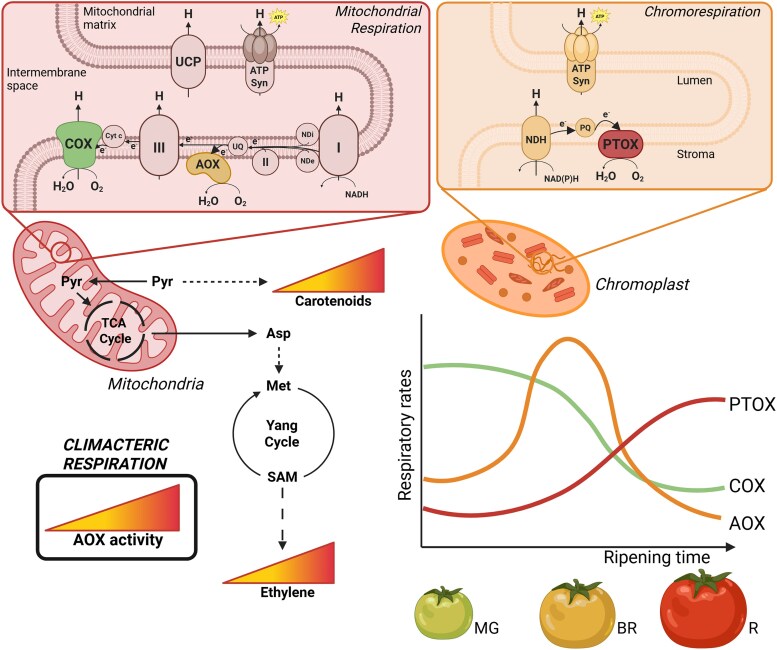 Figure 1
- —Alternative and Atomic Energies Commision
Peer Reviews
No public reviews on file for this paper yet. If you reviewed it on a platform where reviews are public (OpenReview, ICLR, NeurIPS, ICML), you can paste yours below so the community can read it here.
Videos
No videos yet. Explain this paper in a talk, walkthrough, or lecture? Add one.
Taxonomy
TopicsAntioxidant Activity and Oxidative Stress · Postharvest Quality and Shelf Life Management
Respiration is the fundamental process in which cells break down sugars in the presence of oxygen to produce energy in the form of ATP, which fuels cellular maintenance, metabolic reactions, and many physiologic processes of living organisms. In plants, respiration is not only relevant for growth, development, and stress responses but becomes particularly important in highly energy-demanding processes such as fruit ripening (Jiang et al. 2007). During ripening, respiration provides the metabolic activity necessary for synthesizing the protein, hormones, and pigments that will give rise to the mature fruit. In tomato (Solanum lycopersicum), fruit ripening is accompanied by chlorophyll degradation, ethylene production, and the progressive accumulation of carotenoid pigments (Su et al. 2015). Although the participation of respiration in climacteric fruit ripening is well documented, its in vivo regulation and function at different ripening stages remain unclear.
Plant cellular respiration involves glycolysis in the cytosol, the tricarboxylic acid cycle in the mitochondrial matrix, and electron transport in the inner mitochondrial membrane (Fernie et al. 2004). Within the electron transport reactions, several respiratory pathways exist. The main route leading to ATP production involves different respiratory complexes, ubiquinone, and the cytochrome c oxidase (COX). However, alternative respiratory pathways allow mitochondrial redox balance at the expense of ATP generation (Vanlerberghe 2013). In particular, the alternative oxidase (AOX) oxidizes ubiquinone and reduces O_2_ to H_2_O, thereby bypassing the proton pumping of complexes III and IV (Del-Saz et al. 2018). Several AOX genes have been reported in tomato and are suggested to have a role in climacteric respiration and fruit ripening (Xu et al. 2012). Moreover, a plastid terminal oxidase (PTOX) catalyzes a similar reaction in the chromoplast (a specialized plastid in fruits), which can produce ATP with the NAD(P)H dehydrogenase complex in a process called chromorespiration (Grabsztunowicz et al. 2019). This process has been demonstrated to generate ATP during late ripening stages in tomato fruits (Renato et al. 2014). However, the coordinated regulation of the different respiratory pathways during fruit ripening remains unknown.
In this issue of Plant Physiology, Iglesias-Sanchez et al. (2025) determined the in vivo activities of COX and AOX during ripening in tomato and their impact on the expression of ripening-related genes and primary and carotenoid metabolism. The authors used the Ailsa Craig wild type tomato line and the PTOX-defective ghost mutant (Barr et al. 2004) to disentangle the role of PTOX during ripening. They found that respiration increased at the breaker ripening stage when ethylene increased. Measurements were performed by using an oxygen electrode and ^18^O discrimination, a technique to assess oxygen isotope fractionation between alternative respiratory pathways. ^18^O discrimination by the AOX and COX pathways was determined in the presence of the chemical inhibitors KCN and SHAM, respectively. In vivo AOX activity (v_alt_) was the main contributor to climacteric respiration. By contrast, in vivo COX activity (v_cyt_) was detected only until the breaker ripening stage, while chromorespiration gains significance at the end of ripening.
Due to the importance of AOX activity during tomato fruit ripening, Iglesias-Sanchez and colleagues decided to study and knock out the AOX genes responsible for this activity. The expression of AOX1a and AOX1b was quantified. While AOX1b expression did not change significantly during ripening, AOX1a expression steadily increased until the end of this process. Thus, the authors generated 2 homozygous aox1a mutant lines through CRISPR/Cas9 and analyzed their fruit-ripening process. The knockout mutants were able to reproduce and develop fruits. However, fruit weight, size, and number were lower than in wild type plants. Moreover, a delay was observed in the first fruit development and the onset of ripening, mainly due to an increase in the transition times to and from the breaker ripening stage.
To further characterize the relevance of AOX in fruit ripening, Iglesias-Sanchez et al. measured total respiration and AOX capacity in the aox1a mutants. Impairments in climacteric respiration were observed in the 2 mutant lines, in agreement with the delay in the onset of ripening. The expression of ethylene-responsive genes was also delayed or decreased, supporting the involvement of AOX respiration in the ethylene-induced response. Finally, metabolic profiling showed alterations in primary metabolism and carotenoid contents in the aox1a mutant lines. Interestingly, aspartate and methionine accumulation (ethylene synthesis precursors) was affected in the absence of AOX1a, suggesting a more direct link between AOX respiration and ethylene response.
In summary, Iglesias-Sanchez et al. (2025) characterize the respiratory pathways involved in fruit ripening in tomato, highlighting the importance of the AOX in climacteric respiration (Fig.). Through analysis of the ghost tomato line and the generation of aox1a mutants by CRISPR/Cas9, the authors concluded that COX activity and chromorespiration are mainly relevant during the early and late stages of tomato fruit ripening, respectively. In contrast, AOX activity triggers high respiratory fluxes, providing precursors for carotenoid synthesis and the production of key metabolites (i.e. aspartate and methionine) for ethylene in tomato. The work provides a better understanding of the metabolic and energy fluxes driving ripening in this economically relevant fruit.
The reference list from the paper itself. Each links out to its DOI / PubMed record.
- 1Barr J, White WS, Chen L, Bae H, Rodermel S. The GHOST terminal oxidase regulates developmental programming in tomato fruit. Plant Cell Environ. 2004:27(7):840–852. 10.1111/j.1365-3040.2004.01190.x · doi ↗
- 2Del-Saz NF, Ribas-Carbo M, Mc Donald AE, Lambers H, Fernie AR, Florez-Sarasa I. An in vivo perspective of the role(s) of the alternative oxidase pathway. Trends Plant Sci. 2018:23(3):206–219. 10.1016/j.tplants.2017.11.00629269217 · doi ↗ · pubmed ↗
- 3Fernie AR, Carrari F, Sweetlove LJ. Respiratory metabolism: glycolysis, the TCA cycle and mitochondrial electron transport. Curr Opin Plant Biol. 2004:7(3):254–261. 10.1016/j.pbi.2004.03.00715134745 · doi ↗ · pubmed ↗
- 4Grabsztunowicz M, Mulo P, Baymann F, Mutoh R, Kurisu G, Sétif P, Beyer P, Krieger-Liszkay A. Electron transport pathways in isolated chromoplasts from Narcissus pseudonarcissus L. Plant J. 2019:99(2):245–256. 10.1111/tpj.1431930888718 · doi ↗ · pubmed ↗
- 5Iglesias-Sanchez A, Del-Saz NF, Ezquerro M, Feixes-Prats E, Ribas-Carbo M, Fernie AR, Rodríguez-Concepción M, Florez-Sarasa I. Activation of alternative oxidase ensures carbon supply for ethylene and carotenoid biosynthesis during tomato fruit ripening. Plant Physiol. 2025. 10.1101/2025.01.30.635696 PMC 1259627341102481 · doi ↗ · pubmed ↗
- 6Jiang Y, Jiang Y, Qu H, Duan X, Luo Y, Jiang W. Energy aspects in ripening and senescence of harvested horticultural crops. Stewart Postharvest Rev. 2007:3:1–5. 10.2212/spr.2007.2.5 · doi ↗
- 7Renato M, Pateraki I, Boronat A, Azcón-Bieto J. Tomato fruit chromoplasts behave as respiratory bioenergetic organelles during ripening. Plant Physiol. 2014:166(2):920–933. 10.1104/pp.114.24393125125503 PMC 4213118 · doi ↗ · pubmed ↗
- 8Su L, Diretto G, Purgatto E, Danoun S, Zouine M, Li Z, Roustan J-P, Bouzayen M, Giuliano G, Chervin C. Carotenoid accumulation during tomato fruit ripening is modulated by the auxin-ethylene balance. BMC Plant Biol. 2015:15(1):114. 10.1186/s 12870-015-0495-425953041 PMC 4424491 · doi ↗ · pubmed ↗