Clips and elastic band-assisted traction for biliary cannulation in a patient with an ectopic papilla within a juxtapapillary duodenal diverticulum
Zhongshang Sun, Feng Pan, Shuran Hu, Rui Xie

Abstract
Genes, proteins, chemicals, diseases, species, mutations and cell lines named across the full text — each resolved to its canonical identifier and authoritative record.
Click any figure to enlarge with its caption.
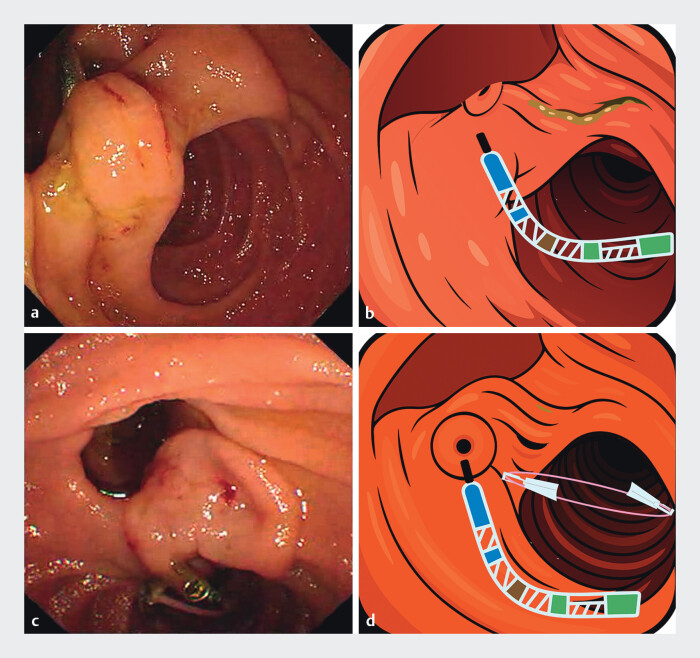 Fig. 1
Peer Reviews
No public reviews on file for this paper yet. If you reviewed it on a platform where reviews are public (OpenReview, ICLR, NeurIPS, ICML), you can paste yours below so the community can read it here.
Videos
No videos yet. Explain this paper in a talk, walkthrough, or lecture? Add one.
Taxonomy
TopicsGallbladder and Bile Duct Disorders · Pediatric Hepatobiliary Diseases and Treatments · Gastrointestinal disorders and treatments
A 63-year-old man with choledocholithiasis underwent endoscopic retrograde cholangiopancreatography (ERCP). Intraoperatively, the major duodenal papilla was located within a large juxtapapillary diverticulum. Diverticular traction rendered the papilla highly mobile, resulting in substantial difficulty with biliary cannulation. An attempt to stabilize the papilla by applying a clip to the diverticular ridge was unsuccessful ( Fig. 1 a, b ).
Clip–elastic band traction facilitates biliary cannulation of an intradiverticular papilla. a Intradiverticular major papilla with diverticular traction: papillary hypermobility leading to difficult biliary cannulation and failure of clip-only stabilization. b Vector-style schematic corresponding to panel a , illustrating papillary hypermobility due to diverticular traction. c Two-clip elastic-band traction stabilizes the papilla and straightens the biliary axis, enabling deep common bile duct cannulation. d Vector-style schematic corresponding to panel c , illustrating clip and band placement and papillary stabilization.
To overcome this challenge, a simple traction system was assembled using two endoscopic clips and an elastic band. The first clip was affixed to the suprapapillary duodenal wall (i.e., below the papilla) to avoid inadvertent clamping of the biliary orifice or ductal structures; the second clip was then used to anchor the elastic band to the distal duodenum, thereby optimizing papillary stabilization and exposure and straightening the biliary axis ( Fig. 1 c, d , Video 1 ). Following stabilization, deep cannulation of the common bile duct was achieved without difficulty. The patient tolerated the procedure well and recovered uneventfully.
Clip–elastic band traction for biliary cannulation in an intradiverticular papilla.Video 1
Cases involving an anatomic variant – specifically, an ectopic papilla located within a large duodenal diverticulum – can significantly complicate ERCP. The use of clip-assisted traction may facilitate successful cannulation in such challenging scenarios 1 . Strategic traction of peripapillary tissue using readily available endoscopic accessories can effectively stabilize the papilla and facilitate successful cannulation, offering a practical approach for managing complex biliary anatomy and potentially improving procedural outcomes.
Endoscopy_UCTN_Code_TTT_1AR_2AC
The reference list from the paper itself. Each links out to its DOI / PubMed record.