A case in which all stones, including gallbladder stones as well as stacked bile duct stones, were removed using a transpapillary procedure
Tomoya Takahashi, Hiroshi Ohyama, Yoshiki Ogane, Kazuki Watabe, Mayu Ouchi, Motoyasu Kan, Jun Kato

Abstract
Genes, proteins, chemicals, diseases, species, mutations and cell lines named across the full text — each resolved to its canonical identifier and authoritative record.
Click any figure to enlarge with its caption.
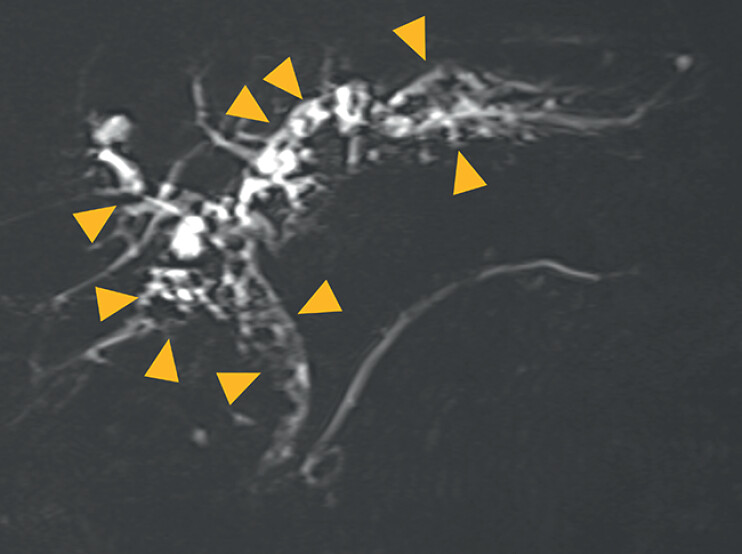 Fig. 1
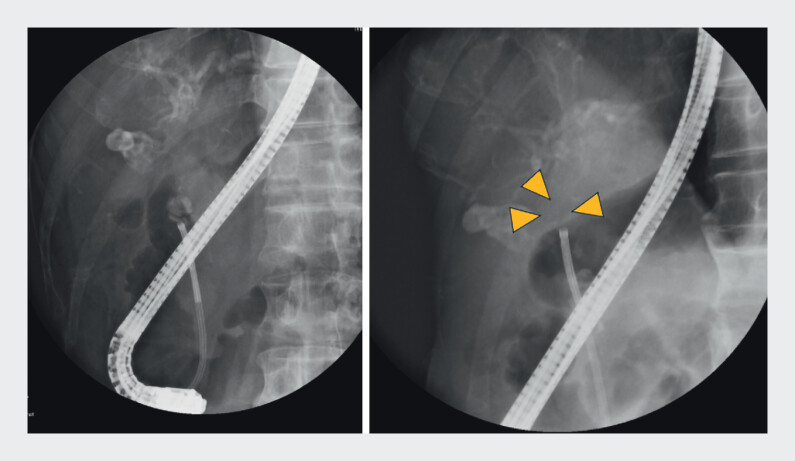 Fig. 2
Peer Reviews
No public reviews on file for this paper yet. If you reviewed it on a platform where reviews are public (OpenReview, ICLR, NeurIPS, ICML), you can paste yours below so the community can read it here.
Videos
No videos yet. Explain this paper in a talk, walkthrough, or lecture? Add one.
Taxonomy
TopicsGallbladder and Bile Duct Disorders · Biliary and Gastrointestinal Fistulas · Pediatric Hepatobiliary Diseases and Treatments
The guidelines for the treatment of choledocholithiasis recommend that cholecystectomy should be performed after endoscopic removal of stones in the common bile duct (CBD) in cases with gallbladder stones 1 2 , but we report here on a case in which all stones in the CBD, intrahepatic bile duct, and gallbladder were removed through the papilla.
A 76-year-old man visited his previous doctor with nausea. He was diagnosed with acute cholangitis due to a large, stacked-type bile duct stone that had blocked the left and right intrahepatic bile ducts ( Fig. 1 ). However, the stone was difficult to remove, and he was referred to our hospital.
Magnetic resonance cholangiopancreatography showed stacked common bile duct stones (arrowheads).
First, we performed an endoscopic sphincterotomy combined with large-balloon dilation using a disposable balloon dilator. We then removed the distal bile duct stone using a stone removal balloon. Electrohydraulic lithotripsy was performed using a cholangioscope for the large stone at the cystic duct bifurcation. Then, we successfully removed giant stones at the confluence of the gallbladder ducts ( Fig. 2 ). As the cystic duct was large and a guidewire was successfully inserted, the stone was crushed using a stone-crushing basket, and a plastic stent was placed. In the re-treatment, endoscopic papillary large-balloon dilation was performed using a papilla dilation balloon, and the intrahepatic bile duct stone was removed using a balloon catheter. The stone at the bottom of the gallbladder remained, but the rotating basket (RASEN-2; Kaneka Medix, Osaka, Japan) was guided into the gallbladder, and the stone at the bottom of the gallbladder was removed ( Video 1 ). The cholangiogram confirmed that the stone had been completely removed.
Electrohydraulic lithotripsy was performed using a cholangioscope for the large stone at the cystic duct bifurcation. We then successfully removed the giant stones at the confluence of the gallbladder ducts.
The stone at the bottom of the gallbladder remained, but the rotating basket was guided into the gallbladder, and the stone was removed.Video 1
Stones in the biliary tract can be removed entirely by transpapillary procedures. If the cystic duct is thick and straight, we might also attempt to remove the gallbladder stones.
Endoscopy_UCTN_Code_TTT_1AR_2AH
The reference list from the paper itself. Each links out to its DOI / PubMed record.
- 1Boerma D Rauws EA Keulemans Y Wait and see policy or laparoscopic cholecystectomy after endoscopic sphincterotomy for bile duct stones: a randomized trial Lancet 200236076176512241833 10.1016/S 0140-6736(02)09896-3 · doi ↗ · pubmed ↗
- 2Fujita N Yasuda I Endo I Evidence-based clinical practice guidelines for cholelithiasis 2021 J Gastroenterol 20235880183310.1007/s 00535-023-02014-637452855 PMC 10423145 · doi ↗ · pubmed ↗