High intelligence is not associated with a greater propensity for mental health disorders – CORRIGENDUM
Camille Michèle Williams, Hugo Peyre, Ghislaine Labouret, Judicael Fassaya, Adoración Guzmán García, Nicolas Gauvrit, Franck Ramus

Abstract
Genes, proteins, chemicals, diseases, species, mutations and cell lines named across the full text — each resolved to its canonical identifier and authoritative record.
Click any figure to enlarge with its caption.
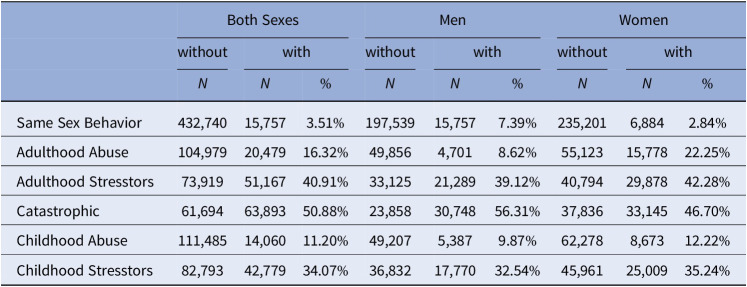 Figure 1
Peer Reviews
No public reviews on file for this paper yet. If you reviewed it on a platform where reviews are public (OpenReview, ICLR, NeurIPS, ICML), you can paste yours below so the community can read it here.
Videos
No videos yet. Explain this paper in a talk, walkthrough, or lecture? Add one.
Taxonomy
TopicsHealth and Well-being Studies · Cognitive Abilities and Testing
In this article, Table 1 was published with a number of errors in the values. The corrected Table 1 is below:Both SexesMenWomenwithoutwithwithoutwithwithoutwith N
N % N
N % N
N %Same Sex Behavior432,74015,7573.51%197,53915,7577.39%235,2016,8842.84%Adulthood Abuse104,97920,47916.32%49,8564,7018.62%55,12315,77822.25%Adulthood Stresstors73,91951,16740.91%33,12521,28939.12%40,79429,87842.28%Catastrophic61,69463,89350.88%23,85830,74856.31%37,83633,14546.70%Childhood Abuse111,48514,06011.20%49,2075,3879.87%62,2788,67312.22%Childhood Stresstors82,79342,77934.07%36,83217,77032.54%45,96125,00935.24%
In addition, there is an error on page 6 of the article, which currently reads as follows:Individuals with high intelligence were also more likely to present certain traits, such as having an afternoon–evening chronotype, to have ever tried cannabis, or have ever engaged in same-sex behavior, whereas the low g-factor group was less likely to have ever tried cannabis and engaged in same-sex behavior than the average g-factor group.
The correct paragraph should be as follows:Individuals with high intelligence were also more likely to present certain traits, such as having an afternoon–evening chronotype, to have ever tried cannabis, or have ever engaged in same-sex behavior, whereas the low g-factor group was less likely to have ever tried cannabis than the average g-factor group.
The reference list from the paper itself. Each links out to its DOI / PubMed record.