Efficacy of botanical extracts for knee osteoarthritis: a network meta-analysis of randomized controlled trials
Chao Yan, Xiaotao Du, Yan Liu, Fan Xia, Hongling Yu, Yongliang Zhu, Tianyi Bao

TL;DR
This study evaluated the effectiveness of various plant extracts for treating knee osteoarthritis and found that Cucumis sativus extract showed the most promise.
Contribution
The study provides a network meta-analysis comparing multiple botanical extracts for knee osteoarthritis, identifying Cucumis sativus as a top candidate.
Findings
Cucumis sativus extract significantly improved pain and function scores in knee osteoarthritis patients.
Ashwagandha extract was more effective in reducing stiffness scores compared to placebo.
The study highlights the need for larger trials to confirm the efficacy of Cucumis sativus extract.
Abstract
Traditional botanical drugs and medicinal plants, along with their metabolite extracts, have exhibited considerable potential in the management of knee osteoarthritis (KOA) due to their natural properties, favorable safety profiles, and minimal adverse effects. This study aimed to evaluate the therapeutic efficacy of various botanical and medicinal plant extracts on KOA. Search Methods: We conducted a comprehensive literature search across PubMed, Embase, Cochrane Library, and Web of Science, focusing exclusively on randomized controlled trials (RCTs) that investigated the efficacy of botanical and medicinal plant extracts for KOA. Selection Criteria: Studies were included if they met the following criteria: (1) experimental groups receiving single botanical drugs or plant extracts for KOA; (2) control groups comprising patients receiving placebo or standard care; (3) clinical RCT…
Genes, proteins, chemicals, diseases, species, mutations and cell lines named across the full text — each resolved to its canonical identifier and authoritative record.
Click any figure to enlarge with its caption.
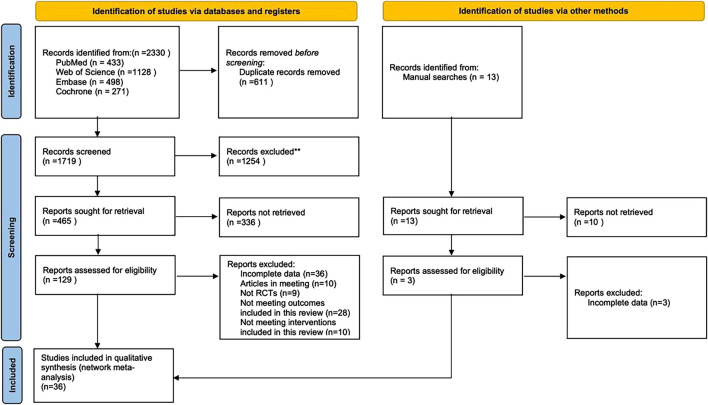 FIGURE 1
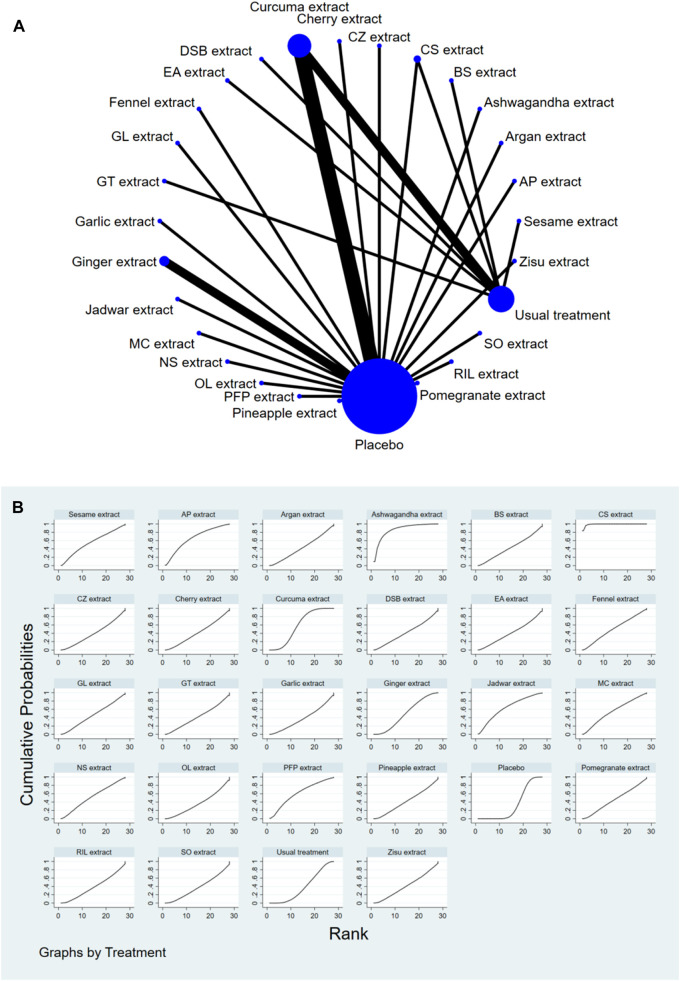 FIGURE 2
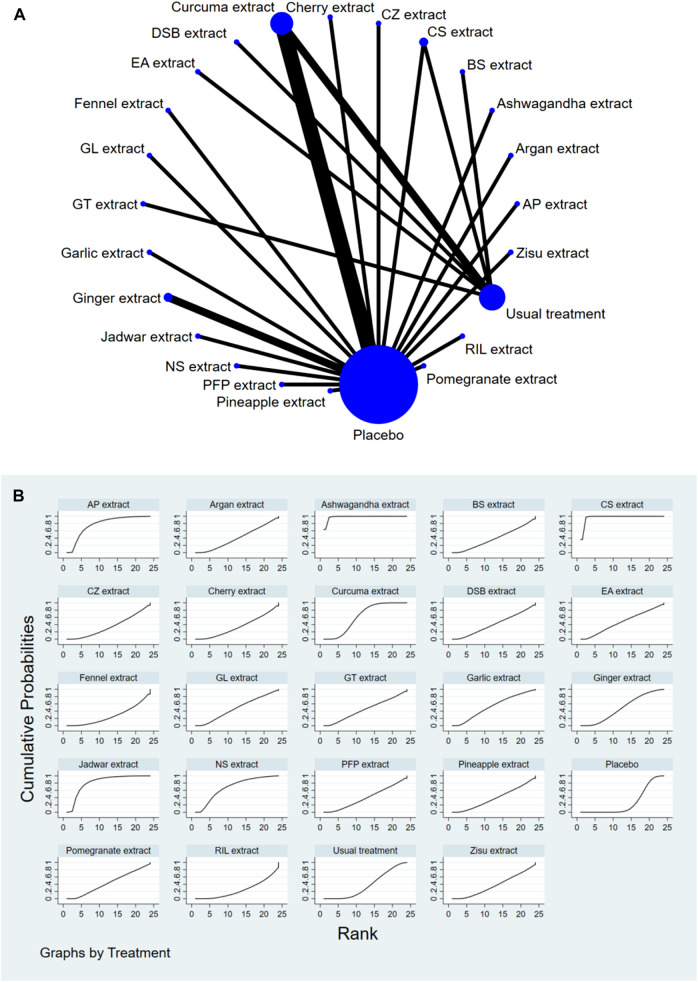 FIGURE 3
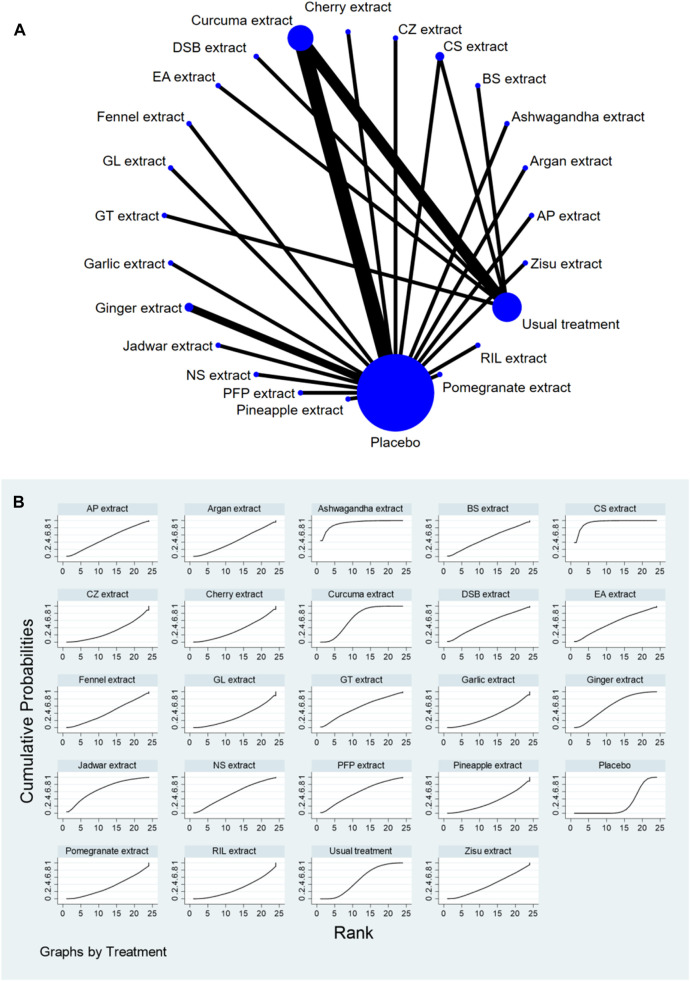 FIGURE 4
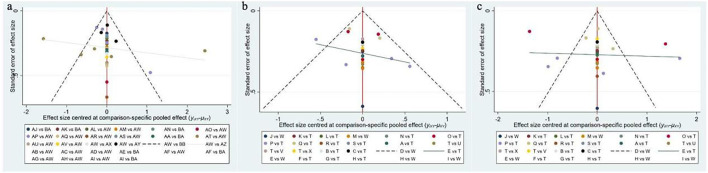 FIGURE 5
| Author | Country | Year | Age (mean + SD) | Total/male/female | Intervention | Control | Outcome |
|---|---|---|---|---|---|---|---|
| Altman | United States | 2001 | T: 64.0 (11.5) | T: 124/50/74 | Ginger extract | Placebo | WOMAC, SF-36 |
| C: 66.3 (11.6) | C: 123/45/78 | Length of Intervention: 6 weeks | |||||
| Freq: 2 times a day | |||||||
| Single dose: 255 mg | |||||||
| Wigler | Israel | 2003 | T: 64.7 (NA) | T: 14/1/13 | Ginger extract | Placebo | VAS |
| C: 59.3 (NA) | C: 15/5/10 | Length of Intervention: 12 weeks | |||||
| Freq: 4 times a day | |||||||
| Single dose: 250 mg | |||||||
| Brien | United Kingdom | 2006 | T: 62.83 (9.36) | T: 24/13/11 | Pineapple extract | Placebo | WOMAC,SF-36 |
| C: 60.43 (7.63) | C: 23/11/12 | Length of Intervention: 12 weeks | |||||
| Freq: 1 time a day | |||||||
| Single dose: 800 mg | |||||||
| Sontakke | India | 2007 | T: NA | T: 33/NA/NA | Boswellia serrata extract | Usual treatment | WOMAC |
| C: NA | C: 33/NA/NA | Length of Intervention: 6 months | |||||
| Freq: NA | |||||||
| Single dose: NA | |||||||
| Farid | Iran | 2010 | T: 55 (14.1) | T: 17/5/12 | Passion fruit peel extract | Placebo | WOMAC |
| C: 49.71 (14) | C: 16/3/13 | Length of Intervention: 2 months | |||||
| Freq: 1 time a day | |||||||
| Single dose: 150 mg | |||||||
| Kuptniratsaikul | Thailand | 2011 | T: 59.4 (7) | T: 55/8/47 | Derris scandens Benth extract | Usual treatment | WOMAC |
| C: 60.5 (8.2) | C: 52/10/42 | Length of Intervention: 4 weeks | |||||
| Freq: 1 time a day | |||||||
| Single dose: 800 mg | |||||||
| Zakeri | Iran | 2011 | T: 48.4 (11.1) | T: 103/20/83 | Ginger extract | Placebo | WOMAC, VAS |
| C: 45.74 (12.5) | C: 101/20/81 | Length of Intervention: 6 weeks | |||||
| Freq: 2 times a day | |||||||
| Single dose: 250 mg | |||||||
| Pinsornsak | Thailand | 2012 | T: NA | T: 36/NA/NA | Curcuma extract | Usual treatment | VAS, KOOS |
| C: NA | C: 37/NA/NA | Length of Intervention: 3 months | |||||
| Freq: 2 times a day | |||||||
| Single dose: 500 mg | |||||||
| Sadat | Iran | 2013 | T: NA | T: 22/NA/NA | Sesame extract | Usual treatment | VAS, KOOS |
| C: NA | C: 23/NA/NA | Length of Intervention: 2 months | |||||
| Freq: 1 time a day | |||||||
| Single dose: 40 g | |||||||
| Madhu | India | 2013 | T: 56.63 (10.58) | T: 30/13/17 | Curcuma extract | Placebo | WOMAC, VAS |
| C: 56.77 (9.98) | C: 30/13/17 | Length of Intervention: 42 days | |||||
| Freq: 2 times a day | |||||||
| Single dose: 500 mg | |||||||
| Schumacher | United States | 2013 | T: 56.7 (11.3) | T: 27/NA/NA | Cherry extract | Placebo | WOMAC |
| C: 56.7 (11.3) | C: 31/NA/NA | Length of Intervention: 6 weeks | |||||
| Freq: 1 time a day | |||||||
| Single dose: 8 oz | |||||||
| Takeda | Japan | 2013 | T: 61.4 (8.3) | T: 13/3/10 | Olive leave extract | Placebo | JOA |
| C: 60.8 (7.2) | C: 12/3/9 | Length of Intervention: 4 weeks | |||||
| Freq: 1 time a day | |||||||
| Single dose: 50.1 mg | |||||||
| Kuptniratsaikul | Thailand | 2014 | T: 60.3 (6.8) | T: 171/14/157 | Curcuma extract | Usual treatment | WOMAC |
| C: 60.9 (6.9) | C: 160/21/139 | Length of Intervention: 4 weeks | |||||
| Freq: 1 time a day | |||||||
| Single dose: 1500 mg | |||||||
| Panahi | Iran | 2014 | T: 57.32 (8.78) | T: 27/5/22 | Curcuma extract | Placebo | WOMAC |
| C: 57.57 (9.05) | C: 26/4/22 | Length of Intervention: 6 weeks | |||||
| Freq: 3 times a week | |||||||
| Single dose: 500 mg | |||||||
| Ghoochani | Iran | 2016 | T: 56.74 (10.23) | T: 19/2/17 | Pomegranate extract | Placebo | WOMAC |
| C: 53.84 (11.95) | C: 19/2/17 | Length of Intervention: 6 weeks | |||||
| Freq: 1 time a day | |||||||
| Single dose: 200 mL | |||||||
| Panahi | Iran | 2016 | T: 55.2 (7.8) | T: 32/6/26 | Elaeagnus Angustifolia extract | Usual treatment | WOMAC, VAS, LPFI |
| C: 53.7 (10) | C: 32/2/30 | Length of Intervention: 7 weeks | |||||
| Freq: 1 time a day | |||||||
| Single dose: 600 mg | |||||||
| Ramakanth | India | 2016 | T: 58.92 (6.07) | T: 20/13/7 | Ashwagandha extract | Placebo | WOMAC, VAS |
| C: 58.95 (3.73) | C: 20/16/4 | Length of Intervention: 12 weeks | |||||
| Freq: 2 times a week | |||||||
| Single dose: 250 mg | |||||||
| Srivastava | India | 2016 | T: 50.23 (8.08) | T: 78/25/53 | Curcuma extract | Placebo | WOMAC, VAS |
| C: 50.27 (8.63) | C: 82/32/50 | Length of Intervention: 4 months | |||||
| Freq: 1 time a day | |||||||
| Single dose: 500 mg | |||||||
| Essouiri | Morocco | 2017 | T: 58.24 (8.8) | T: 55/4/51 | Argan extract | Placebo | WOMAC, VAS |
| C: 58.85 (5.6) | C: 52/3/49 | Length of Intervention: 8 weeks | |||||
| Freq: 1 time a day | |||||||
| Single dose: 80 mL | |||||||
| Hashempur | Iran | 2018 | T: 56.65 (8.07) | T: 20/17/3 | Green tea extract | Usual treatment | WOMAC, VAS |
| C: 53.05 (11.06) | C: 20/15/5 | Length of Intervention: 4 weeks | |||||
| Freq: 3 times a day | |||||||
| Single dose: 500 mg | |||||||
| Kakuo | Japan | 2018 | T: 53.2 (6.3) | T: 27/12/15 | Guava leaf extract | Placebo | JKOM |
| C: 54.4 (7.5) | C: 26/9/17 | Length of Intervention: 12 weeks | |||||
| Freq: 1 time a day | |||||||
| Single dose: 1000 mg | |||||||
| May | Malaysia | 2018 | T: 61.97 (9.19) | T: 38/NA/NA | Momordica charantia extract | Placebo | KOOS |
| C: 57.81 (9.15) | C: 37/NA/NA | Length of Intervention: 3 months | |||||
| Freq: 3 times a day | |||||||
| Single dose: 500 mg | |||||||
| Nash | United Kingdom | 2018 | T: 51.9 (9) | T: 61/33/28 | Cucumis sativus extract | Usual treatment | WOMAC, VAS |
| C: 52.5 (5) | C: 61/29/32 | Length of Intervention: 180 days | |||||
| Freq: 2 times a day | |||||||
| Single dose: 10 mg | |||||||
| Panda | India | 2018 | T: 55.2 (8.58) | T: 25/NA/NA | Curcuma extract | Placebo | WOMAC, VAS |
| C: 53.12 (8.25) | C: 25/NA/NA | Length of Intervention: 12 weeks | |||||
| Freq: 1 time a day | |||||||
| Single dose: 500 mg | |||||||
| Salimzadeh | Iran | 2018 | T: NA | T: 39/NA/39 | Garlic extract | Placebo | WOMAC |
| C: NA | C: 37/NA/37 | Length of Intervention: 12 weeks | |||||
| Freq: 2 times a day | |||||||
| Single dose: 500 mg | |||||||
| Hancke | India | 2019 | T: 55.3 (8.2) | T: 35/4/31 | Andrographis paniculata extract | Placebo | WOMAC, SF-36 |
| C: 55.7 (7.7) | C: 36/9/27 | Length of Intervention: 84 days | |||||
| Freq: 2 times a day | |||||||
| Single dose: 300 mg | |||||||
| Henrotin | Belgium | 2019 | T: 60.9 (9.78) | T: 49/10/39 | Curcuma extract | Placebo | KOOS |
| C: 63.3 (7.69) | C: 45/11/34 | Length of Intervention: 3 months | |||||
| Freq: 2 times a day | |||||||
| Single dose: 3 caps | |||||||
| Alazadeh | Iran | 2020 | T: NA | T: 33/NA/33 | Fennel extract | Placebo | WOMAC, VAS |
| C: NA | C: 33/NA/33 | Length of Intervention: 2 weeks | |||||
| Freq: 2 times a day | |||||||
| Single dose: 400 mg | |||||||
| Ha | Korea | 2021 | T: 60.57 (8.93) | T: 53/7/46 | Chrysanthemum zawadskii extract | Placebo | WOMAC, VAS, SF-36 |
| C: 59.63 (8.05) | C: 57/6/51 | Length of Intervention: 12 weeks | |||||
| Freq: 1 time a day | |||||||
| Single dose: 600 mg | |||||||
| Singhal | India | 2021 | T: 53.1 (10.9) | T: 73/20/53 | Curcuma extract | Usual treatment | WOMAC |
| C: 50.8 (9.9) | C: 71/17/54 | Length of Intervention: 6 weeks | |||||
| Freq: 2 times a day | |||||||
| Single dose: 500 mg | |||||||
| Henrotin | Belgium | 2022 | T: 55.69 (1.25) | T: 64/21/43 | Rubus idaeus leaf extract | Placebo | WOMAC, VAS, SF-36 |
| C: 52.93 (1.39) | C: 68/25/43 | Length of Intervention: 12 weeks | |||||
| Freq: 1 time a day | |||||||
| Single dose: 400 mg | |||||||
| Huseini | Iran | 2022 | T: 59.6 (9.1) | T: 58/16/42 | Nigella sativa extract | Placebo | WOMAC, VAS |
| C: 63.3 (8.6) | C: 58/13/45 | Length of Intervention: 1 month | |||||
| Freq: 3 times a day | |||||||
| Single dose: 5 mL | |||||||
| Kim | Korea | 2023 | T: 42.3 (12.6) | T: 40/14/26 | Zisu extract | Placebo | WOMAC, VAS |
| C: 34.5 (14.5) | C: 40/14/26 | Length of Intervention: 8 weeks | |||||
| Freq: 2 times a day | |||||||
| Single dose: 700 mg | |||||||
| Nash | UNITED KINGDOM | 2023 | T: NA | T: 31/13/18 | Cucumis sativus extract | Placebo | WOMAC, VAS, LPFI |
| C: NA | C: 46/21/25 | Length of Intervention: 180 days | |||||
| Freq: 2 times a day | |||||||
| Single dose: 50 mg | |||||||
| Navid | Iran | 2023 | T: 57.33 (8.85) | T: 52/23/29 | Jadwar extract | Placebo | WOMAC, VAS |
| C: 59.43 (7.88) | C: 52/24/28 | Length of Intervention: 4 weeks | |||||
| Freq: 2 times a day | |||||||
| Single dose: 500 mg | |||||||
| Taheri | Iran | 2023 | T: 54.13 (7.53) | T: 43/10/33 | Squill oxymel extract | Placebo | VAS, KOOS |
| C: 5508.8 (7.12) | C: 45/8/37 | Length of Intervention: 8 weeks | |||||
| Freq: 1 time a day | |||||||
| Single dose: 10 mL |
| CS extract | Ashwagandha extract | AP extract | Jadwar extract | PFP extract | Curcuma extract | Sesame extract | MC extract | NS extract | Fennel extract | Ginger extract | Pomegranate extract | GL extract | Pineapple extract |
|---|---|---|---|---|---|---|---|---|---|---|---|---|---|
| CS extract | 2.87 (−1.76,7.50) | 4.85 (0.31,9.39) | 4.99 (0.46,9.52) | 5.01 (0.43,9.59) | 5.55 (2.66,8.45) | 5.50 (0.94,10.07) | 5.59 (1.06,10.13) | 5.79 (1.27,10.31) | 5.87 (1.33,10.40) | 5.99 (2.50,9.49) | 6.13 (1.57,10.68) | 6.18 (1.64,10.72) | 6.36 (1.80,10.92) |
| −2.87 (−7.50,1.76) | Ashwagandha extract | 1.98 (−3.13,7.09) | 2.12 (−2.98,7.22) | 2.14 (−3.00,7.28) | 2.68 (−1.30,6.66) | 2.63 (−2.98,8.25) | 2.72 (−2.38,7.82) | 2.92 (−2.17,8.01) | 3.00 (−2.11,8.10) | 3.12 (−1.08,7.33) | 3.26 (−1.86,8.37) | 3.31 (−1.80,8.42) | 3.49 (−1.64,8.61) |
| −4.85 (−9.39,−0.31) | −1.98 (−7.09,3.13) | AP extract | 0.14 (−4.87,5.16) | 0.16 (−4.89,5.22) | 0.70 (−3.17,4.57) | 0.66 (−4.88,6.20) | 0.75 (−4.27,5.77) | 0.94 (−4.07,5.95) | 1.02 (−4.00,6.04) | 1.15 (−2.96,5.25) | 1.28 (−3.76,6.32) | 1.33 (−3.69,6.36) | 1.51 (−3.53,6.55) |
| −4.99 (−9.52,−0.46) | −2.12 (−7.22,2.98) | −0.14 (−5.16,4.87) | Jadwar extract | 0.02 (−5.02,5.07) | 0.56 (−3.29,4.42) | 0.52 (−5.01,6.04) | 0.61 (−4.40,5.61) | 0.80 (−4.20,5.80) | 0.88 (−4.13,5.88) | 1.00 (−3.09,5.09) | 1.14 (−3.89,6.16) | 1.19 (−3.82,6.20) | 1.37 (−3.66,6.40) |
| −5.01 (−9.59,−0.43) | −2.14 (−7.28,3.00) | −0.16 (−5.22,4.89) | −0.02 (−5.07,5.02) | PFP extract | 0.54 (−3.37,4.45) | 0.49 (−5.07,6.06) | 0.58 (−4.47,5.63) | 0.78 (−4.26,5.82) | 0.86 (−4.20,5.91) | 0.98 (−3.16,5.13) | 1.12 (−3.95,6.18) | 1.17 (−3.89,6.23) | 1.35 (−3.73,6.42) |
| −5.55 (−8.45,−2.66) | −2.68 (−6.66,1.30) | −0.70 (−4.57,3.17) | −0.56 (−4.42,3.29) | −0.54 (−4.45,3.37) | Curcuma extract | −0.05 (−4.08,3.99) | 0.04 (−3.81,3.90) | 0.24 (−3.61,4.09) | 0.32 (−3.54,4.18) | 0.44 (−2.12,3.00) | 0.58 (−3.31,4.46) | 0.63 (−3.24,4.50) | 0.81 (−3.08,4.70) |
| −5.50 (−10.07,−0.94) | −2.63 (−8.25,2.98) | −0.66 (−6.20,4.88) | −0.52 (−6.04,5.01) | −0.49 (−6.06,5.07) | 0.05 (−3.99,4.08) | Sesame extract | 0.09 (−5.44,5.62) | 0.29 (−5.24,5.81) | 0.36 (−5.17,5.89) | 0.49 (−4.23,5.20) | 0.62 (−4.92,6.17) | 0.68 (−4.86,6.21) | 0.85 (−4.70,6.41) |
| −5.59 (−10.13,−1.06) | −2.72 (−7.82,2.38) | −0.75 (−5.77,4.27) | −0.61 (−5.61,4.40) | −0.58 (−5.63,4.47) | −0.04 (−3.90,3.81) | −0.09 (−5.62,5.44) | MC extract | 0.20 (−4.80,5.20) | 0.27 (−4.74,5.28) | 0.40 (−3.69,4.49) | 0.53 (−4.50,5.56) | 0.59 (−4.43,5.60) | 0.76 (−4.27,5.80) |
| −5.79 (−10.31,−1.27) | −2.92 (−8.01,2.17) | −0.94 (−5.95,4.07) | −0.80 (−5.80,4.20) | −0.78 (−5.82,4.26) | −0.24 (−4.09,3.61) | −0.29 (−5.81,5.24) | −0.20 (−5.20,4.80) | NS extract | 0.08 (−4.93,5.08) | 0.20 (−3.88,4.29) | 0.34 (−4.68,5.36) | 0.39 (−4.62,5.40) | 0.57 (−4.46,5.59) |
| −5.87 (−10.40,−1.33) | −3.00 (−8.10,2.11) | −1.02 (−6.04,4.00) | −0.88 (−5.88,4.13) | −0.86 (−5.91,4.20) | −0.32 (−4.18,3.54) | −0.36 (−5.89,5.17) | −0.27 (−5.28,4.74) | −0.08 (−5.08,4.93) | Fennel extract | 0.13 (−3.97,4.22) | 0.26 (−4.77,5.29) | 0.31 (−4.70,5.33) | 0.49 (−4.54,5.53) |
| −5.99 (−9.49,−2.50) | −3.12 (−7.33,1.08) | −1.15 (−5.25,2.96) | −1.00 (−5.09,3.09) | −0.98 (−5.13,3.16) | −0.44 (−3.00,2.12) | −0.49 (−5.20,4.23) | −0.40 (−4.49,3.69) | −0.20 (−4.29,3.88) | −0.13 (−4.22,3.97) | Ginger extract | 0.13 (−3.98,4.25) | 0.19 (−3.91,4.29) | 0.37 (−3.76,4.49) |
| −6.13 (−10.68,−1.57) | −3.26 (−8.37,1.86) | −1.28 (−6.32,3.76) | −1.14 (−6.16,3.89) | −1.12 (−6.18,3.95) | −0.58 (−4.46,3.31) | −0.62 (−6.17,4.92) | −0.53 (−5.56,4.50) | −0.34 (−5.36,4.68) | −0.26 (−5.29,4.77) | −0.13 (−4.25,3.98) | Pomegranate extract | 0.05 (−4.98,5.09) | 0.23 (−4.82,5.28) |
| −6.18 (−10.72,−1.64) | −3.31 (−8.42,1.80) | −1.33 (−6.36,3.69) | −1.19 (−6.20,3.82) | −1.17 (−6.23,3.89) | −0.63 (−4.50,3.24) | −0.68 (−6.21,4.86) | −0.59 (−5.60,4.43) | −0.39 (−5.40,4.62) | −0.31 (−5.33,4.70) | −0.19 (−4.29,3.91) | −0.05 (−5.09,4.98) | GL extract | 0.18 (−4.86,5.22) |
| −6.36 (−10.92,−1.80) | −3.49 (−8.61,1.64) | −1.51 (−6.55,3.53) | −1.37 (−6.40,3.66) | −1.35 (−6.42,3.73) | −0.81 (−4.70,3.08) | −0.85 (−6.41,4.70) | −0.76 (−5.80,4.27) | −0.57 (−5.59,4.46) | −0.49 (−5.53,4.54) | −0.37 (−4.49,3.76) | −0.23 (−5.28,4.82) | −0.18 (−5.22,4.86) | Pineapple extract |
| −6.40 (−10.96,−1.85) | −3.53 (−9.14,2.07) | −1.56 (−7.08,3.97) | −1.42 (−6.93,4.10) | −1.39 (−6.95,4.16) | −0.85 (−4.88,3.17) | −0.90 (−5.92,4.12) | −0.81 (−6.33,4.71) | −0.61 (−6.12,4.90) | −0.54 (−6.06,4.98) | −0.41 (−5.11,4.29) | −0.28 (−5.81,5.26) | −0.22 (−5.75,5.30) | −0.05 (−5.59,5.49) |
| −6.34 (−10.87,−1.81) | −3.47 (−8.57,1.62) | −1.50 (−6.51,3.52) | −1.35 (−6.36,3.65) | −1.33 (−6.38,3.71) | −0.79 (−4.65,3.06) | −0.84 (−6.36,4.69) | −0.75 (−5.76,4.26) | −0.55 (−5.55,4.45) | −0.48 (−5.48,4.53) | −0.35 (−4.44,3.74) | −0.22 (−5.24,4.81) | −0.16 (−5.17,4.85) | 0.02 (−5.02,5.05) |
| −6.38 (−10.90,−1.85) | −3.51 (−8.60,1.59) | −1.53 (−6.54,3.48) | −1.39 (−6.38,3.61) | −1.37 (−6.41,3.68) | −0.83 (−4.67,3.02) | −0.87 (−6.39,4.65) | −0.78 (−5.78,4.22) | −0.59 (−5.58,4.41) | −0.51 (−5.51,4.49) | −0.38 (−4.47,3.70) | −0.25 (−5.27,4.77) | −0.20 (−5.20,4.81) | −0.02 (−5.04,5.01) |
| −6.46 (−11.03,−1.89) | −3.59 (−9.20,2.03) | −1.61 (−7.15,3.93) | −1.47 (−7.00,4.06) | −1.45 (−7.01,4.12) | −0.91 (−4.95,3.13) | −0.95 (−5.99,4.08) | −0.86 (−6.39,4.67) | −0.67 (−6.19,4.86) | −0.59 (−6.12,4.94) | −0.46 (−5.18,4.25) | −0.33 (−5.88,5.22) | −0.28 (−5.81,5.26) | −0.10 (−5.65,5.46) |
| −6.44 (−10.99,−1.90) | −3.57 (−9.17,2.02) | −1.60 (−7.11,3.92) | −1.45 (−6.96,4.05) | −1.43 (−6.98,4.11) | −0.89 (−4.90,3.12) | −0.94 (−5.95,4.07) | −0.85 (−6.36,4.66) | −0.65 (−6.16,4.85) | −0.58 (−6.09,4.93) | −0.45 (−5.14,4.24) | −0.32 (−5.84,5.21) | −0.26 (−5.78,5.25) | −0.08 (−5.62,5.45) |
| −6.52 (−11.06,−1.97) | −3.65 (−8.76,1.46) | −1.67 (−6.70,3.36) | −1.53 (−6.54,3.49) | −1.51 (−6.57,3.55) | −0.97 (−4.84,2.91) | −1.01 (−6.55,4.53) | −0.92 (−5.94,4.10) | −0.73 (−5.74,4.28) | −0.65 (−5.67,4.37) | −0.52 (−4.63,3.58) | −0.39 (−5.43,4.65) | −0.34 (−5.36,4.69) | −0.16 (−5.20,4.89) |
| −6.53 (−11.09,−1.98) | −3.66 (−9.26,1.94) | −1.69 (−7.21,3.84) | −1.54 (−7.06,3.97) | −1.52 (−7.08,4.03) | −0.98 (−5.01,3.04) | −1.03 (−6.05,3.99) | −0.94 (−6.46,4.58) | −0.74 (−6.25,4.77) | −0.67 (−6.19,4.85) | −0.54 (−5.24,4.16) | −0.41 (−5.94,5.13) | −0.35 (−5.88,5.17) | −0.17 (−5.72,5.37) |
| −6.55 (−11.07,−2.03) | −3.68 (−8.77,1.41) | −1.70 (−6.71,3.30) | −1.56 (−6.55,3.43) | −1.54 (−6.58,3.50) | −1.00 (−4.84,2.84) | −1.04 (−6.56,4.47) | −0.96 (−5.95,4.04) | −0.76 (−5.75,4.23) | −0.68 (−5.68,4.32) | −0.56 (−4.64,3.52) | −0.42 (−5.44,4.59) | −0.37 (−5.37,4.63) | −0.19 (−5.21,4.83) |
| −6.44 (−9.31,−3.58) | −3.57 (−7.91,0.77) | −1.60 (−5.84,2.65) | −1.45 (−5.68,2.77) | −1.43 (−5.71,2.85) | −0.89 (−2.80,1.01) | −0.94 (−4.50,2.62) | −0.85 (−5.08,3.38) | −0.65 (−4.88,3.57) | −0.58 (−4.81,3.66) | −0.45 (−3.54,2.64) | −0.32 (−4.57,3.94) | −0.26 (−4.50,3.98) | −0.08 (−4.35,4.18) |
| −6.54 (−11.06,−2.02) | −3.67 (−8.76,1.42) | −1.69 (−6.70,3.31) | −1.55 (−6.55,3.44) | −1.53 (−6.57,3.51) | −0.99 (−4.84,2.86) | −1.04 (−6.56,4.48) | −0.95 (−5.95,4.05) | −0.75 (−5.74,4.24) | −0.67 (−5.68,4.33) | −0.55 (−4.63,3.53) | −0.42 (−5.43,4.60) | −0.36 (−5.37,4.64) | −0.18 (−5.21,4.84) |
| −6.61 (−11.13,−2.08) | −3.74 (−8.83,1.36) | −1.76 (−6.77,3.25) | −1.62 (−6.62,3.38) | −1.60 (−6.64,3.45) | −1.06 (−4.91,2.79) | −1.10 (−6.63,4.42) | −1.01 (−6.02,3.99) | −0.82 (−5.81,4.18) | −0.74 (−5.75,4.26) | −0.62 (−4.70,3.47) | −0.48 (−5.50,4.54) | −0.43 (−5.44,4.58) | −0.25 (−5.28,4.78) |
| −6.68 (−11.21,−2.15) | −3.81 (−8.91,1.29) | −1.83 (−6.85,3.18) | −1.69 (−6.69,3.31) | −1.67 (−6.71,3.38) | −1.13 (−4.98,2.73) | −1.17 (−6.70,4.35) | −1.08 (−6.09,3.92) | −0.89 (−5.89,4.11) | −0.81 (−5.82,4.20) | −0.68 (−4.77,3.40) | −0.55 (−5.58,4.47) | −0.50 (−5.51,4.51) | −0.32 (−5.35,4.71) |
| −6.80 (−11.37,−2.22) | −3.93 (−9.07,1.21) | −1.95 (−7.01,3.11) | −1.81 (−6.85,3.23) | −1.79 (−6.87,3.30) | −1.25 (−5.15,2.66) | −1.29 (−6.86,4.27) | −1.20 (−6.25,3.84) | −1.01 (−6.05,4.03) | −0.93 (−5.98,4.12) | −0.80 (−4.94,3.34) | −0.67 (−5.74,4.39) | −0.62 (−5.67,4.44) | −0.44 (−5.51,4.63) |
| −6.65 (−9.48,−3.83) | −3.78 (−7.45,−0.11) | −1.81 (−5.36,1.75) | −1.66 (−5.20,1.87) | −1.64 (−5.24,1.96) | −1.10 (−2.63,0.43) | −1.15 (−5.39,3.10) | −1.06 (−4.60,2.48) | −0.86 (−4.39,2.67) | −0.79 (−4.33,2.76) | −0.66 (−2.71,1.39) | −0.53 (−4.10,3.04) | −0.47 (−4.02,3.08) | −0.29 (−3.87,3.28) |
| Plant species | Pharmacopoeial status | Extract details (As reported in study) | Metabolites analyzed/quantified in original study | Reference |
|---|---|---|---|---|
| Foeniculum vulgare Mill | JP, EP (fruit/seed) | 200 mg dried extract per capsule (from 7 g seeds), 70% ethanol maceration, 4 capsules/day | Total flavonoids 0.81 mg/g (quercetin equivalent) |
|
| Zingiber officinale Roscoe (Ginger) | JP, USP, EP, BP | 255 mg EV.EXT77 capsule twice daily (total 510 mg/day), extracted from 2.5–4 g dried ginger + 0.5–1.5 g Alpinia galanga, standardized to gingerols | Gingerols identified; no quantification of individual gingerols or total gingerol content reported |
|
| Delphinium denudatum Wall. (Jadwar) | No pharmacopoeial monograph identified | Root powder extract | Delphinine, stahisagrine, delphocurarine, condelphine, denudatin, isotalatizidine, quercetin |
|
| Ananas comosus (Bromelain) | USP | 800 mg/day bromelain (two 200 mg tablets bid), crude aqueous pineapple stem extract, standardized enzyme activity (FIP units). | No quantification of individual enzymes or proteolytic activity reported. |
|
| Sesamum indicum L. (Sesame) | USP, EP (seeds/oil) | Ground sesame seed powder, 40 g/day orally for 2 months | Lignans (e.g., sesamin, sesamolin), vitamin E, unsaturated fatty acids (not quantified) |
|
| Argania spinosa (Argan) | EP (oil) | Culinary argan oil, 30 mL/day for 8 weeks | Tocopherols (e.g., γ-tocopherol 75%), phytosterols, squalene, unsaturated fatty acids (reported from prior compositional analysis) |
|
| Passiflora edulis Sims (Passion fruit peel) | No pharmacopoeial monograph identified | 150 mg/day PFP extract capsule, flavonoid-rich (anthocyanins, quercetin, luteolin, cyanidin-3-O-glucoside) | Flavonoids identified by HPLC; no quantification of individual flavonoids or total flavonoid content. |
|
| Punica granatum L. (Pomegranate) | EP (peel); juice not monographed | Pomegranate juice, 200 mL/day for 6 weeks | Polyphenols (punicalagin, ellagic acid), anthocyanins (not quantified in this study) |
|
| Chrysanthemum zawadskii var. latilobum | Chinese Pharmacopoeia (Chrysanthemum morifolium); not in JP/USP/EP/BP | Ethanol extract from stems and leaves | Linarin, other flavonoids and phenols |
|
| Andrographis paniculata Nees | Chinese/Indian Pharmacopoeia; not in JP/USP/EP/BP | 300 or 600 mg/day ParActin®, 50% andrographolide | Andrographolide quantified; 14-deoxyandrographolide & neoandrographolide also detected |
|
| Camellia sinensis (Green tea) | JP, USP, EP, BP | 1500 mg/day green tea tablet, 33.97% EGCG, 50.65 mg pyrogallol | EGCG and pyrogallol quantified by HPLC |
|
| Rubus idaeus (Raspberry) | No pharmacopoeial monograph identified | Ethanolic leaf extract | Sanguiine H6 (a polyphenol), other polyphenols |
|
| Curcuma longa L. (Turmeric) | JP, EP, USP (rhizome) | Bio-optimized Curcuma longa extract (Flexofytol), 46.67 mg turmeric rhizome extract per capsule with polysorbate 80 (E433) as emulsifier; low dose: 2脳2 capsules/day, high dose: 2脳3 capsules/day, duration 3 months | Curcumin serum levels quantified (pharmacokinetics assessed); sColl2-1 biomarker of cartilage degradation measured (ELISA); no detailed quantification of curcuminoid composition reported |
|
| Nigella sativa (Black Seed) | USP | Oil extracted from seeds | Thymoquinone, linoleic acid, palmitic acid, oleic acid |
|
| Psidium guajava L. (Guava leaf) | No pharmacopoeial monograph identified | 1 g/day guava leaf extract capsule | Ellagic acid identified; no total polyphenol content reported |
|
| Perilla frutescens (L.) Britton var. frutescens | JP (Perilla leaf), Chinese Pharmacopoeia | Extract from leaves | Isoegomaketone, perillaldehyde, anthocyanins, terpenoids, coumarins |
|
| Derris scandens Benth. | No pharmacopoeial monograph identified | 800 mg/day of dried ethanolic extract (50% ethanol, reflux), standardized capsule (400 mg each), genistein-7-O-[rhamnopyranosyl-(1→6)-glucopyranoside] as major active. | Genistein derivative quantified by UPLC; no total isoflavonoid content reported. |
|
| Curcuma domestica Valeton (Turmeric) | Same as Curcuma longa (JP, USP, EP, BP) | Curcuma domestica extract, 1500 mg/day | Curcuminoids 75–85% (curcumin:demethoxycurcumin:bisdemethoxycurcumin = 1:0.59:0.23) |
|
| Curcuma longa L. (Turmeric) | JP, USP, EP, BP | 500 mg NR-INF-02 capsule twice daily (total 1,000 mg/day), polysaccharide-rich extract (12.6% w/w polysaccharides by HPLC) | Polysaccharide content quantified; no curcuminoid analysis (curcuminoids explicitly removed) |
|
| Cucumis sativus L. (Cucumber) | No pharmacopoeial monograph identified | 10 mg twice daily Q-Actin™ aqueous extract, standardized to 1% IdoBR1 | IdoBR1 iminosugar quantified |
|
| Cucumis sativus (Cucumber) | No pharmacopoeial monograph identified | Standardized extract with iminosugar idoBR1 | Iminosugar idoBR1 |
|
| Curcuma longa L. (Turmeric) | JP, USP, EP, BP | Curcuminoids extract (C3 Complex®), 1500 mg/day in 3 divided doses | Curcuminoids ≥95% (curcumin, demethoxycurcumin, bisdemethoxycurcumin); Bioperine® 5 mg/capsule |
|
| Elaeagnus angustifolia L. (Russian Olive) | No pharmacopoeial monograph identified | Aqueous extract syrup, 300 or 600 mg/day for 7 weeks | Kaempferol 0.21% w/w (HPLC quantified); flavonoids and tannins (not fully quantified) |
|
| Curcuma longa L. | JP, USP, EP, BP | 500 mg/day Curene® capsule, Aquasome™ bioavailable curcuminoids | Curcuminoids (no total content specified) |
|
| Curcuma longa L. (Turmeric) | JP, USP, EP, BP | 1,000 mg/day curcuminoid capsules (2×250 mg bid), combined with diclofenac 75 mg/day | Each capsule contained 250 mg turmeric extract equivalent to curcuminoids; no individual curcuminoid quantification |
|
| Withania somnifera (Ashwagandha) | USP | Aqueous extract of root + leaf (Sensoril®), 125 or 250 mg twice daily | Withanolide glycosides ≥10%, oligosaccharides ≥32%, Withaferin-A ≤0.5% (HPLC standardized) |
|
| Allium sativum L. (Garlic) | BP, EP, USP | 1000 mg/day odorless garlic tablet, 2.5 mg allicin | Allicin quantified; no total sulfur compound content reported |
|
| Prunus cerasus L. (Tart Cherry) | No pharmacopoeial monograph identified | Tart cherry juice blend (≥90% cherry juice), 8 oz twice daily for 6 weeks | Phenolics ≥450 mg/bottle (as gallic acid equivalents); Anthocyanins ≥30 mg/bottle (as cyanidin-3-glucoside) |
|
| Curcuma longa (Turmeric) | JP, USP, EP, BP | BCM-95 extract containing curcuminoids and essential oil of turmeric | Curcumin, demethoxycurcumin, bisdemethoxycurcumin, ar-turmerone |
|
| Boswellia serrata Roxb. (Indian Frankincense) | EP (resin) | 333 mg Boswellia serrata extract capsule thrice daily (total 999 mg/day), standardized to ≥40% total boswellic acids | Total boswellic acids quantified; individual acids reported (11-keto-β-BA: 6.44%, 3-O-acetyl-β-BA: 8.58%, etc.) |
|
| Momordica charantia L. (Bitter melon) | Chinese Pharmacopoeia; not in JP/USP/EP/BP | 4500 mg/day whole fruit extract, 500 mg/capsule, 3 capsules TID | No specific compound quantified; phytochemical screening mentioned |
|
| Curcuma longa L. (Turmeric) | JP, USP, EP, BP | CL extract capsule (500 mg, 2× daily) for 4 months | ≥95% curcuminoids (curcumin, demethoxycurcumin, bisdemethoxycurcumin) |
|
| Drimia maritima (Squill) | EP, USP | Oxymel syrup from squill vinegar extract and honey | Bufadienolides (e.g., proscillaridin A) |
|
| Olea europaea L. (Olive leaf) | EP, USP (leaf/oil); hydroxytyrosol not monographed | 50.1 mg/day olive extract (HT-20), containing 10.04 mg hydroxytyrosol | Hydroxytyrosol quantified by HPLC (22% of extract); no other phenolics quantified |
|
| Zingiber officinale (Ginger) | JP, USP, EP, BP | 250 mg Zintona EC capsule qid (total 1,000 mg/day), enteric-coated, supercritical CO₂ extract, 10 mg gingerol per capsule | Gingerol content quantified by HPLC; dissolution tested (20% release in gastric fluid, remainder in intestinal fluid) |
|
| Zingiber officinale (Ginger) | JP, USP, EP, BP | 250 mg Zintoma capsule twice daily (total 500 mg/day), containing 250 mg powdered ginger per capsule | No phytochemical quantification; only stated as “powdered ginger” |
|
| Ashwagandha extract | CS extract | Jadwar extract | AP extract | NS extract | Curcuma extract | Curcuma extract | NS extract | GL extract | EA extract | Pomegranate extract | GT extract |
|---|---|---|---|---|---|---|---|---|---|---|---|
| Ashwagandha extract | 0.42 (−1.67,2.51) | 2.42 (0.21,4.64) | 2.65 (0.42,4.89) | 3.04 (0.84,5.25) | 3.37 (1.51,5.23) | 3.54 (1.32,5.76) | 3.68 (1.71,5.65) | 3.69 (1.45,5.92) | 3.72 (1.28,6.17) | 3.74 (1.48,6.00) | 3.77 (1.30,6.25) |
| −0.42 (−2.51,1.67) | CS extract | 2.00 (0.21,3.80) | 2.23 (0.41,4.06) | 2.62 (0.84,4.41) | 2.95 (1.76,4.14) | 3.12 (1.32,4.92) | 3.26 (1.77,4.75) | 3.27 (1.45,5.09) | 3.31 (1.50,5.11) | 3.32 (1.46,5.17) | 3.36 (1.51,5.20) |
| −2.42 (−4.64,−0.21) | −2.00 (−3.80,−0.21) | Jadwar extract | 0.23 (−1.74,2.20) | 0.62 (−1.31,2.55) | 0.94 (−0.59,2.48) | 1.12 (−0.83,3.06) | 1.25 (−0.41,2.92) | 1.26 (−0.70,3.23) | 1.30 (−0.91,3.51) | 1.31 (−0.68,3.31) | 1.35 (−0.89,3.59) |
| −2.65 (−4.89,−0.42) | −2.23 (−4.06,−0.41) | −0.23 (−2.20,1.74) | AP extract | 0.39 (−1.57,2.35) | 0.72 (−0.84,2.28) | 0.89 (−1.08,2.86) | 1.03 (−0.66,2.72) | 1.04 (−0.95,3.03) | 1.07 (−1.15,3.30) | 1.09 (−0.93,3.10) | 1.12 (−1.14,3.38) |
| −3.04 (−5.25,−0.84) | −2.62 (−4.41,−0.84) | −0.62 (−2.55,1.31) | −0.39 (−2.35,1.57) | NS extract | 0.32 (−1.20,1.84) | 0.50 (−1.44,2.43) | 0.63 (−1.02,2.29) | 0.64 (−1.31,2.60) | 0.68 (−1.52,2.88) | 0.69 (−1.29,2.68) | 0.73 (−1.50,2.96) |
| −3.37 (−5.23,−1.51) | −2.95 (−4.14,−1.76) | −0.94 (−2.48,0.59) | −0.72 (−2.28,0.84) | −0.32 (−1.84,1.20) | Curcuma extract | 0.17 (−1.36,1.71) | 0.31 (−0.85,1.47) | 0.32 (−1.24,1.88) | 0.36 (−1.28,1.99) | 0.37 (−1.23,1.97) | 0.41 (−1.27,2.09) |
| −3.54 (−5.76,−1.32) | −3.12 (−4.92,−1.32) | −1.12 (−3.06,0.83) | −0.89 (−2.86,1.08) | −0.50 (−2.43,1.44) | −0.17 (−1.71,1.36) | Curcuma extract | 0.14 (−1.53,1.80) | 0.15 (−1.82,2.12) | 0.18 (−2.02,2.39) | 0.20 (−1.80,2.20) | 0.23 (−2.01,2.47) |
| −3.68 (−5.65,−1.71) | −3.26 (−4.75,−1.77) | −1.25 (−2.92,0.41) | −1.03 (−2.72,0.66) | −0.63 (−2.29,1.02) | −0.31 (−1.47,0.85) | −0.14 (−1.80,1.53) | NS extract | 0.01 (−1.68,1.70) | 0.05 (−1.92,2.01) | 0.06 (−1.67,1.79) | 0.10 (−1.90,2.10) |
| −3.69 (−5.92,−1.45) | −3.27 (−5.09,−1.45) | −1.26 (−3.23,0.70) | −1.04 (−3.03,0.95) | −0.64 (−2.60,1.31) | −0.32 (−1.88,1.24) | −0.15 (−2.12,1.82) | −0.01 (−1.70,1.68) | GL extract | 0.04 (−2.19,2.26) | 0.05 (−1.97,2.07) | 0.09 (−2.17,2.35) |
| −3.72 (−6.17,−1.28) | −3.31 (−5.11,−1.50) | −1.30 (−3.51,0.91) | −1.07 (−3.30,1.15) | −0.68 (−2.88,1.52) | −0.36 (−1.99,1.28) | −0.18 (−2.39,2.02) | −0.05 (−2.01,1.92) | −0.04 (−2.26,2.19) | EA extract | 0.01 (−2.24,2.27) | 0.05 (−1.95,2.05) |
| −3.74 (−6.00,−1.48) | −3.32 (−5.17,−1.46) | −1.31 (−3.31,0.68) | −1.09 (−3.10,0.93) | −0.69 (−2.68,1.29) | −0.37 (−1.97,1.23) | −0.20 (−2.20,1.80) | −0.06 (−1.79,1.67) | −0.05 (−2.07,1.97) | −0.01 (−2.27,2.24) | Pomegranate extract | 0.04 (−2.25,2.32) |
| −3.77 (−6.25,−1.30) | −3.36 (−5.20,−1.51) | −1.35 (−3.59,0.89) | −1.12 (−3.38,1.14) | −0.73 (−2.96,1.50) | −0.41 (−2.09,1.27) | −0.23 (−2.47,2.01) | −0.10 (−2.10,1.90) | −0.09 (−2.35,2.17) | −0.05 (−2.05,1.95) | −0.04 (−2.32,2.25) | GT extract |
| −3.88 (−6.31,−1.45) | −3.46 (−5.24,−1.68) | −1.46 (−3.64,0.73) | −1.23 (−3.43,0.98) | −0.84 (−3.01,1.34) | −0.51 (−2.12,1.10) | −0.34 (−2.53,1.85) | −0.20 (−2.14,1.74) | −0.19 (−2.40,2.01) | −0.16 (−2.09,1.78) | −0.14 (−2.37,2.09) | −0.11 (−2.08,1.87) |
| −3.90 (−6.10,−1.69) | −3.48 (−5.26,−1.69) | −1.47 (−3.40,0.46) | −1.24 (−3.20,0.71) | −0.85 (−2.77,1.07) | −0.53 (−2.04,0.99) | −0.36 (−2.29,1.58) | −0.22 (−1.87,1.43) | −0.21 (−2.16,1.75) | −0.17 (−2.37,2.02) | −0.16 (−2.14,1.83) | −0.12 (−2.35,2.11) |
| −3.91 (−6.18,−1.63) | −3.49 (−5.36,−1.62) | −1.48 (−3.49,0.53) | −1.25 (−3.29,0.78) | −0.86 (−2.87,1.14) | −0.54 (−2.16,1.08) | −0.37 (−2.38,1.65) | −0.23 (−1.97,1.51) | −0.22 (−2.25,1.82) | −0.18 (−2.45,2.08) | −0.17 (−2.23,1.89) | −0.13 (−2.43,2.16) |
| −3.94 (−6.15,−1.72) | −3.52 (−5.32,−1.72) | −1.51 (−3.46,0.43) | −1.28 (−3.25,0.68) | −0.89 (−2.83,1.04) | −0.57 (−2.10,0.97) | −0.40 (−2.34,1.55) | −0.26 (−1.92,1.41) | −0.25 (−2.22,1.72) | −0.21 (−2.42,2.00) | −0.20 (−2.20,1.80) | −0.16 (−2.40,2.08) |
| −3.90 (−5.91,−1.88) | −3.48 (−4.64,−2.32) | −1.47 (−3.19,0.24) | −1.25 (−2.99,0.50) | −0.85 (−2.56,0.85) | −0.53 (−1.40,0.34) | −0.36 (−2.08,1.36) | −0.22 (−1.61,1.17) | −0.21 (−1.95,1.53) | −0.17 (−1.56,1.21) | −0.16 (−1.94,1.61) | −0.12 (−1.56,1.31) |
| −3.95 (−6.40,−1.51) | −3.53 (−5.34,−1.73) | −1.53 (−3.73,0.68) | −1.30 (−3.53,0.92) | −0.91 (−3.11,1.29) | −0.58 (−2.22,1.05) | −0.41 (−2.62,1.79) | −0.27 (−2.24,1.69) | −0.26 (−2.49,1.96) | −0.23 (−2.19,1.73) | −0.21 (−2.47,2.04) | −0.18 (−2.18,1.82) |
| −3.96 (−6.24,−1.69) | −3.55 (−5.42,−1.67) | −1.54 (−3.56,0.47) | −1.31 (−3.35,0.72) | −0.92 (−2.93,1.08) | −0.60 (−2.22,1.02) | −0.43 (−2.44,1.59) | −0.29 (−2.03,1.46) | −0.28 (−2.31,1.76) | −0.24 (−2.51,2.03) | −0.23 (−2.29,1.84) | −0.19 (−2.49,2.11) |
| −4.05 (−6.25,−1.85) | −3.63 (−5.41,−1.85) | −1.62 (−3.55,0.30) | −1.40 (−3.35,0.55) | −1.00 (−2.92,0.91) | −0.68 (−2.19,0.83) | −0.51 (−2.44,1.42) | −0.37 (−2.01,1.27) | −0.36 (−2.31,1.59) | −0.32 (−2.51,1.87) | −0.31 (−2.29,1.67) | −0.27 (−2.50,1.95) |
| −4.06 (−6.30,−1.81) | −3.64 (−5.48,−1.80) | −1.64 (−3.62,0.34) | −1.41 (−3.41,0.60) | −1.02 (−2.99,0.95) | −0.69 (−2.27,0.89) | −0.52 (−2.50,1.46) | −0.38 (−2.09,1.32) | −0.37 (−2.37,1.63) | −0.34 (−2.57,1.90) | −0.32 (−2.35,1.71) | −0.29 (−2.55,1.98) |
| −4.28 (−6.50,−2.06) | −3.86 (−5.67,−2.05) | −1.85 (−3.81,0.10) | −1.63 (−3.60,0.35) | −1.23 (−3.18,0.71) | −0.91 (−2.45,0.63) | −0.74 (−2.69,1.22) | −0.60 (−2.27,1.07) | −0.59 (−2.56,1.39) | −0.55 (−2.77,1.66) | −0.54 (−2.54,1.46) | −0.50 (−2.75,1.74) |
| −4.16 (−5.90,−2.43) | −3.74 (−4.90,−2.58) | −1.74 (−3.11,−0.36) | −1.51 (−2.92,−0.10) | −1.12 (−2.48,0.24) | −0.79 (−1.47,−0.12) | −0.62 (−2.00,0.76) | −0.48 (−1.42,0.45) | −0.47 (−1.88,0.94) | −0.44 (−2.16,1.29) | −0.42 (−1.87,1.03) | −0.39 (−2.15,1.38) |
| −4.30 (−6.50,−2.11) | −3.89 (−5.66,−2.11) | −1.88 (−3.80,0.04) | −1.65 (−3.60,0.29) | −1.26 (−3.17,0.65) | −0.94 (−2.44,0.57) | −0.76 (−2.69,1.16) | −0.63 (−2.26,1.01) | −0.62 (−2.56,1.33) | −0.58 (−2.77,1.61) | −0.57 (−2.54,1.41) | −0.53 (−2.75,1.69) |
| CS extract | Ashwagandha extract | Jadwar extract | Curcuma extract | NS extract | PFP extract | GT extract | Usual treatment | NS extract | DSB extracts | EA extract | AP extract |
|---|---|---|---|---|---|---|---|---|---|---|---|
| CS extract | −0.04 (−3.75,3.67) | 2.20 (−1.35,5.75) | 2.51 (0.24,4.77) | 2.67 (−0.27,5.62) | 2.72 (−0.88,6.33) | 2.81 (−0.76,6.38) | 2.94 (0.73,5.15) | 2.96 (−0.58,6.50) | 2.95 (−0.59,6.48) | 2.96 (−0.59,6.52) | 3.16 (−0.39,6.71) |
| 0.04 (−3.67,3.75) | Ashwagandha extract | 2.24 (−1.84,6.32) | 2.55 (−0.72,5.82) | 2.71 (−0.85,6.28) | 2.76 (−1.36,6.89) | 2.85 (−1.65,7.36) | 2.98 (−0.54,6.51) | 3.00 (−1.07,7.07) | 2.99 (−1.49,7.47) | 3.01 (−1.48,7.50) | 3.20 (−0.88,7.28) |
| −2.20 (−5.75,1.35) | −2.24 (−6.32,1.84) | Jadwar extract | 0.30 (−2.78,3.39) | 0.47 (−2.93,3.87) | 0.52 (−3.46,4.50) | 0.61 (−3.76,4.99) | 0.74 (−2.62,4.09) | 0.76 (−3.17,4.68) | 0.75 (−3.60,5.09) | 0.76 (−3.59,5.12) | 0.96 (−2.98,4.89) |
| −2.51 (−4.77,−0.24) | −2.55 (−5.82,0.72) | −0.30 (−3.39,2.78) | Curcuma extract | 0.17 (−2.20,2.53) | 0.22 (−2.93,3.37) | 0.31 (−2.87,3.49) | 0.43 (−1.06,1.93) | 0.45 (−2.62,3.53) | 0.44 (−2.70,3.58) | 0.46 (−2.70,3.62) | 0.65 (−2.44,3.74) |
| −2.67 (−5.62,0.27) | −2.71 (−6.28,0.85) | −0.47 (−3.87,2.93) | −0.17 (−2.53,2.20) | NS extract | 0.05 (−3.40,3.51) | 0.14 (−3.76,4.04) | 0.27 (−2.44,2.97) | 0.29 (−3.10,3.68) | 0.27 (−3.59,4.14) | 0.29 (−3.59,4.17) | 0.49 (−2.91,3.89) |
| −2.72 (−6.33,0.88) | −2.76 (−6.89,1.36) | −0.52 (−4.50,3.46) | −0.22 (−3.37,2.93) | −0.05 (−3.51,3.40) | PFP extract | 0.09 (−4.33,4.51) | 0.22 (−3.20,3.63) | 0.24 (−3.74,4.21) | 0.22 (−4.17,4.62) | 0.24 (−4.16,4.65) | 0.44 (−3.55,4.42) |
| −2.81 (−6.38,0.76) | −2.85 (−7.36,1.65) | −0.61 (−4.99,3.76) | −0.31 (−3.49,2.87) | −0.14 (−4.04,3.76) | −0.09 (−4.51,4.33) | GT extract | 0.13 (−2.68,2.93) | 0.15 (−4.22,4.51) | 0.13 (−3.81,4.07) | 0.15 (−3.80,4.10) | 0.35 (−4.03,4.72) |
| −2.94 (−5.15,−0.73) | −2.98 (−6.51,0.54) | −0.74 (−4.09,2.62) | −0.43 (−1.93,1.06) | −0.27 (−2.97,2.44) | −0.22 (−3.63,3.20) | −0.13 (−2.93,2.68) | Usual treatment | 0.02 (−3.33,3.37) | 0.01 (−2.76,2.77) | 0.03 (−2.76,2.81) | 0.22 (−3.14,3.58) |
| −2.96 (−6.50,0.58) | −3.00 (−7.07,1.07) | −0.76 (−4.68,3.17) | −0.45 (−3.53,2.62) | −0.29 (−3.68,3.10) | −0.24 (−4.21,3.74) | −0.15 (−4.51,4.22) | −0.02 (−3.37,3.33) | NS extract | −0.01 (−4.35,4.33) | 0.01 (−4.35,4.36) | 0.20 (−3.73,4.13) |
| −2.95 (−6.48,0.59) | −2.99 (−7.47,1.49) | −0.75 (−5.09,3.60) | −0.44 (−3.58,2.70) | −0.27 (−4.14,3.59) | −0.22 (−4.62,4.17) | −0.13 (−4.07,3.81) | −0.01 (−2.77,2.76) | 0.01 (−4.33,4.35) | DSB extracts | 0.02 (−3.90,3.94) | 0.21 (−4.14,4.56) |
| −2.96 (−6.52,0.59) | −3.01 (−7.50,1.48) | −0.76 (−5.12,3.59) | −0.46 (−3.62,2.70) | −0.29 (−4.17,3.59) | −0.24 (−4.65,4.16) | −0.15 (−4.10,3.80) | −0.03 (−2.81,2.76) | −0.01 (−4.36,4.35) | −0.02 (−3.94,3.90) | EA extract | 0.19 (−4.17,4.56) |
| −3.16 (−6.71,0.39) | −3.20 (−7.28,0.88) | −0.96 (−4.89,2.98) | −0.65 (−3.74,2.44) | −0.49 (−3.89,2.91) | −0.44 (−4.42,3.55) | −0.35 (−4.72,4.03) | −0.22 (−3.58,3.14) | −0.20 (−4.13,3.73) | −0.21 (−4.56,4.14) | −0.19 (−4.56,4.17) | AP extract |
| −3.14 (−6.69,0.41) | −3.18 (−7.67,1.31) | −0.93 (−5.29,3.42) | −0.63 (−3.79,2.53) | −0.46 (−4.34,3.42) | −0.41 (−4.82,3.99) | −0.32 (−4.27,3.63) | −0.20 (−2.98,2.58) | −0.18 (−4.53,4.17) | −0.19 (−4.11,3.73) | −0.17 (−4.10,3.76) | 0.02 (−4.34,4.38) |
| −3.57 (−7.11,−0.03) | −3.61 (−7.68,0.46) | −1.37 (−5.29,2.55) | −1.07 (−4.14,2.01) | −0.90 (−4.29,2.49) | −0.85 (−4.82,3.13) | −0.76 (−5.13,3.61) | −0.63 (−3.98,2.71) | −0.61 (−4.53,3.30) | −0.62 (−4.96,3.71) | −0.61 (−4.96,3.74) | −0.41 (−4.34,3.51) |
| −3.59 (−7.14,−0.04) | −3.63 (−7.71,0.45) | −1.39 (−5.33,2.54) | −1.09 (−4.17,2.00) | −0.92 (−4.32,2.48) | −0.87 (−4.85,3.11) | −0.78 (−5.16,3.60) | −0.65 (−4.01,2.70) | −0.63 (−4.56,3.29) | −0.65 (−4.99,3.70) | −0.63 (−4.99,3.73) | −0.43 (−4.37,3.50) |
| −3.71 (−7.26,−0.17) | −3.76 (−7.83,0.32) | −1.51 (−5.44,2.42) | −1.21 (−4.29,1.87) | −1.04 (−4.44,2.35) | −0.99 (−4.97,2.99) | −0.90 (−5.27,3.47) | −0.78 (−4.13,2.58) | −0.76 (−4.68,3.17) | −0.77 (−5.11,3.58) | −0.75 (−5.11,3.61) | −0.56 (−4.49,3.38) |
| −3.97 (−7.54,−0.39) | −4.01 (−8.11,0.09) | −1.77 (−5.72,2.19) | −1.46 (−4.57,1.65) | −1.29 (−4.72,2.13) | −1.24 (−5.25,2.76) | −1.15 (−5.55,3.24) | −1.03 (−4.41,2.35) | −1.01 (−4.96,2.94) | −1.02 (−5.39,3.35) | −1.00 (−5.38,3.38) | −0.81 (−4.77,3.15) |
| −4.08 (−7.64,−0.51) | −4.12 (−8.21,−0.03) | −1.87 (−5.82,2.07) | −1.57 (−4.67,1.53) | −1.40 (−4.82,2.01) | −1.35 (−5.35,2.64) | −1.26 (−5.65,3.12) | −1.14 (−4.51,2.24) | −1.12 (−5.06,2.82) | −1.13 (−5.49,3.23) | −1.11 (−5.48,3.26) | −0.92 (−4.87,3.03) |
| −4.12 (−7.66,−0.57) | −4.16 (−8.23,−0.08) | −1.92 (−5.84,2.01) | −1.61 (−4.69,1.47) | −1.44 (−4.84,1.95) | −1.39 (−5.37,2.58) | −1.30 (−5.68,3.07) | −1.18 (−4.53,2.17) | −1.16 (−5.08,2.76) | −1.17 (−5.51,3.17) | −1.15 (−5.51,3.20) | −0.96 (−4.89,2.97) |
| −4.21 (−7.77,−0.65) | −4.25 (−8.34,−0.17) | −2.01 (−5.95,1.93) | −1.71 (−4.80,1.39) | −1.54 (−4.94,1.87) | −1.49 (−5.48,2.50) | −1.40 (−5.78,2.98) | −1.27 (−4.64,2.09) | −1.25 (−5.18,2.68) | −1.26 (−5.62,3.09) | −1.25 (−5.61,3.12) | −1.05 (−5.00,2.89) |
| −4.21 (−7.79,−0.62) | −4.25 (−8.36,−0.14) | −2.00 (−5.97,1.96) | −1.70 (−4.82,1.43) | −1.53 (−4.97,1.90) | −1.48 (−5.50,2.53) | −1.39 (−5.80,3.01) | −1.27 (−4.66,2.13) | −1.25 (−5.20,2.71) | −1.26 (−5.63,3.12) | −1.24 (−5.63,3.15) | −1.05 (−5.01,2.92) |
| −4.22 (−7.75,−0.68) | −4.26 (−8.32,−0.19) | −2.01 (−5.93,1.90) | −1.71 (−4.78,1.36) | −1.54 (−4.92,1.84) | −1.49 (−5.46,2.47) | −1.40 (−5.76,2.96) | −1.28 (−4.61,2.06) | −1.26 (−5.17,2.65) | −1.27 (−5.60,3.06) | −1.25 (−5.60,3.09) | −1.06 (−4.98,2.86) |
| −4.28 (−7.81,−0.74) | −4.32 (−8.39,−0.25) | −2.08 (−6.00,1.84) | −1.77 (−4.84,1.30) | −1.61 (−4.99,1.78) | −1.55 (−5.53,2.42) | −1.46 (−5.83,2.90) | −1.34 (−4.68,2.00) | −1.32 (−5.23,2.60) | −1.33 (−5.67,3.01) | −1.31 (−5.66,3.03) | −1.12 (−5.04,2.81) |
| −4.28 (−6.49,−2.08) | −4.32 (−7.31,−1.34) | −2.08 (−4.86,0.70) | −1.78 (−3.11,−0.44) | −1.61 (−3.56,0.34) | −1.56 (−4.41,1.29) | −1.47 (−4.85,1.91) | −1.34 (−3.22,0.53) | −1.32 (−4.09,1.45) | −1.34 (−4.68,2.01) | −1.32 (−4.67,2.04) | −1.12 (−3.91,1.66) |
Peer Reviews
No public reviews on file for this paper yet. If you reviewed it on a platform where reviews are public (OpenReview, ICLR, NeurIPS, ICML), you can paste yours below so the community can read it here.
Videos
No videos yet. Explain this paper in a talk, walkthrough, or lecture? Add one.
Taxonomy
TopicsPharmacological Effects of Natural Compounds · Natural product bioactivities and synthesis · Natural Compounds in Disease Treatment
1 Introduction
Knee Osteoarthritis (KOA) is a degenerative disease primarily affecting the knee joint function of middle-aged and elderly populations (Giordano et al., 2020). Its pathological characteristics include joint space narrowing, subchondral bone sclerosis, and osteophyte formation, with clinical symptoms such as joint pain, restricted mobility, crepitus during movement, joint deformity, and muscle atrophy (Sharma, 2021). Remarkably, KOA has contributed more to the global burden of OA than any other site (Long et al., 2022). With the global trend of population aging, the prevalence of KOA continues to rise, becoming an increasingly serious public health issue worldwide (Menon and Mishra, 2018) and placing substantial pressure on healthcare systems and economies (Bedenbaugh et al., 2021; Jin et al., 2023). Data released by the World Health Organization in February 2021 reported that the number of osteoarthritis patients worldwide had reached approximately 343 million. In China, the overall prevalence of KOA is 8.1%, with rates of 5.2% in individuals aged 50 and above and rising to 11% in those aged 60 and older (Chen et al., 2022). By comparison, the overall prevalence rates of KOA in the United States and Europe are 4.3% and 5.3% (Chen et al., 2022), respectively, further highlighting the extensive impact of this condition.
Currently, the treatment of KOA primarily includes non-pharmacological interventions, pharmacological therapies, and surgical procedures (Charlesworth et al., 2019). Non-pharmacological interventions encompass patient education, moderate physical activity, mobility support, and physical therapy, aiming to reduce joint load, improve joint function, and enhance quality of life. Pharmacological therapies include oral administration of chondroprotective agents such as glucosamine and chondroitin sulfate, as well as analgesics like nonsteroidal anti-inflammatory drugs (NSAIDs) to alleviate pain and suppress inflammation (Kolasinski et al., 2020). Surgical interventions, such as joint replacement surgery, are typically recommended for patients with more severe conditions (Hannon et al., 2023). However, while conventional treatments can alleviate the symptoms of KOA to some extent, they cannot achieve a complete cure. Moreover, long-term use of certain medications may result in adverse effects, such as gastrointestinal discomfort and liver or kidney damage (da Costa et al., 2017). Therefore, the search for safer and more effective treatment options has become a major focus of current research efforts.
As there are currently no specific drugs for the treatment of KOA, traditional botanical drugs or medicinal plants and their extracted metabolites have shown significant potential due to their natural origins, high safety profile, and minimal side effects. The screening of botanical drugs and elucidation of their mechanisms of action are of great importance in the treatment of KOA (Wang et al., 2022). Many botanical and medicinal plant extracts, such as curcumin, ginger extract, and willow bark extract, have been found to possess anti-inflammatory, anti-swelling, and analgesic properties, effectively alleviating the symptoms of KOA. Numerous botanical drugs and their secondary metabolites, including extracts from Scutellaria baicalensis, turmeric, chicory root, frankincense, and ginger, have demonstrated potential therapeutic activity against KOA (Wang et al., 2022). The underlying mechanisms include reducing oxidative stress, inhibiting chondrocyte apoptosis, promoting autophagy, and modulating the NF-κB signaling pathway (Ziadlou et al., 2019). In recent years, significant progress has been made in the application of botanical drugs for the treatment of KOA (Walzer et al., 2015). Multiple clinical trials have indicated that botanical drugs or their active metabolites play an important role in alleviating KOA symptoms. Meta-analyses have shown that botanical medicines exhibit better efficacy in treating KOA compared to placebos and some conventional biomedicines (Lin et al., 2022). Additionally, combining traditional Chinese medicine with Biomedicine has proven more effective than using biomedicine alone (Liang et al., 2022). However, due to potential biases in the included studies, further research is needed to identify the active metabolites of botanical medicines and clarify their mechanisms of action.
Network meta-analysis (NMA) is an evidence-based technique used to compare the effectiveness of multiple interventions for a specific disease and to rank these treatments based on their efficacy (Rouse et al., 2017). In this study, we employed a network meta-analysis to compare different botanical and medicinal plant extracts, evaluate their effectiveness in treating patients with KOA, and provide patients and clinicians with a clearer understanding of the therapeutic potential of these extracts. Our objective is to assess the effects of these botanical and medicinal plant extracts on KOA patients and provide evidence-based recommendations for both patients and clinicians.
2 Materials and methods
2.1 Search strategies
Researchers retrieved data from four electronic databases (PubMed, EMBASE, Cochrane Central Register of Controlled Trials, and Web of Science) spanning from their inception to October 2024. The search strategy was developed based on the PICOS framework: (P) Population: Knee Osteoarthritis; (I) Intervention: botanical and medicinal plant extracts; (C) Comparison: Placebo or conventional treatment measures; (O) Outcome: Functional scores of patients with knee osteoarthritis; (S) Study design: Randomized controlled trials (RCTs). The detailed search strategy is presented in Supplementary Table S5. The PICOTS framework is detailed in Supplementary Table S6.
2.2 Inclusion criteria
-
- Experimental groups of various single botanical drugs or plant extracts for knee osteoarthritis included: Zingiber officinale Roscoe [Zingiberaceae; Zingiberis rhizoma] (Ginger), Ananas comosus (L.) Merr. [Bromeliaceae; Ananasis caulis] (Pineapple, bromelain), Boswellia serrata Roxb. ex Colebr. [Burseraceae; Olibanum indicum] (Indian frankincense, BS), Passiflora edulis Sims [Passifloraceae; Passiflorae edulis pericarpium] (Passion fruit peel, PFP), Derris scandens (Roxb.) Benth. [Fabaceae; Derridis scandentis caulis] (DSB), Curcuma longa L. [Zingiberaceae; Curcumae longae rhizoma] (Turmeric, Curcuma), Sesamum indicum L. [Pedaliaceae; Sesami semen] (Sesame), Prunus cerasus L. [Rosaceae; Pruni cerasi fructus] (Tart Cherry), Olea europaea L. [Oleaceae; Oleae folium] (Olive leaf, OL), Punica granatum L. [Lythraceae; Granati pericarpium] (Pomegranate), Elaeagnus angustifolia L. [Elaeagnaceae; Elaeagni angustifoliae fructus] (EA, Russian olive), Withania somnifera (L.) Dunal [Solanaceae; Withaniae radix] (Ashwagandha), Argania spinosa (L.) Skeels [Sapotaceae; Arganiae oleum] (Argan), Camellia sinensis (L.) Kuntze [Theaceae; Theae folium] (Green tea, GT), Psidium guajava L. [Myrtaceae; Psidii guajavae folium] (Guava leaf, GL), Momordica charantia L. [Cucurbitaceae; Momordicae fructus] (MC, bitter melon), Cucumis sativus L. [Cucurbitaceae; Cucumeris sativi fructus] (CS, cucumber), Allium sativum L. [Amaryllidaceae; Allii sativi bulbus] (Garlic), Andrographis paniculata (Burm.f.) Nees [Acanthaceae; Andrographidis herba] (AP), Foeniculum vulgare Mill. [Apiaceae; Foeniculi fructus] (Fennel), Chrysanthemum zawadskii var. latilobum [Asteraceae; Chrysanthemi flos] (CZ), Rubus idaeus L. [Rosaceae; Rubi idaei folium] (RIL, raspberry leaf), Nigella sativa L. [Ranunculaceae; Nigellae semen] (NS, black seed), Perilla frutescens (L.) Britton [Lamiaceae; Perillae folium] (Zisu), Delphinium denudatum Wall. ex Hook. f. and Thomson [Ranunculaceae; Delphinii radix] (Jadwar), and Drimia maritima (L.) Stearn [Asparagaceae; Scillae bulbus] (SO, Squill oxymel); All botanical drugs were selected and reported according to the guidelines of the “Consortium for Phytochemical Characterization of Medicinal Plants (ConPhyMP)”; (2) Control groups consisting of patients who received only placebo or usual treatment; (3) Study designs limited to clinical RCTs; and (4) Outcome measures that included at least one of the following: Western Ontario and McMaster Universities Osteoarthritis Index (WOMAC), Visual Analogue Scale (VAS), Short Form 36 Health Survey (SF-36), Knee injury and Osteoarthritis Outcome Score (KOOS), Lequesne’s Pain-Function Index (LPFI), Japanese Orthopaedic Association Score (JOA).
2.3 Exclusion criteria
-
- Studies with incomplete data or unreported data; (2) Non-RCTs (including quasi-RCTs, animal studies, protocols, conference abstracts, case reports or correspondence); (3) Study on mixed preparations of various botanical drugs or plant extracts; (4) Research on synthetic drugs with similar composition to botanical drugs or plant extracts.
2.4 Study selection
The EndNote reference management software was used to screen and exclude studies. Two researchers initially screened the titles of studies to identify duplicates, non-RCTs, review articles, conference papers, protocols, and correspondence. Subsequently, the abstracts of the studies were reviewed by the two researchers to determine eligible and ineligible studies. Finally, the full texts of the remaining studies were independently reviewed by the two researchers to further confirm the studies for inclusion. During this process, the two researchers independently conducted the screening and compared the remaining studies. If their decisions were consistent, the studies were included. In cases of discrepancies, a third researcher was consulted to resolve the issue through discussion.
2.5 Data extraction
This study utilized a standardized, pre-specified data extraction form with seven items to record the following information: (1) author, (2) publication year, (3) country, (4) study duration, (5) sample size, (6) mean age, and (7) details of the intervention.
2.6 Risk of bias in individual studies
Two researchers independently assessed the risk of bias (ROB) using the Cochrane Handbook version 5.1.0 to evaluate the ROB in RCTs. The assessment considered the following seven aspects: (1) generation of the random sequence; (2) allocation concealment; (3) blinding of participants; (4) blinding of personnel; (5) blinding of outcome assessors; (6) incomplete outcome data; and (7) selective reporting. Based on the number of metabolites with potentially high ROB, trials were categorized into three levels of ROB: high risk (five or more metabolites), moderate risk (three or four metabolites), and low risk (two or fewer metabolites) (Higgins et al., 2011).
2.7 Data analysis
In studies using botanical and medicinal plant extracts as interventions, all variables were continuous and were expressed as means with standard deviations (SD) (Li and Chen, 2021). Continuous variables were reported as either mean differences (MD, defined as the absolute difference between the means of the treatment and control groups, calculated using the same scale) or standardized mean differences (SMD, defined as the mean difference between groups divided by the standard deviation of outcomes among participants, used for pooling trial data from different scales) along with their 95% confidence intervals (CI) for analysis. The effect sizes are categorized as negligible (SMD <0.2), small (0.2–0.49), moderate (0.5–0.79), or significant (≥0.8). For interpretation, we apply the same evaluation criteria to the absolute values of SMD: negative SMD values (indicating better outcomes in the intervention group) are still assessed using the same evaluation standards after converting to absolute values. Given the potential heterogeneity across studies, a random-effects model was selected for analysis instead of a fixed-effects model (Jackson et al., 2011).
We used Stata software (version 15.1) in accordance with the PRISMA-NMA guidelines (Moher et al., 2015) to perform NMA aggregation and analysis within a Bayesian framework using Markov chain Monte Carlo (MCMC) simulation. To ensure the validity of the NMA, we carefully assessed transitivity and consistency, which are critical assumptions underlying indirect treatment comparisons. Transitivity was evaluated by examining the distribution of key effect modifiers (such as patient demographics, baseline severity of KOA, intervention doses, and study duration) across the included studies. We considered the assumption plausible if the populations, interventions, and outcomes were sufficiently similar to allow for meaningful indirect comparisons. Consistency was evaluated by comparing direct and indirect evidence using both local (node-splitting) and global inconsistency models. Statistical evidence for inconsistency was considered significant if p < 0.05. Deviations from transitivity or consistency assumptions were documented, and sensitivity analyses were performed to test the robustness of the results (Salanti et al., 2011).
Stata software was used to generate and describe network diagrams for different exercise interventions. Each node in the generated network diagram represents a specific exercise intervention or control condition, and the lines connecting the nodes represent direct head-to-head comparisons between interventions. The size of each node and the thickness of the connecting lines were proportional to the number of studies included (Chaimani et al., 2013).
The intervention hierarchy was summarized and reported using P-scores. P-scores are considered frequency simulations under the surface of the cumulative ranking curve (SUCRA) values, measuring the certainty of one treatment being better than another across all competing treatments, on average. The P-score ranges from 0 to 1, where a score of 1 indicates the best treatment with no uncertainty, and a score of 0 indicates the worst treatment with no uncertainty. Although P-scores or SUCRA values can effectively be reinterpreted as percentages representing the effectiveness or acceptability of interventions, these scores should be interpreted cautiously unless there are clinically meaningful differences between interventions. To examine potential bias in small-scale studies, which could lead to publication bias in the NMA, a network funnel plot was generated and visually inspected for symmetry (Khera et al., 2016).
2.8 GRADE evidence assessment
We applied the GRading of Recommendations Assessment, Development and Evaluation (GRADE) framework to rate the certainty of evidence for the three primary outcomes: knee pain intensity, knee stiffness severity, and limitation of knee function. RCTs begin as high-certainty evidence. We then evaluated five potential downgrade domains: (1) risk of bias, (2) inconsistency, (3) indirectness, (4) imprecision, and (5) publication bias, lowering the grade one level for each serious limitation identified. All included studies were RCTs with no serious risk of bias, indirectness, or imprecision; however, serious inconsistency was present for every outcome. Consequently, the certainty of evidence was downgraded by one level for each outcome, resulting in a final rating of moderate certainty.
3 Results
3.1 Study identification and selection
A total of 2,330 articles were retrieved from electronic databases, along with an additional 13 articles identified through manual searches. After removing duplicates, 1,732 articles remained for title and abstract screening, after which 1,603 were excluded. The remaining 129 articles underwent full-text review, resulting in the exclusion of another 93 articles for reasons including non-RCTs, incomplete data, conference papers, or failure to meet the inclusion criteria for interventions. Ultimately, 36 articles were included in this study (Figure 1).
Flowchart of literature selection.
3.2 Quality assessment of included studies
A total of 36 RCTs were included in this study. Overall, the quality of the included studies was moderate. Specific details will be presented in Table 1.
We used Grade to evaluate the evidence level of three indicators. Since there was no closed loop situation for all indicators, all inconsistent dimensions were downgraded. Specific details are presented. Specific details will be presented in Supplementary Table S1.
3.3 Characteristics of included studies
A total of 36 RCTs involving 3,285 patients diagnosed with KOA were included in this study. The interventions in the control group included Zingiber officinale Roscoe [Zingiberaceae; Zingiberis rhizoma] extract (3 studies) (Altman and Marcussen, 2001; Wigler et al., 2003; Zakeri et al., 2011), Ananas comosus (L.) Merr. [Bromeliaceae; Ananasis caulis] extract (1 study) (Brien et al., 2006), Boswellia serrata Roxb. ex Colebr. [Burseraceae; Olibanum indicum] extract (1 study) (Sontakke et al., 2007), Passiflora edulis Sims [Passifloraceae; Passiflorae edulis pericarpium] extract (1 study) (Farid et al., 2010), Derris scandens (Roxb.) Benth. [Fabaceae; Derridis scandentis caulis] extract (1 study) (Kuptniratsaikul et al., 2011), Curcuma longa L. [Zingiberaceae; Curcumae longae rhizoma] extract (8 studies) (Henrotin et al., 2019; Kuptniratsaikul et al., 2014; Madhu et al., 2013; Panahi et al., 2014; Panda et al., 2018; Pinsornsak and Niempoog, 2012; Singhal et al., 2021; Srivastava et al., 2016), Sesamum indicum L. [Pedaliaceae; Sesami semen] extract (1 study) (Eftekhar Sadat et al., 2013), Prunus cerasus L. [Rosaceae; Pruni cerasi fructus] extract (1 study) (Schumacher et al., 2013), Olea europaea L. [Oleaceae; Oleae folium] extract (1 study) (Takeda et al., 2013), Punica granatum L. [Lythraceae; Granati pericarpium] extract (1 study) (Ghoochani et al., 2016), Elaeagnus angustifolia L. [Elaeagnaceae; Elaeagni angustifoliae fructus] extract(1 study) (Panahi et al., 2016), Withania somnifera (L.) Dunal [Solanaceae; Withaniae radix] extract (1 study) (Ramakanth et al., 2016), Argania spinosa (L.) Skeels [Sapotaceae; Arganiae oleum] extract (1 study) (Essouiri et al., 2017), Camellia sinensis (L.) Kuntze [Theaceae; Theae folium] extract (1 study) (Hashempur et al., 2018), Psidium guajava L. [Myrtaceae; Psidii guajavae folium] extract (1 study) (Kakuo et al., 2018), Momordica charantia L. [Cucurbitaceae; Momordicae fructus] extract (1 study) (May et al., 2018), Cucumis sativus L. [Cucurbitaceae; Cucumeris sativi fructus] extract (2 studies) (Nash et al., 2018; Nash et al., 2023), Allium sativum L. [Amaryllidaceae; Allii sativi bulbus] extract (1 study) (Salimzadeh et al., 2018), Andrographis paniculata (Burm.f.) Nees [Acanthaceae; Andrographidis herba] extract (1 study) (Hancke et al., 2019), Foeniculum vulgare Mill. [Apiaceae; Foeniculi fructus] extract (1 study) (Alazadeh et al., 2020), Chrysanthemum zawadskii var. latilobum [Asteraceae; Chrysanthemi flos] extract (1 study) (Ha et al., 2021), Rubus idaeus L. [Rosaceae; Rubi idaei folium] extract (1 study) (Henrotin et al., 2022), Nigella sativa L. [Ranunculaceae; Nigellae semen] extract (1 study) (Huseini et al., 2022), erilla frutescens (L.) Britton [Lamiaceae; Perillae folium] extract (1 study) (Kim et al., 2023), Delphinium denudatum Wall. ex Hook. f. and Thomson [Ranunculaceae; Delphinii radix] extractt (1 study) (Navid et al., 2023), and Drimia maritima (L.) Stearn [Asparagaceae; Scillae bulbus] extract (1 study) (Taheri et al., 2023). Twenty-eight studies reported WOMAC as the outcome measure, 21 studies reported VAS, 5 studies reported KOOS, and 5 studies reported SF-36 as outcome measures. Of these, 28 studies were conducted in Asia, 2 in the Americas, 5 in Europe, and 1 in Africa. Since the age and gender distribution in the included studies are relatively consistent, transitivity is considered to be good. The characteristics of the included studies are summarized in Table 2. The pharmacopoeia and detailed characteristics of each plant extract are shown in Table 3.
3.4 Network meta-analysis
The complete NMA diagrams are presented in Figures 2A, 3A, 4A.
(A) NMA figure for Pain Score. (B) SUCRA plot for Pain Score.
(A) NMA figure for Stiffness Score. (B) SUCRA plot for Stiffness Score.
(A) NMA figure for Function Score. (B) SUCRA plot for Function Score.
3.4.1 Knee joint pain score
The p-values for all indirect and direct comparisons among the studies were tested for consistency and inconsistency, with all p-values exceeding 0.05, indicating that the influence of inconsistency among the studies was acceptable. We conducted global inconsistency test and found that the p value was 0.63. The DIC of consistency model was 201.4, while that of inconsistency model was 208.9. ΔDIC was all >5, indicating that the consistency model was supported. Detailed information is provided in Supplementary Table S2.
The results of the network meta-analysis showed that, compared to the control group using placebo, CS extract [SMD = 6.65, 95% CI = (3.83, 9.48)] and Ashwagandha extract [SMD = 3.78, 95% CI = (0.11, 7.45)] were more effective in reducing Pain scores. Compared to the control group receiving conventional treatment, CS extract [SMD = 6.44, 95% CI = (3.58, 9.31)] was also more effective in reducing Pain scores. In the probability ranking for reducing Pain scores among different botanical and medicinal plant extracts, CS extract ranked first in SUCRA (99.2%, see Figure 2B). The comparisons between the two different interventions are presented in Table 2.
3.4.2 Knee joint stiffness score
The p-values for all indirect and direct comparisons across the studies were tested for consistency and inconsistency, with all p-values exceeding 0.05, indicating that the consistency among the studies was acceptable. We conducted global inconsistency test and found that the p value was 0.57. The DIC of consistency model was 176.8, while that of inconsistency model was 184.3. ΔDIC was all >5, indicating that the consistency model was supported. Detailed information is provided in Supplementary Table S3.
The results of the network meta-analysis showed that, compared to the placebo control group, Ashwagandha extract [SMD = 4.16, 95% CI = (2.43, 5.90)], CS extract [SMD = 3.74, 95% CI = (2.58, 4.90)], Jadwar extract [SMD = 1.74, 95% CI = (0.36, 3.11)], AP extract [SMD = 1.51, 95% CI = (0.10, 2.92)], and Curcuma extract [SMD = 0.79, 95% CI = (0.12, 1.47)] were more effective in reducing Stiff scores. Compared to the control group receiving conventional treatment, Ashwagandha extract [SMD = 3.90, 95% CI = (1.88, 5.91)] and CS extract [SMD = 3.48, 95% CI = (2.32, 4.64)] were more effective in reducing Stiff scores. In the probability ranking for reducing Stiff scores among different botanical and medicinal plant extracts, Ashwagandha extract ranked first in SUCRA (98.3%, see Figure 3B). Comparisons between the two different interventions are presented in Table 4.
3.4.3 Knee joint function score
The p-values for all indirect and direct comparisons across the studies were tested for consistency and inconsistency, with all p-values exceeding 0.05, indicating that the consistency among the studies was acceptable. We conducted global inconsistency test and found that the p value was 0.43. The DIC of consistency model was 223.7, while that of inconsistency model was 230.1. ΔDIC was all >5, indicating that the consistency model was supported. Detailed information is provided in Supplementary Table S4.
The results of the network meta-analysis showed that, compared to the placebo control group, CS extract [SMD = 4.28, 95% CI = (2.08, 6.49)], Ashwagandha extract [SMD = 4.32, 95% CI = (1.34, 7.31)], and Curcuma extract [SMD = 1.78, 95% CI = (0.44, 3.11)] were more effective in reducing Function scores. Compared to the control group receiving conventional treatment, CS extract [SMD = 2.94, 95% CI = (0.73, 5.15)] was more effective in reducing Function scores. In the probability ranking for reducing Function scores among different botanical and medicinal plant extracts, CS extract ranked first in SUCRA (94.6%, see Figure 4B). Comparisons between the two different interventions are presented in Table 5.
3.5 Adverse events and safety outcomes
In terms of safety, the included botanical and plant-based preparations were generally well tolerated. Across trials, most adverse events were mild and gastrointestinal in nature. For example, ginger extract was associated with dyspepsia or heartburn in a small number of participants but without any treatment-related serious adverse events (Altman and Marcussen, 2001; Wigler et al., 2003). Bromelain mainly caused transient gastrointestinal upset without severe consequences (Brien et al., 2006). In a trial of curcumin co-administered with diclofenac, adverse events such as renal impairment and allergic swelling occurred only in the diclofenac group, whereas the combination group reported only a single case of hair loss (Pinsornsak and Niempoog, 2012). More recently, perilla extract was associated with only mild and unlikely drug-related adverse events and no laboratory abnormalities (Kim et al., 2023). Overall, no trial reported life-threatening or irreversible harms, and in several studies the safety profile compared favorably with conventional pharmacological comparators.
3.6 Publication bias test
We constructed independent funnel plots for all outcome measures to assess potential publication bias. Visual inspection of the funnel plots revealed no significant evidence of publication bias. Detailed information is presented in Figure 5.
Funnel plot on publication bias. (a) Pain Score; (b) Stiffness Score; (c) Function score.
4 Discussion
This study compared the efficacy of various botanical and medicinal plant extract interventions in treating patients with KOA. A total of 36 studies, comprising 26 different botanical and medicinal plant extracts and 3,285 patients diagnosed with KOA, were included. Our analysis indicated that CS extract was the most effective botanical and medicinal plant extract for reducing knee pain scores and functional impairment scores, while Ashwagandha extract demonstrated better efficacy in reducing knee stiffness scores. Overall, we consider CS extract to be the most suitable intervention for improving KOA symptoms. Given that there are only two studies with high homogeneity but small sample size for Cucumis sativus, the first result should be regarded as an exploratory signal and needs to be verified by a large sample multi-center RCT with independent teams.
From the results, it is evident that CS extract demonstrated the most significant therapeutic effect in alleviating pain scores among patients. Pain is the predominant symptom of KOA, typically characterized by mild to severe aching discomfort within the joint. In more severe instances, patients may experience tearing or pinprick sensations that persist even during rest and are often influenced by changes in weather conditions. The pathophysiology of KOA pain primarily arises from degenerative wear of joint cartilage, leading to an uneven articular surface that causes friction and impact during movement (Gelber, 2024). Furthermore, synovial inflammation due to cartilage damage releases inflammatory mediators that stimulate nerve endings, further contributing to joint pain (Tudorachi et al., 2021). CS extract contains a rare imino sugar amino acid, idoBR1 (Olajide et al., 2022), which has emerged as a novel anti-inflammatory molecule with excellent oral bioavailability and in vivo stability. Imino sugar amino acids are extremely rare in nature and exhibit no significant functional or structural similarity to current drugs for the treatment of osteoarthritis. Studies have shown that idoBR1 can effectively inhibit lipopolysaccharide (LPS)-induced production of the pro-inflammatory cytokine TNF-α in human serum and THP-1 cells, where elevated TNF-α levels are a key factor in degenerative changes (Nash et al., 2023). Additionally, idoBR1 was found to dose-dependently reduce LPS-induced TNF-α levels and significantly suppress multiple inflammatory markers, including interleukin-6 (IL-6), nitric oxide (NO), and transcription factor NF-κB, demonstrating its comprehensive anti-inflammatory potential(Nash et al., 2020; Olajide et al., 2022). The meta-analysis included two RCTs on CS extract, which showed that it exhibited the best therapeutic effects in improving pain. Additionally, its SUCRA ranking was second for alleviating knee stiffness. While Curcuma extract and BS extract have been promising in recent studies for KOA treatment (Liu et al., 2018; Yu et al., 2020), our study found CS extract to be more effective than both. In addition, other extracts are also considered to have certain clinical value, Ashwagandha extract can significantly reduce the release of pro-inflammatory cytokines such as IL-1β and TNF-α in synovial fluid monocytes by inhibiting the activation of the NF-κB signaling pathway, thereby alleviating the inflammatory response of knee joint synovium. It can also cooperate with chondroitin sulfate to upregulate the synthesis of glycosaminoglycans (GAGs) in articular cartilage and reduce the excessive production of nitric oxide (NO), thereby maintaining the homeostasis of cartilage matrix. The main active metabolite of Curcuma, curcumin, can block the NF-κB and MAPK cascades, inhibit the expression of cartilage-degrading enzymes such as MMP-3 and MMP-13, and thereby delay the destruction of articular cartilage. At the same time, curcumin can reduce oxidative stress damage in the joint cavity by enhancing the activity of superoxide dismutase (SOD) and reducing lipid peroxidation products, further improving the microenvironment of knee osteoarthritis.
Patients with KOA often experience joint stiffness, reduced fluidity of movement, and even locking sensations during activity, with stiffness being particularly prominent in the morning. These symptoms are often accompanied by joint swelling, pain, and restricted range of motion. The pathophysiology is complex, involving inflammation-induced synovial hyperplasia, congestion, and edema, along with structural changes such as capsular thickening and contracture, which significantly impair normal joint movement (Gelber, 2024). Inflammation may also lead to the accumulation of synovial fluid in the joint cavity, further exacerbating restrictions in joint mobility (Tudorachi et al., 2021). Prolonged inflammation can result in tension, spasms, and even atrophy of the surrounding muscles, further worsening joint stiffness and creating a vicious cycle. Ashwagandha (Indian ginseng) is a traditional Ayurvedic botanical drug. A previous study reported that Ashwagandha extract significantly reduced NO release in cartilage samples from osteoarthritis patients, demonstrating its anti-inflammatory effects (Sumantran et al., 2008). Clinically, it has been shown that after 4 and 8 weeks of Ashwagandha extract administration in KOA patients, patients showed statistically significant reductions in all efficacy variables in a dose-dependent manner (Ramakanth et al., 2016). However, studies on this botanical medicine remain limited, and its mechanisms and potential benefits in alleviating joint stiffness require further investigation.
Similarly, CS extract demonstrated the most effective treatment in reducing knee functional limitation scores. The degenerative wear and destruction of articular cartilage, reactive proliferation of subchondral bone forming osteophytes, and inflammatory reactions in the joint synovium result in abnormal joint structure, thereby affecting normal joint function (Gelber, 2024). The superior anti-inflammatory properties of CS extract exhibit better therapeutic outcomes in clinical practice compared to both placebo and chondroitin sulfate.
In conclusion, this study has a certain clinical significance. CS extract has a significant effect on relieving pain, stiffness and functional improvement of knee osteoarthritis, and it is a good natural extract for the treatment of KOA.
5 Strengths and limitations
Our study included 36 studies and 3,285 patients, representing a relatively large sample size. We summarized the efficacy of various botanical and medicinal plant extracts for treating KOA patients from databases, with each study comparing botanical and medicinal plant extracts to placebo or conventional treatment interventions, providing updated and more comprehensive evidence-based recommendations.
However, our study shares some common limitations with the studies on which it is based. Although we made every effort to control for heterogeneity when including the original studies, heterogeneity between studies was inevitable (e.g., differences in the proportion of studies conducted in various regions and gender disparities among participants). Although 36 studies were included in our analysis, the number of studies for each type of botanical and medicinal plant extract was relatively small, with most botanical and medicinal plant extracts supported by only 1–2 RCTs. In addition, certain studies had limited evaluation criteria, and their results should be interpreted with caution. This highlights the need for further research to expand the evidence base. Most of the clinical trials included in this systematic review were conducted by Asian research teams, and the subjects were mainly from Asian populations. Due to differences in genetic background, lifestyle, dietary habits, and physical constitution, the efficacy and safety of botanical interventions observed in Asian populations may not be directly extrapolated to other racial or regional populations. Therefore, the applicability of the existing evidence to non-Asian populations remains uncertain. Currently, nearly all plant extracts/formulations in the field are only compared with placebos or conventional treatments, resulting in a severe lack of head-to-head randomized controlled trials (RCTs). To reduce uncertainties from indirect comparisons, future studies should prioritize multi-arm designs or platform trials that directly compare 2-3 of the most promising botanical extracts. Standardizing dosage regimens, treatment durations, and outcome measures will enhance the robustness of network meta-analysis results.
6 Conclusion
Based on our findings, we recommend CS extract for patients seeking to alleviate knee pain and improve joint function, and Ashwagandha extract for those aiming to reduce knee stiffness. Overall, CS extract is the most recommended botanical and medicinal plant extract for osteoarthritis patients aiming to improve overall knee joint symptoms.
This study has been registered with PROSPERO, registration number: CRD42024617459.
Data availability statement
The original contributions presented in the study are included in the article/Supplementary Material, further inquiries can be directed to the corresponding authors.
The reference list from the paper itself. Each links out to its DOI / PubMed record.
- 1Alazadeh M. Azadbakht M. Niksolat F. Asgarirad H. Moosazadeh M. Ahmadi A. (2020). Effect of sweet fennel seed extract capsule on knee pain in women with knee osteoarthritis. Complement. Ther. Clin. Pract. 40, 101219. 10.1016/j.ctcp.2020.101219 32835919 · doi ↗ · pubmed ↗
- 2Altman R. D. Marcussen K. C. (2001). Effects of a ginger extract on knee pain in patients with osteoarthritis. Arthritis Rheum. 44 (11), 2531–2538. 10.1002/1529-0131(200111)44:11<2531::aid-art 433>3.0.co;2-j 11710709 · doi ↗ · pubmed ↗
- 3Bedenbaugh A. V. Bonafede M. Marchlewicz E. H. Lee V. Tambiah J. (2021). Real-world health care resource utilization and costs among US patients with knee osteoarthritis compared with controls. Clin. Outcomes Res. 13, 421–435. 10.2147/CEOR.S 302289 34054301 PMC 8153072 · doi ↗ · pubmed ↗
- 4Brien S. Lewith G. Walker A. F. Middleton R. Prescott P. Bundy R. (2006). Bromelain as an adjunctive treatment for moderate-to-severe osteoarthritis of the knee: a randomized placebo-controlled pilot study. Qjm-an Int. J. Med. 99 (12), 841–850. 10.1093/qjmed/hcl 118 17121765 · doi ↗ · pubmed ↗
- 5Chaimani A. Higgins J. P. Mavridis D. Spyridonos P. Salanti G. (2013). Graphical tools for network meta-analysis in STATA. P Lo S One 8 (10), e 76654. 10.1371/journal.pone.0076654 24098547 PMC 3789683 · doi ↗ · pubmed ↗
- 6Charlesworth J. Fitzpatrick J. Perera N. K. P. Orchard J. (2019). Osteoarthritis-a systematic review of long-term safety implications for osteoarthritis of the knee. BMC Musculoskelet. Disord. 20 (1), 151. 10.1186/s 12891-019-2525-0 30961569 PMC 6454763 · doi ↗ · pubmed ↗
- 7Chen N. Fong D. Y. T. Wong J. Y. H. (2022). Secular trends in musculoskeletal rehabilitation needs in 191 countries and territories from 1990 to 2019. JAMA Netw. Open 5 (1), e 2144198. 10.1001/jamanetworkopen.2021.44198 35044468 PMC 8771302 · doi ↗ · pubmed ↗
- 8da Costa B. R. Reichenbach S. Keller N. Nartey L. Wandel S. Juni P. (2017). Effectiveness of non-steroidal anti-inflammatory drugs for the treatment of pain in knee and hip osteoarthritis: a network meta-analysis. Lancet 390 (10090), e 21–e 33. 10.1016/S 0140-6736(17)31744-0 28699595 · doi ↗ · pubmed ↗